New Book: “”Harold Garfinkel: The Creation and Development of Ethnomethodology” Left Coast Press

Ethnomethodology, Garfinkel, interaction

A bit of self-advertisement… in May my book “Harold Garfinkel: The Creation and Development of Ethnomethodology” was published by Left Coast Press. The book discusses Garfinkel’s creation of ethnomethodology, its anticipation of and important influence on a range of contemporary developments in sociology, including the sociology of science and technology, the new sociology of knowledge, the sociology of work, gender studies and others.

The book is based on and expands the German version published by UVK Verlagsgesellschaft in 2012.

Harold Garfinkel: The Creation and Development of Ethnomethodology (Left Coast Press.)

Amazon.com

Amazon.co.uk

Eurospanbookstore.com

481_tn

Small Printer Speaks to Large Issues: Online Reviews and Research Epistemology

interaction, Marketing, online reviews, social media marketing, Technology

Amy Bruckman's avatarThe Next Bison: Social Computing and Culture

Are online reviews fair? Consider these reviews of a small printer, the Canon Pixma MG6320 on the Consumer Reports website. At the time I am writing, there are three reviews, and all three writers gave it one star out of a possible five—the worst possible rating. The review titles are:

  • “Piece of junk”
  • “Unreliable and unbelievably expensive”
  • “The worst printer ever.”

 On the other hand, on Amazon.com the same printer currently has 464 reviews, and it gets an average of four out of five stars. Sample review titles include:

  • “Amazing printer”
  • “Made a great gift”
  • “A very good buy”

There are also negative reviews of course (“I wish I could give it minus stars”), but the consensus is four-star positive.

What is going on here? You could speculate that it’s just a matter of randomness and numbers—the three reviews are too small of a sample to matter, and…

View original post 872 more words

Symbolic Interactionists take on Music

Uncategorized

Thanks to Dirk for reminding me to start posting some of the details on
the Couch-Stone Symposium, held on March 27-29, 2014 at Texas State
University. “Symbolic Interactionist Takes on Music” was a big hit.
There were 41 presenters on the program, and approximately 195 attendees
for the 7 sessions. The Thursday evening BBQ and jam was a lot of fun
(see attached picture), as was the Friday evening dinner and Leon Russell
concert. We are now assembling abstracts from presenters for four
publishers who are interested in considering them for a book or special
journal issue. Overall, we clearly demonstrated the wide range of rich
topics comprising a symbolic interactionist approach to music. But, we
also clarified real and potential collaborations with friends in other
disciplines. I am also attaching the primary symposium poster, designed
by an undergraduate sociology major at Texas State. On the next post, I
will attach the program.

Attendees: Please post your two cents on the C-S!

Joe Kotarba

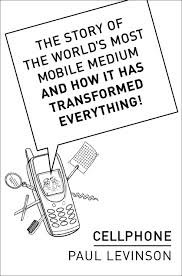
Cellphone by Paul Levinson

Book Review, interaction, Mobile, mobility, public places, sociology, symbolic interactionism

In the social sciences as well as media and communication studies there is an increasing interest in everyday technologies, like the cellphone and the webcam. Already in 2004 Paul Levinson, Professor of Communication & Media Studies at Fordham University in NYC, student of Neil Postman, and author of science fiction novels, published his book “Cellphone. The Story of the World’s Most Mobile Medium and How It Has Transformed Everything!“. The book situates the cellphone that in the UK is called “mobile phone” or simply “mobile” and in Germany “handy” within the development of other media before and alongside this highly mobile communication tools. At the centre of this highly readable volume are the new forms of communication and the mobility that the “Cellphone” enables. These characteristics of the mobile phone  have given rise to a number of opportunities and challenges that Levinson discusses, not without comparing them to the emergence of other media, such as the radio and television or the desktop computer.

Unknown

Levinson highlights in particular that in the age of the mobile personal communication we have the possibility to reach out to others wherever we are whilst at the same time being reachable by others all the time. In fact, we expect of each other to be reachable at any point in time and have to account for moments in which we do not pick up our cellphone. The further advancement of the cellphone technology that has turned the “handy” into a highly mobile personal computer with access to email and social networking sites has increased the expectation of permanent reachability. Not surprisingly therefore people report that work increasingly interferes in private lives, work email is checked at family dinners and the Internet is being searched for news in sometimes inappropriate situations. Moreover, Levinson discusses the opportunities offered by video-cameras built into cellphones and its potential impact on news reporting, an impact that in recent years, we have seen being played out when news channels increasingly use video-clips shot with cellphone cameras by people present at events such as the  London riots or the London bombings in 2007.

Although Levinson’s ‘Cellphone’ is more than 10 years old it still is very relevant. It could do with an update that reflects the increasingly wide distribution of smart phones, includes research on cellphone use in social situations and discusses some of the solutions that people have developed to deal with the problem of omni-reachability, i.e. the use of multiple-phones for different purposes, phone stacks, digital etiquettes and technology shabbaths.


Obama launches Web App to Raise Awareness about Climate Change

innovation, Marketing, Teaching, Technology

It’s increasingly recognized that while large parts of the of populations of the US (and other Western countries) are aware of climate change and accept that human action contributes to it only little behavioural change can be observed. People continue with their lives as usual although knowing their actions contribute to climate change.

“Although a poll by the Pew Research Center last October found that 67 percent of Americans believe that global warming is happening, a Pew poll in January showed that Americans ranked global warming as 19th on a list of 20 issues for Congress and the president.” (NYT-19 March 2014)

President Obama now has launched the development of a website that is designed to make visible to people the impact of climate change locally, in their citie  and neighborhoods. The New York Times reported on this development in its Science Section “Obama Turns to Web to Illustrate the Effects of a Changing Climate” and cites the motivation behind the campaign as “building a political case for the climate rules, both by defusing the opposition and by trying to create an urgent sense among Americans that they are necessary”.

Gail Markle’s recent article “Accounting for the Performance of Environmentally Significant Behavior: The Symbolic Significance of Recycling” published in Symbolic Interaction addresses this very same issue. Markle investigates why people consider recycling as a sufficient action to help the environment although being aware of the impact their consumption habits and life-style have on the environment.

A related campaign to use the Internet to raise awareness for ethics and ethical action has recently been launched by Andrea Prothero, Associate Professor at University College Dublin. The Facebook Group Talk About Ethics was launched a couple of weeks ago and encourages its members to take pictures of themselves stating why ‘talking about ethics’ is important.

Planning pregnancy, pre-pregnancy supplements and antenatal Screening

Ethnomethodology, interaction, symbolic interactionism

There is growing concern that despite planning pregnancy women delay taking pre-pregnancy supplements like folic acid as advised by experts who argue that these supplements substantially decrease the risk of birth defects that can impact the brain. These concerns have been raised in newspapers lie The Guardian and the Nursing Times.

A study concerned with the uncertainty towards their pregnancy and potential risk to it that become apparent in antenatal screening has just been published on Early View of Symbolic Interaction where I am book review editor. Alison Pilnick and Olga Zayt’s article explores the interaction between participants during antenatal screenings. In their analysis they focus on the ways in which this uncertainty is used to manage the institutionally defined category of ‘high risk’.

Marketing, Interaction and Technology – Syllabus 2014

interaction, Marketing, Syllabus, Teaching

Syllabus – Topics and Readings


Week 1 (13 January 2014) Introduction to the Course

The first lecture introduces the course content, rationale and requirements of the course.

Relevant Book

Kotler, P. & G. Armstrong (2013). Principles of Marketing. Harlow: Pearsons.

Core Readings

Humphreys, L. (2005). “Cellphones in Public: Social Interactions in a Wireless Era.” New Media & Society 7 (6): 810–833.

Additional Readings

Kujovich, Mary Yeager. 1970. “The Refrigerator Car and the Growth of the American Dressed Beef Industry.The Business History Review 44 (4): 460–482.

Wei, Ran, and Louis Leung. 1999. “Blurring Public and Private Behaviors in Public Space: Policy Challenges in the Use and Improper Use of the Cell Phone.Telematics and Informatics 16 (1): 11–26.

Related Reading

Selinger, E. (2013). How not to be a jerk with your stupid smartphone. The Atlantic (November).


Week 2 (20 January 2014) Marketing and Technology

Public debates about technological innovation often talk about the ‘revolutionary’ impact of new technology. There are myriad examples for this phenomenon: “the internet revolution”, the “social media revolution” or the “Twitter revolution” to name but a few. These discussions principally argue that technological developments are shaping how we conduct our affairs, including how we organise our daily interactions as well as how we conduct marketing activities. At the same time, these discussions often ignore the political shaping and relevance of these technologies. This lecture explores the textbook premises of the relationship between marketing and technology. It sheds light on different perspectives on how technology is interwoven with marketing theory and practice.

Core Readings

Constantinides, E. (2006). “The Marketing Mix Revisited: Towards the 21st Century Marketing.” Journal of Marketing Management 22 (3-4): pp. 407–438.

Additional Readings

Bartels, R. (1986). Marketing: Management Technology or Social Process at the Twenty-First Century? In Marketing Management Technology as a Social Process. Edited by George Fisk. New York et al.: Praeger, pp.30-42.

Marx, L. (2010). Technology: The Emergence of a Hazardous Concept. Technology & Culture, 51(3), 561-577.

Möller, K. (2006). “The Marketing Mix Revisited: Towards the 21st Century Marketing by E. Constantinides.” Journal of Marketing Management 22 (3-4): pp. 439–450.

Related Readings

Friedman, T. (2009). Tweeting the Dialectic of Technological Determinism. FlowTV http://flowtv.org/2009/06/tweeting-the-dialectic-of-technological-determinism  ted-friedman  georgia-state-university-atlanta  /


Related Books

Robertson, D., and B. Breen. 2013. Brick by Brick: How LEGO Rewrote the Rules of Innovation and Conquered the Global Toy Industry. Random House Business.

Stone, Brad. 2013. The Everything Store: Jeff Bezos and the Age of Amazon. Bantam Press.

Week 3 (27 January 2014) Technology, Interaction and Networks

Over the past few years, social relationships are increasingly being described as networks. We find public discourse about networks, social networks, the network economy, network society and others. This lecture begins with a discussion of social interaction before moving on to concepts of market relationships and networks. It will form the basis for subsequent lectures concerned with online communities

Core Readings

Kaplan, Andreas M., and Michael Haenlein. 2010. “Users of the World, Unite! The Challenges and Opportunities of Social Media.” Business Horizons 53 (1): 59–68.

Additional Readings

Bernoff, J., & Li, C. (2008). Harnessing The Power of The Oh-So-Social Web, MIT Sloan Management Review, 2008, 49, pp. 335-342.

boyd, d. (2010). “Social Network Sites as Networked Publics : Affordances, Dynamics, and Implications.” In Networked Self: Identity, Community, and Culture on Social Networking Sites, ed. Zizi Papacharissi, pp.39–58. Abingdon: Routledge.

Ferguson, R., (2008). Word of mouth and viral marketing: taking the temperature of the hottest trends in marketing. Journal of Consumer Marketing, 25(3), pp. 179 – 182.

Watts, Duncan J, and Steve Hasker. 2006. “Marketing in an Unpredictable World.” Harvard Business Review.

Watts, D.J., 1999. Networks, Dynamics, and the Small-World Phenomenon. American Journal of Sociology, 105(2), p.493-527.


Related Books

Papacharissi, Zizi (2008). Networked Self: Identity, Community, and Culture on Social Networking Sites. Abingdon: Routledge.

Rainie, L., & Wellman, B. (2012). Networked: The New Social Operating System. Cambridge, MA: MIT Press.

Week 4 (3 February 2014) Wessel van Rensburg (RAAK) Inequality in Networks (working title)

@wildebees 

 Week 5 (10 February 2014) Social Networks and Reputation Management

At the same tome as social media and social networking has risen in importance for marketing practitioners new challenges have emerged that for example impact the ways in which companies’ reputation can be impacted by the use of these new media. This lecture draws on a few recent examples to explore some of these challenges to companies’ reputation and discusses ways in which companies might manage their reputation when using social media and social networking sites for their marketing communications.

Core Readings

Hennig-Thurau, Thorsten, Caroline Wiertz, and Fabian Feldhaus. (2013) “Does Twitter Matter? An Investigation of the Impact of Micro Blogging Word of Mouth on Consumers’ Adoption of New Products.” http://papers.ssrn.com/sol3/papers.cfm?abstract_id=2016548

Additional Readings

Gruzd, A., B. Wellman, and Y. Takhteyev. 2011. “Imagining Twitter as an Imagined Community.” American Behavioral Scientist 55 (10): 1294–1318.

Hamilton, K. & P. Hewer. (2010). Tribal mattering spaces: Social-networking sites, celebrity affiliations, and tribal innovations. Journal of Marketing Management, 26(3), p.271-289.

Hennig-Thurau, T., E. C. Malthouse, C. Friege, S. Gensler, L. Lobschat, a. Rangaswamy, and B. Skiera. 2010. “The Impact of New Media on Customer Relationships.” Journal of Service Research 13 (3): 311–330.

Phelps, J. E., Lewis, R., Mobilio, L., Perry, D., & Raman, N. (2004). Viral Marketing or Electronic Word-of-Mouth Advertising: Examining Consumer Responses and Motivations to Pass Along Email. Journal of Advertising Research, 44(4), 333-348.

Rainie, L., & Wellman, B. (2012). Networked: The New Social Operating System. MIT Press.

Sarstedt, M. (2009). Reputation Management in Times of Crisis. Journal of Brand Management. Vol.16, 499-503.

Week 6 (24 February 2013) Rob Wilmot (BCS Agency Start-ups and Valuations

 @robwilmot

Week 7 (3 March 2013) Jadis Tillery Content Marketing (working title)

@jadistillery

Related Books

Jenkins, Henry. 2008. Convergence Culture: Where Old and New Media Collide. New York University Press.

Week 8 (10 March) – Search and Social Media Marketing

Over the past decade or so two important developments have emerged in the context of Internet Marketing: Search Marketing and Social Media Marketing. The growing economic weight of companies like Google suggest that Search will be one of the important marketing activities over the coming years. It is being used to obtain an understanding of the market as well as for the building of relationships and networks (Marsden and Kirby 2005; Moran and Hunt 2008). The lecture will discuss some of the practices involved in Search Marketing and assess possible problems these practices might raise for the relationship between companies and their customers. It then will turn to Social Media Marketing and explore how social networks like Facebook, Myspace or Jumo are used for marketing purposes, including the design, promotion and distribution of products and services (Penenberg 2009; Scott 2008). The discussion will touch on current debates concerned with viral marketing and online gaming as well as trust and reputation.   


Core Readings

Rijnsoever, Frank J. van, Castaldi, Carolina, Dijst, Martin J. (2012). In what sequence are information sources consulted by involved consumers? The case of automobile pre-purchase search, Journal of Retailing and Consumer Services, 19(3), pp.343-352.


Related Books

Marsden, P., & Kirby, J. (2005). Connected Marketing: The Viral, Buzz and Word of Mouth Revolution. Butterworth-Heinemann.

Moran, M., & Hunt, B. (2008). Search Engine Marketing, Inc.: Driving Search Traffic to Your Companys Web Site. IBM Press.

Pariser, E., 2011. The Filter Bubble: What The Internet Is Hiding From You, Viking.

Week 10 (17 March 2013) – Social and Sustainability Marketing and Technology

The arrival of new technology has also been picked up by market and consumer researchers. For example, over recent years video recording of consumers in shopping and leisure environments has been used to track people’s navigation through isles and gain an understanding of their shopping behaviour. With the arrival of the internet it has been recognised that people’s every ‘click’ can be tracked and followed and the information be used to personalise offers. This lecture critically assesses how technology is used to improve companies’ profits as well as offers for customers and considers some of the practical and ethical implications of these developments.


Core Readings

Brennan, Ross, Stephan Dahl, and Lynne Eagle. 2010. “Persuading Young Consumers to Make Healthy Nutritional Decisions.” Journal of Marketing Management 26 (7-8) (July 9): 635–655.

Related Books

Aaker, J., & A. Smith. (2010). The Dragonfly Effect: Quick, Effective, and Powerful Ways to Use Social Media to Drive Social Change. Jossey Bass.

Peattie, K., & Belz, F. F.-M. (2009). Sustainability Marketing: A Global Perspective (p. 306). John Wiley & Sons.

Striphas, T. (2009). The Late Age of Print: Everyday Book Culture from Consumerism to Control. Columbia University Press.

Vaidhynathan, S., 2011. The Googlization of Everything: (And Why We Should Worry), Berkeley, CA: University of California Press.


Week 10  (24 March 2013) Marketing, Interaction & Technology

Transkription von Videodaten in den Sozialwissenschaften

notes on books, sociology, Teaching, Videoanalysis

Die zunehmende Bedeutung von Videodaten in den Sozialwissenschaften in den vergangenen 30 Jahren wurde ueberraschenderweise nicht von technischen Entwicklungen begleitet, die dem Sozialwissenschaftler dabei helfen, mit der Komplixitaet des Datenmaterials umzugehen. Dies ist ueberraschend, da andere Benutzer von Videodaten, wie beispielsweise Trainer von Athletn und Fussballern, schon seit laengerem (semi-)professionelle Softwarepakete zur Analyse ihrer Daten verwenden.

Christine Moritz, die selbst das System Feldpartitur entwickelt hat, hat nun ein Buch herausgegeben, in dem Sozialwissenschaftler ihre sehr unterschiedlichen Vorgehensweisen und Praktiken zur Transkription von Video- und Filmdaten darstellen und erklaeren. Ihr Band “Transkription von Video- und Filmdaten in der Qualitativen Sozialforschung” beinhaltet drei Beitraege, die sich mit forschungsmethodologischen Ueberlegungen zur Analyse von Video- und Filmdaten in den Sozialwissenschaften auseinandersetzen, sowie 17 Kapitel, in denen Autoren erlaeutern, wie sie mit ihrer spezifischen forschungsmethodologischen Einstellung Video- und Filmdaten transkribieren und welche Bedeutung ihr Transkript fuer die Datenanalyse und -praesentation hat.

Mehr Informationen ueber den Band finden sich hier.

Das Inhaltsverzeichnis kann hier runtergeladen werden.

Museums and Technology

exhibitions, experience, interaction, interactivity, museums, Technology

This week Roger Highfield, Director of External Affairs at the Science Museum in London, made a strong case for the use of technology to enhance visitors’ experience of museums. In his article published in London’s Evening Standard Highfield writes

“When used wisely, computers and interactives have a role in showing our visitors that science is more than just a collection of cold, hard facts, arcane theorems and grey metal boxes. With a little digital magic, all these facets can now all sparkle. This is important for all museums, for London and for the nation’s high-tech industry. We never seem to have enough scientists, mathematicians and engineers. The same goes for designers and the creative industry and, yes, classicists too. Museums need to use all the tools at their disposal to inspire the next generation.”

I could not agree more. Luckily, these days there are plenty of excellent examples of technology in museums that intrigues visitors, allows them to see science, art and design in novel ways, and maybe not at last, attracts people to look at museum objects who without technology would find them boring, uninteresting and maybe also inaccessible. In these cases, technology is an invaluable tool that facilitates and enhances access. Moreover, as Highfield points out in his article technology can make visible aspects of science, art and design that otherwise could not be shown. Examples for such phenomena are miniscule molecular processes processes or the ways in which old objects like the famous washstand by William Burges in the Victoria & Albert Museum would have been used by its owners.

The effectiveness of these technologies in museums has variously been shown. A Special Issue of  Curator: the Museum Journal (2004) elaborated some of the opportunities offered by technology and interactivity in museums, highlighting that technology can facilitate new forms of engagement and learning occurring in museums. Robert West however also pointed at the potential costs of interactivity in museums. Aside from momentary costs West also points to the danger that technology when broken or difficult to use can spoil the museum experience for visitors and that some people for various reasons are intimidated by technology in exhibitions.

This latter point is echoed in a recent research paper by Susie Scott and colleagues that has recently been published in the journal Symbolic Interaction. In their paper “Goffman in the Gallery” the authors elaborate on the emergence of situational shyness at interactive exhibits and explicate ways in which visitors cope with their uncertainty of using an exhibit or hesitation to approach it because they fear they might find themselves in an embarrassing situation unable to use the technology. Amongst other points that Scott and colleagues’ paper makes it suggests that one solution that people find to overcome “situational shyness” is to learn from others. People observe others and use their actions as “replacement scripts”.

The importance of mutual observability in museums for people’s exploration and sense making in museums has been a topic since the inception of the modern museum. Tony Bennett in his well-known “The Birth of the Museum” as well as Norman Trondsen in a paper from the 1970s “Social Control in the Art Museum” have highlighted how the design and layout of museums facilitates mutual observation that allows people to learn @proper conduct@ from observing others, and in turn people behave ‘properly’ because they are aware that they might be observed in their actions in museums.

Robin Meisner has taken this argument one step further by explicating how visitors embellish their actions at exhibits. Their interaction with exhibits becomes a performance that invites others to become an audience. The result are shared experiences at exhibits, that on occasion surprise even those who have designed the exhibits. Meisner’s research has a range of other papers that have been published over the past decade or so highlight the importance of social interaction in museums. People enjoy museums as places for sociality and sociability. They visit them with friends and family and meet other people who are there at the same time.

When social interaction is so important for museum visiting it is rather surprising that we still find so much technology in museums that encourages individuals’ engagement whilst not supporting and sometimes undermining social interaction. Examples for studies highlighting the difficulties that visitors find in interweaving the interaction with technology and the interaction with other people. The trouble is as we have shown in our research that design of misconceives interactivity as facilitating interaction. Examples for technologies that often create interactional difficulties between visitors of museums are conventional touch-screen exhibits and interactive guides like PDAs and mobile phones that prioritise the interaction of an individual with the technology over the collaboration between visitors.

Highfield suggests in his article to use technology “wisely” when deploying systems and devices in museums. So far we know relatively little about what “wise” technology design for museums looks like. However, it is clear that it needs to take into account that museum visiting is a social occasion. Designers of systems and novel exhibitions therefore might need to rethink interactivity and develop assemblies and configurations of objects and artefacts that allow people to embed (some of their) their features within their social interaction. Collaborations between museum experts and technology companies, like the one that led to the recent exhibition of Chromeweblab at the Science Museum, have proven quite successful.

It however might be worthwhile thinking about the inclusion of social scientists in such developments who might help to focus on social and interactional configurations emerging at and around technology on the exhibition floor. Moreover, natural laboratories on the exhibition floor, similar to those the Exploratorium in San Francisco uses, might be a worthwhile investment for museums to enable experiments with new configurations of technology and people in exhibitions.