
“I would like to conclude, however, with a word in praise of breakfast cereal. Sheets of card cut from used cereal packets are perfect for catching thoughts on the fly. They are sufficiently stiff that you do not need anything to press on, and large enough to allow ample, unruled space. Sometimes I wake up in the early morning with a problem paragraph that I had been struggling with for all of the previous day perfectly formed in my head. Propped up in bed, I quickly write it down on a cereal packet card. I can write a few hundred words in as many minutes, and having done it, and with the words securely saved, I can then move on. Many of the passages I am most proud of started life in this way. I have never come across anything that works quite as well as cereal packets. They beat the computer hands down. Try it, and you’ll see!” Tim Ingold 2007. Lines: A brief History. London: Routledge. – https://www.dur.ac.uk/writingacrossboundaries/writingonwriting/timingold/
Author: Dirk vom Lehn
Linotype #media #industry #baltimore
Museums, TechnologyI recently had the pleasure to visit the Baltimore Museum of Industry. The museum has a good number of working industrial machines on display. The tour guide shows these machines working in the exhibition. One exhibit that stood out for me was a Linotype that was demonstrated by a gentleman, Mr Ray Loomis, who used to work at one of these extraordinary machines. The Linotype was originally invented and developed by Ottmar Mergenthaler, a German watchmaker. Here’s a video I found on YouTube in which Mr Loomis explains the Linotype.
If you have further interest in the Linotype, the half hour long documentary “Farewell, Eaton Shrdlu” shows the last day of operation of Linotypes at the New York Times.
Symbolic Interactionism and Artificial Intelligence #sssi #sociology #AI
Interaction, sociology, Symbolic InteractionThis is a post reblogged from the blog of the journal Symbolic Interaction, the official journal of the Society for the Study of Symbolic Interaction.

Over the past few years, there has been plenty of discussion about artificial intelligence. Numerous books have been published on the topic and the newspapers and broadcast media are brimful with publications on how our world will be changed by ‘AI’. The discussions reach from novel ‘intelligent’ devices in the home and self-driving cars to ‘intelligent machines’ and ‘robots’ that are said to replace people in many workplaces. These growing debates are related to activities by governments to prioritize ‘AI’ for example “to create a national defence strategy” (NYT) and “to boost investment and set ethical guidelines” (European Commission 2018).
Symbolic Interactionism with its long-standing concern with the mind and cognition has plenty to contribute to these discussions and developments. Since Mead’s (1934) “Mind, Self and Society“, if not earlier, (symbolic) interactionists have explored the reflexive relationship between action and cognition. Some of this…
View original post 334 more words
Ethnomethodologische Interaktionsanalyse #EMCA
Ethnomethodology, experience, Garfinkel, Goffman, interaction, VideoanalysisIn den vergangenen 10 Jahren sind verschiedene Texte zur Analyse von Interaktion erschienen, in deren Zentrum Videoaufnahmen als Daten stehen. Von besonderer Bedeutung sind in diesem Zusammenhang Texte, die sich auf die Ethnomethodologie und Konversationsanalyse stützen. “Ethnomethodologische Interaktionsanalyse” schließt hier und an mein Buch zu Harold Garfinkel an, in dem ich die Entwicklung der Ethnomethodologie als besondere soziologische Einstellung nachzeichne.

“Ethnomethodologische Interaktionsanalyse” bettet die Analyse von Interaktion auf Basis von Videoaufnahmen in den Kontext der Entwicklung der Ethnomethodologie ein und führt die Analyse am Beispiel von Daten, die ich in den Untersuchungsräumen von Optometrikern aufgezeichnet habe, vor. Dabei gehe ich auf Praktikalitäten der Datenerhebung und -analyse und die Transkription von Videodaten ein. Anschließend wendet sich das Buch der Darstellung von Analysebefunden in Live-Präsentationen und in Texten zu. Das Buch ist in der Serie ‘Standards standardisierter und nicht-standardisierter Sozialforschung’, die von Nicole Burzan, Ronald Hitzler und Paul Eisewicht herausgeben wird, bei Beltz/Juventa erschienen. “Ethnomethodologische Interaktionsanalyse” ist als Kindle-Buch und vom 20. August 2018 auch in der gedruckten Version erhältlich.
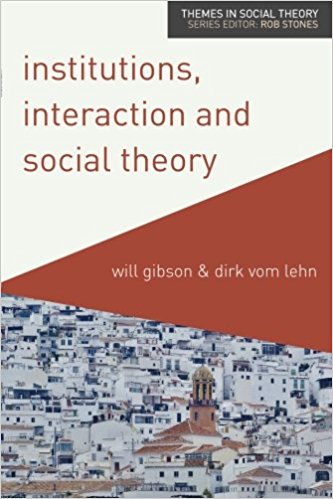
‘Institutions, Interaction, & Social Theory’ #sociology #interaction #organization #theory #research
Announcement, bookEarlier this year, Will Gibson (UCL) and I have published a book titled ‘Institutions, Organisation, & Social Theory’ (Palgrave). In the book we explore relationships between ‘institutional scholarship’ and ‘interactionist’ research. A short discussion of the book cn be found on the ‘Work in Progress Blog’.

Dancing as Interactional Achievement #sociology #emca
aesthetics, dance, Ethnomethodology, experience, sociology, SSSI, UncategorizedTogether with Saul Albert I am currently working on video-data collected at Lindy Hop Dance workshops for beginners. Our interest is in the nexus between the body and the social, that for long have been kept separated in sociology. In July 2017 we presented a paper titled ‘Beginning to Dance: methods of mutual coordination between novice dancers‘ at the Joint Action Meeting (JAM) held at Queen Mary’s University London. The paper explores how novice dancers are able to make a first step in step with a dance partner, with the rhythm of the music and with the other dancers. Analytically and methodologically the paper draws on ethnomethodology and conversation analysis and the more recent development of video-analysis of interaction (Heath, Hindmarsh & Luff 2010) as well as from the fabulous analysis of Lindy Hop dance lessons by Leelo Keevalik.
Further information information about the project is on Saul’s website on Dance as Interaction.
Publications
- Albert, S. (2015) Rhythmical coordination of performers and audience in partner dance: delineating improvised and choreographed interaction. Etnografia e Ricerca Qualitativa 3/2015, 399-428. doi: 10.3240/81723
Presentations
- Albert, S. (2017, September). Assessments in the service of rhythmical closings. Presented at the 7th Language and Social Interaction (LANSI) Working Group Meeting, New York.
- Albert, S. & Vom Lehn, D. (2017, July). Beginning to dance: methods of mutual coordination between novice dancers. Presented at the 7th Joint Action Meeting, London, UK.
- Albert, S. (2015, November). Joint improvisation, choreography and social action in a musical partner dance performance. Paper presented at The Science of Joint Improvisation Meeting, CNRS, Paris.
- Albert, S. (2015, June). Dancing through time and space. Paper presented at Revisiting Participation: Language and Bodies in Interaction, Basel.
- Albert, S. (2014, June). Interactional resources and their use in learning the Lindy Hop. Paper presented at the 6th Ethnography and Qualitative Research Conference, Bergamo.
- Albert, S. (2014, June). Interactional choreography. Paper presented at the 1st EMCA Doctoral Network Meeting, Edinburgh.
New Book: Institutions, Interaction and Social Theory #sociology #sssi #emca #orgtheory
Announcement, book, ethnography, Ethnomethodology, Garfinkel, GoffmanTogether with Will Gibson (UCL) I have just published a book titled “Institutions, Interaction and Social Theory” (Palgrave).
From hospitals and prisons to schools and corporations: no matter how large or seemingly abstract, all institutions are ultimately the result of the actions and interactions of people. In this original and innovative text, Gibson and Vom Lehn show the different ways in which studying people’s own meaning-making practices can help us understand the role of institutions in contemporary society.
Institutions, Interaction and Social Theory takes the reader through the core conceptual foundations of Symbolic Interactionism, Ethnomethodology and Conversation Analysis. Engaging with a rich tradition in sociological thought, it suggests that interactionist perspectives have remained largely absent in the study of institutions, and how they contrast with and contribute to the broader field of research in institutional contexts.
With chapters on healthcare, education, markets, and art and culture, this text will be of interest to those studying institutions, organisations and work in sociology and in business schools. It will also be valuable for students of social theory interested in interactionism, and in the challenges and opportunities of connecting complex theoretical discussions to real world examples.
Programme of recent Ethnomethodology Conference in Konstanz #sociology
Announcement, EthnomethodologyPapers from the conference are currently being published in a Special Issue of Human Studies. Please click Here to get directed to the issue.

Further information about the conference can be found HERE. All information is in German.
Studentship Opportunities at WIT – King’s College London
Announcement(Apologies for cross posting)
We are offering opportunities to become a PhD researcher in the Work, Interaction and Technology group at King’s College London. The current faculty members are: Paul Luff, Dirk vom Lehn, Christian Heath and Jon Hindmarsh. We specialise in video-based field studies, drawing on ethnomethodology and conversation analysis.
Our recent PhD students have adopted this methodological approach to explore a wide range of topics and settings, including:
- Collaboration around new technologies in cars
- The initiation of work talk in open plan offices
- Occupational skills and communication in beauty treatments
- Training conversations in dental education
- Occupational practice and new technologies in control centres
- Teamwork and collaboration in operating theatres
- The work of tour guides in museums and galleries
We are keen to supervise video-based studies on any topic or setting related to work practice, occupations, coordination, organisation, consumer behaviour and new technologies.
If you are interested in finding out more about pursuing a PhD with us, please do get in touch. Alternatively, if you know of high quality students who might be interested in this opportunity, please do forward this message on to them.
Note that there are a range of funding opportunities currently available, including the studentship competition in our School (see below).
Many thanks and best wishes,
Jon, Paul, Dirk and Christian
Doctoral Research Studentships
King’s Business School
King’s Business School invites applications for funded, full-time PhD studentships to start in the 2018-19 academic year. We have a number of studentships available and are keen to attract talented and enthusiastic students who aspire to be future leaders in their academic fields of study.
We are one of the top academic centres in management and business in the UK and have an outstanding reputation for the quality of our research and teaching. Furthermore, we have ambitious plans to grow and develop over the coming years and recently moved into the iconic Bush House in central London, providing our doctoral students with excellent facilities and opportunities to develop their skills and experience.
In addition, we are a constituent part of the LISS-DTP (London Interdisciplinary Social Science Doctoral Training Partnership), which draws together doctoral training at King’s, Imperial College London and Queen Mary, University of London. This partnership is recognised and funded by the Economic and Social Research Council (ESRC).
The 3-year studentship covers the tuition fees, a generous training and conference grant, a stipend (currently £16,553 per annum) and the School provides additional paid teaching opportunities.
King’s Business School welcomes applicants in any of our areas of research expertise.
The closing date for applications is: 25 January 2018 at 5pm.
Decisions will be announced in March 2018.
For full details of the application process, please see:
‘The Senses in Interaction’ – Call for Abstracts – ISA 2018 in Toronto
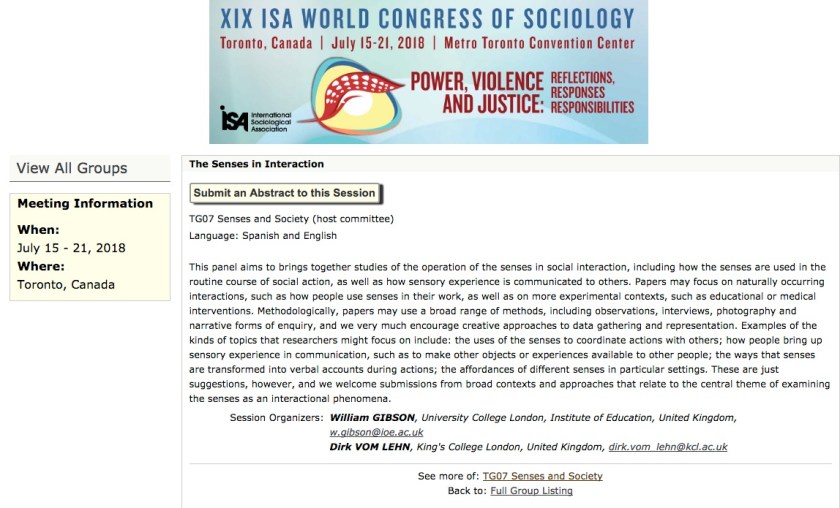
Announcement, Call for PapersWill Gibson (UCL) and I are organising a session titled “The Senses in Interaction’ at the 2018 Conference of the International Sociology Association in Toronto. The Call for Abstracts for the larger track on “Senses and Society” led by Kelvin Low (National University of Singapore) has just been published on the ISA Website. Please click on the image below to be directed there.
 Interaction, Organisation & Technology