Over the past few decades there have been tremendous developments in audience research. Sonia Livingstone’s (2014) book chapter captures some the highlights of these developments. Unsurprisingly, Livingstone’s chapter includes Stuart Hall’s ‘encoding/decoding’ model that has been of outstanding influence in the field. Hall’s concept is closely related to ‘reception theory’ (Iser 1980) and Morley’s (1993) concept of the “active audience”. By and large, when audience research discussed the active audience it was turning away from the idea that media content was passively received by a people sitting in front of their radio and television set. The focus shifted from passive reception to (active) interpretation of media content.
A couple of years ago I came across articles published by the Indian-American scholar Lakshmi Srinivas based at the University of Massachusetts Boston. Srinivas research (2005, 2010ab) immediately struck me as very exciting as it took the ‘active’ in ‘active audience’ literally. She was and remains interested in people’s action and interaction when they visit cinemas. Last year (2016), Srinivas published her research as a book entitled “House Full: Indian Cinema and the Active Audience“.
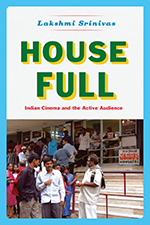
In the book, Srinivas discusses how in India people actively participate in the production of the cinematic experience. She begins her exploration outside the cinema hall where people queue to purchase tickets and wait to enter the auditorium. Inside the auditorium a social structure emerges that can be based on people’s social class but is also related to the nature of the social grouping that attendance a film screening. Where they sit people create a space where all group members can comfortably participate in the film experience. Children for example may sit on prepared blankets and consume food that has been brought to the cinema. During the film it is very common to vocalise loudly responses to the film’s content, such as to locations or actors that are recognised. People also sing along to tunes that are part of the film. Or if they are not interest in long musical sequences they might use the time to chat with others, leave the cinema for socialising outside, or having a smoke. Whilst in Western cinemas it is generally assumed that everybody sitting in the same auditorium sees and experiences the same film, audience members in Indian cinemas construct their cinematic experience in interaction with others and by fitting together the bits of the film they see with content they pick up from conversations with others.
I highly recommend Srinivas’ “House Full” to everyone interested in film consumption and audience research. A more comprehensive review of the book has been published in Symbolic Interaction.
References
Hall, S. (1980). Encoding/Decoding. Culture, Media, Language, 128–138. http://doi.org/10.1007/BF00986815
Iser, W. (1980). The Act of Reading: A Theory of Aesthetic Response. The Johns Hopkins University Press.
Livingstone, Sonia (2012) Exciting moments in audience research – past, present and future. In: Bilandzic , Helena, Patriarche, Geoffrey and Traudt , Paul, (eds.) The social use of media: cultural and social scientific perspectives on audience research. ECREA Book Series. Intellect Ltd, Brighton, UK, pp. 257-274.
Morley, D. (1993). Active Audience Theory: Pendulums and Pitfalls. Journal of Communication, 43(4), 13–19. http://doi.org/10.1111/j.1460-2466.1993.tb01299.x
Srinivas, L. 2005. Imaging the Audience. Journal of South Asian Popular Culture. 3 (2): 101–116.
Srinivas, L. Cinema Halls, Locality and Urban Life. Ethnography. 11 (1): 189-205
Srinivas, L. Cinema in the City: Tangible Forms, Transformations and the Punctuation of Everyday Life. Visual Anthropology, 23 (1): 1-12. [Lead article. Selected for Editor’s Choice].
Srinivas, L. (2016). House full : Indian cinema and the active audience. Chicago & London: The University of Chicago Press.
vom Lehn, D. (2017). Reengaging with the “Active Audience”: An Ethnography of Indian Cinema. Symbolic Interaction. http://doi.org/10.1002/symb.292




 Interaction, Organisation & Technology