Reframing art online through collective meaning-making
Linh Dan Nguyen, Chloe Preece & Dirk Vom Lehn


Linh Dan Nguyen, Chloe Preece & Dirk Vom Lehn
Sensing Life: the social organization of the senses in interaction
Co-edited by
Will Gibson (University College London), Natalia Ruiz-Junco (Auburn University), and Dirk vom Lehn (King’s College London)
This edited collection aims to continue the advances in scholarship of the senses as interactional phenomena and experiences. Our aim is to bring together contemporary empirical research that looks at how the senses are used in interaction, showcasing the broad range of concepts and methodologies through which they can be examined.
In the past decade or so interactionist researchers have been increasingly interested in the role of the senses in social interaction (see e.g., Vannini, Waskul and Gottschalk 2012). A special issue of the journal Symbolic Interaction in 2021 brought together studies that examined sensorial practice, focusing on diverse areas including everyday acts such as cheese and coffee tasting (Mondada, 2021; Fele and Liberman, 2021) through to the professional work of nurses (Grosjean, Matte, and Nahon-Serfaty, 2021) and race car testers (Salvadori and Gobo). These collected papers marked an important development in the empirical examination of communication about the senses, showing how talk, gesture, gaze, material artefacts and other aspects of the physical environment can be mobilised to make the senses accountable to others. The introduction to this special issue (vom Lehn and Gibson, 2021) pointed to several interrelated features of sensorial praxis which the papers helped to bring into focus. The intersection between different sensorial experiences; the entwinement of the senses with cultural resources and practices; their contextually situated nature and the multimodal, structured but also serendipitous form of expression.
The proposed volume aims to continue these lines of analysis by inviting contributions from a multiplicity of approaches, including symbolic interactionism, ethnomethodology, Conversation Analysis, and cognate areas from Discourse Studies and multimodal inquiry. To balance the strong EMCA theme represented in the 2021 special issue we are particularly keen to encourage papers from symbolic interactionism or that use ethnographic methods. We are interested in papers that examine conceptually and empirically the uses of the senses in ‘making something happen’, which might be in an institutional or non-institutional context.
We welcome tentative expressions of interest and are happy to explore the fit of possible research papers with the above theme.
An abstract of no more than 400 words should be submitted by email to Will Gibson, Natalia Ruiz-Junco, and Dirk vom Lehn (SensesInteractionism@gmail.com). Although the deadline has passed on 2 May 2023 we are still accepting abstract submissions.
Bibliography
Fele, Giolo, and Kenneth Liberman. 2021. ‘Some Discovered Practices of Lay Coffee Drinkers’. Symbolic Interaction 44, no. 1: 40–62. https://doi.org/10.1002/symb.486.
Gibson, Will, and Dirk vom Lehn. 2021. ‘Introduction: The Senses in Social Interaction’. Symbolic Interaction 44, no. 1: 3-9.
Grosjean, Sylvie, Frederik Matte, and Isaac Nahon-Serfaty. 2021. ‘“Sensory Ordering” in Nurses’ Clinical Decision-Making: Making Visible Senses, Sensing, and “Sensory Work” in the Hospital’. Symbolic Interaction 44, no. 1: 163–182. https://doi.org/10.1002/symb.490.
Mondada, Lorenza. 2021. ‘Orchestrating Multi-Sensoriality in Tasting Sessions: Sensing Bodies, Normativity, and Language’. Symbolic Interaction 44, no. 1: 63–86.
Vannini, Philip, Dennis D. Waskul, and Simon Gottschalk. 2012. The Senses in Self, Society, and Culture. London: Routledge.
Salvadori, Francesca Astrid, and Giampietro Gobo. 2021. ‘Sensing the Bike: Creating a Collaborative Understanding of a Multi-Sensorial Experience in MotoGP Racing’. Symbolic Interaction 44, no. 1: 112–133. https://doi.org/10.1002/symb.529.
Wiggins, Sally, and Leelo Keevallik. 2021. ‘Enacting Gustatory Pleasure on Behalf of Another: The Multimodal Coordination of Infant Tasting Practices’. Symbolic Interaction 44, no. 1: 87–111. https://doi.org/10.1002/symb.527.
The introduction to “Introduction to “The Routledge International Handbook of Interactionism” edited by Dirk vom Lehn, Natalia Ruiz-Junco, and Will Gibson (2021) can be downloaded below.

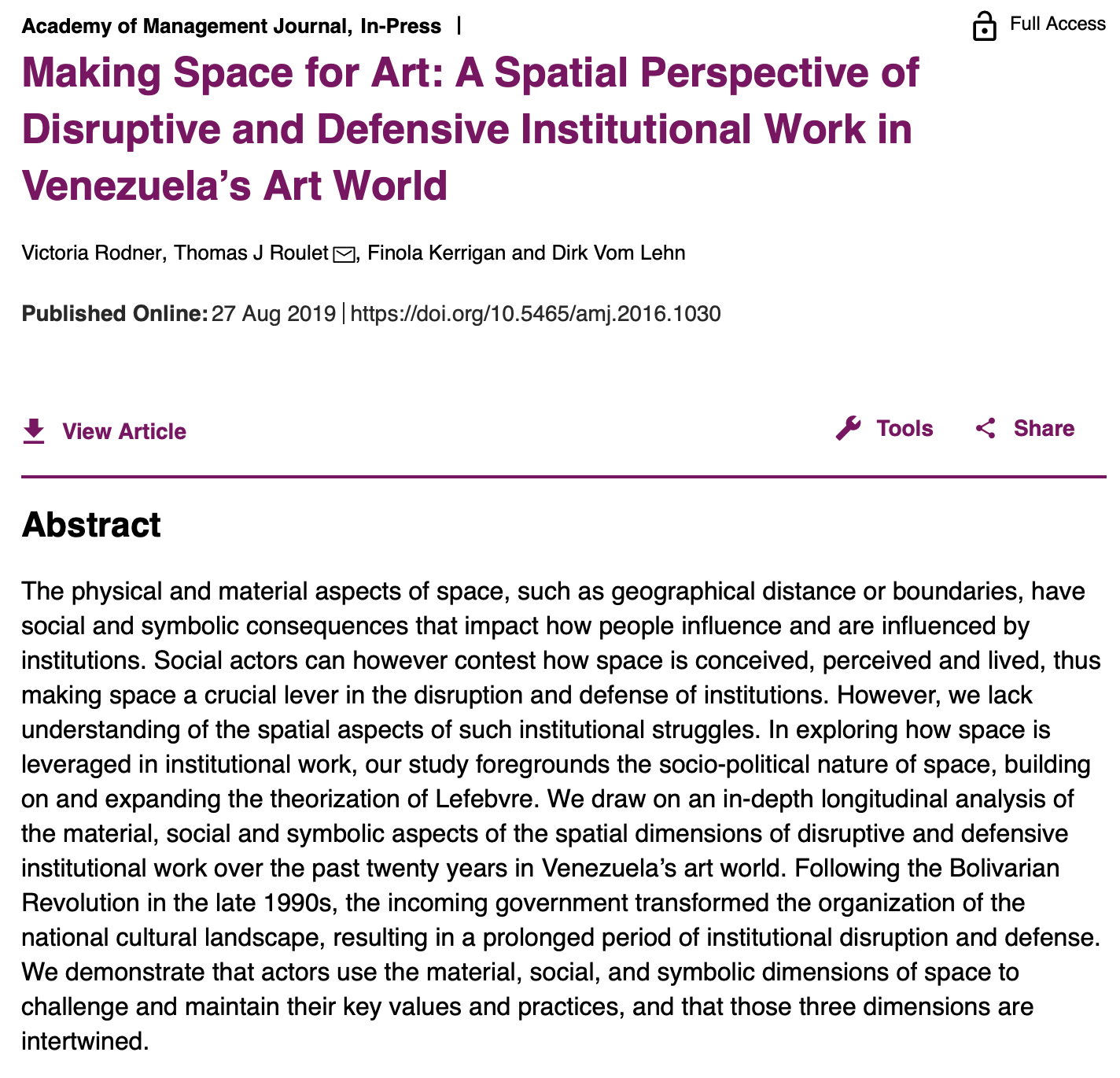
We have just published an article based on Victoria Rodner’s excellent PhD thesis in the Academy of Management Journal (AMJ). Drawing on longitudinal ethnographic and interview data the article explore how space is leveraged in institutional work, our study foregrounds the socio-political nature of space, building on and expanding the theorization of Lefebvre.
The article can be downloaded by clicking the link below:
by Victoria Rodner (@VictoriaLRodner), Thomas Roulet (@thomroulet), Finola Kerrigan (@finolak) and Dirk vom Lehn (@dirkvl)
Abstract
The physical and material aspects of space, such as geographical distance or boundaries, have social and symbolic consequences that impact how people influence and are influenced by institutions. Social actors can however contest how space is conceived, perceived and lived, thus making space a crucial lever in the disruption and defense of institutions. However, we lack understanding of the spatial aspects of such institutional struggles. In exploring how space is leveraged in institutional work, our study foregrounds the socio-political nature of space, building on and expanding the theorization of Lefebvre. We draw on an in-depth longitudinal analysis of the material, social and symbolic aspects of the spatial dimensions of disruptive and defensive institutional work over the past twenty years in Venezuela’s art world. Following the Bolivarian Revolution in the late 1990s, the incoming government transformed the organization of the national cultural landscape, resulting in a prolonged period of institutional disruption and defense. We demonstrate that actors use the material, social, and symbolic dimensions of space to challenge and maintain their key values and practices, and that those three dimensions are intertwined.
Keywords
Institutional theory, Emerging economies, Policy environment, International Management, Ethnography, Interviews
https://doi.org/10.5465/amj.2016.1030
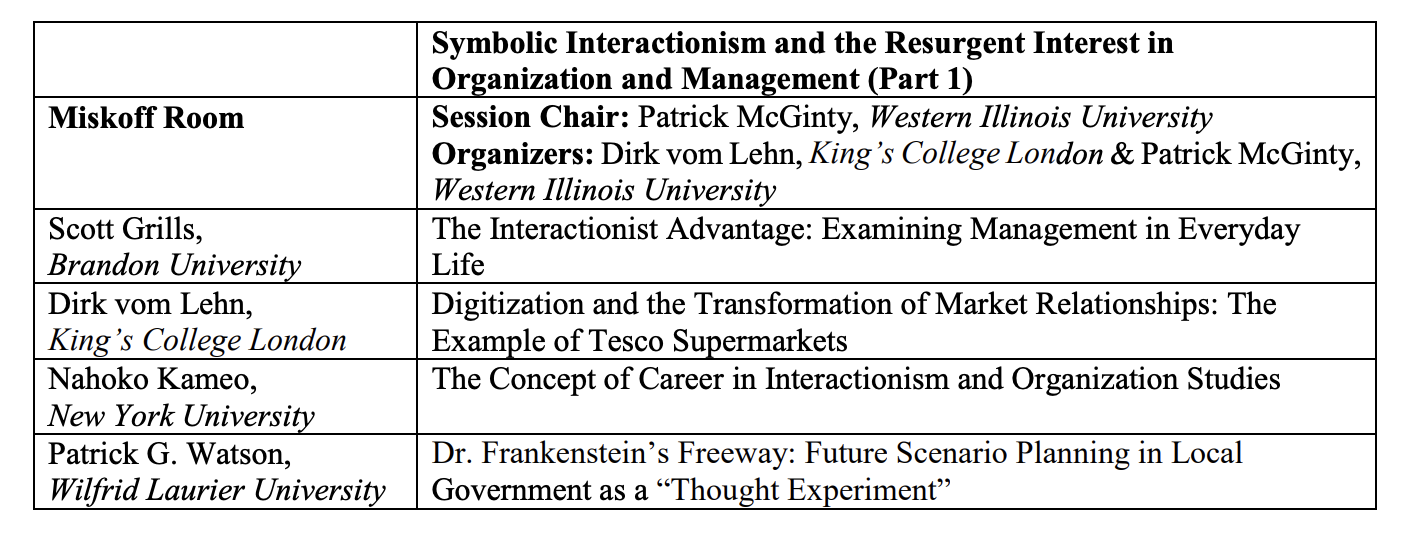
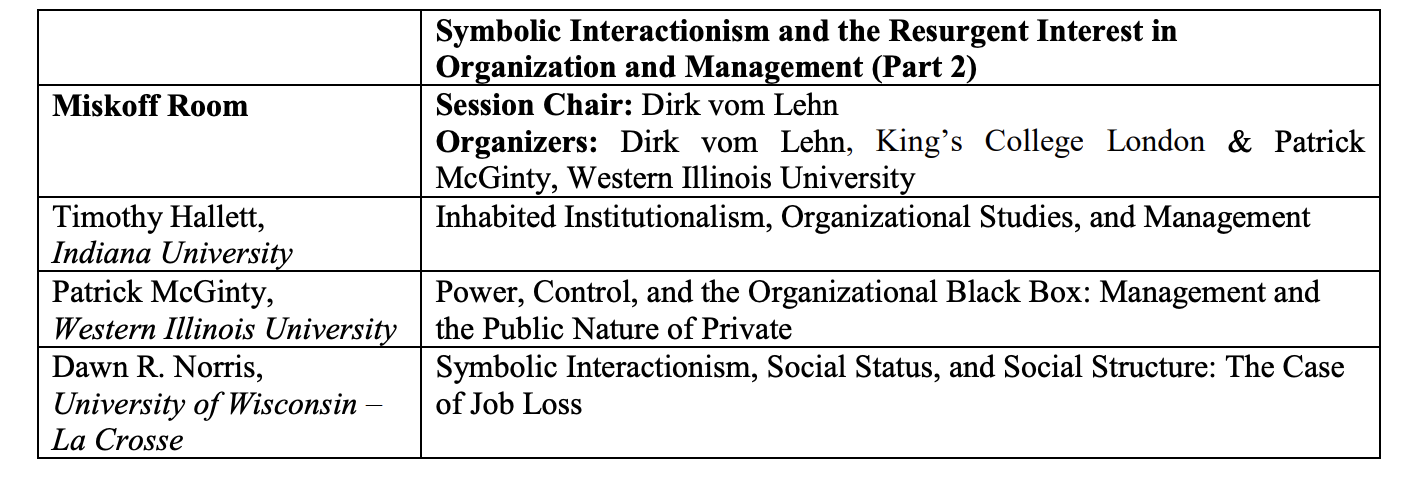
At the SSSI 2019 in NYC, Patrick McGinty and I organized two panels on “Symbolic Interactionism and the Resurgent Interest in Organization and Management”.
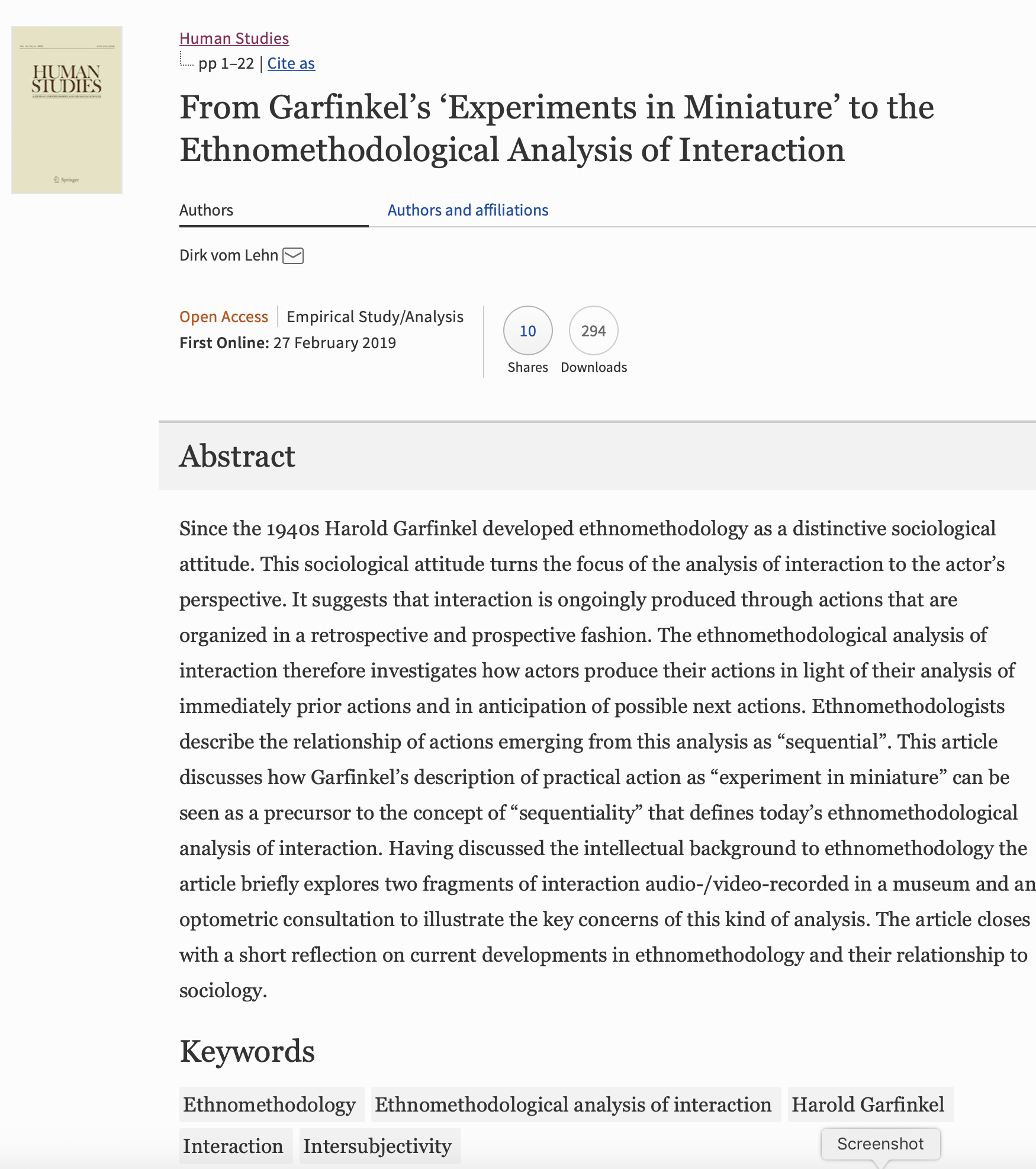
vom Lehn, D. (2019). From Garfinkels’ ‘Experiments in Miniature’ to the Ethnomethodological Analysis of Interaction. Human Studies, 42(2), 305-326. https://doi.org/10.1007/s10746-019-09496-5
#Garfinkel #ethnomethodology #sociology #interaction #interactionism
This is a post reblogged from the blog of the journal Symbolic Interaction, the official journal of the Society for the Study of Symbolic Interaction.

Over the past few years, there has been plenty of discussion about artificial intelligence. Numerous books have been published on the topic and the newspapers and broadcast media are brimful with publications on how our world will be changed by ‘AI’. The discussions reach from novel ‘intelligent’ devices in the home and self-driving cars to ‘intelligent machines’ and ‘robots’ that are said to replace people in many workplaces. These growing debates are related to activities by governments to prioritize ‘AI’ for example “to create a national defence strategy” (NYT) and “to boost investment and set ethical guidelines” (European Commission 2018).
Symbolic Interactionism with its long-standing concern with the mind and cognition has plenty to contribute to these discussions and developments. Since Mead’s (1934) “Mind, Self and Society“, if not earlier, (symbolic) interactionists have explored the reflexive relationship between action and cognition. Some of this…
View original post 334 more words
Together with Saul Albert I am currently working on video-data collected at Lindy Hop Dance workshops for beginners. Our interest is in the nexus between the body and the social, that for long have been kept separated in sociology. In July 2017 we presented a paper titled ‘Beginning to Dance: methods of mutual coordination between novice dancers‘ at the Joint Action Meeting (JAM) held at Queen Mary’s University London. The paper explores how novice dancers are able to make a first step in step with a dance partner, with the rhythm of the music and with the other dancers. Analytically and methodologically the paper draws on ethnomethodology and conversation analysis and the more recent development of video-analysis of interaction (Heath, Hindmarsh & Luff 2010) as well as from the fabulous analysis of Lindy Hop dance lessons by Leelo Keevalik.
Further information information about the project is on Saul’s website on Dance as Interaction.
Publications
Presentations
Jill Walker Rettberg. 2014 “Seeing ourselves through Technology” Palgrave Pivot.
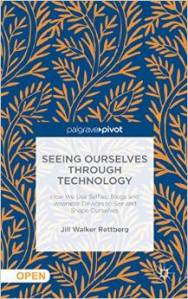
There is a lot of public and academic discussion about “Selfies” at the moment. When we uncritically follow some of this debate we could believe it is an entirely new phenomenon created by mobile phones equipped with cameras, and maybe selfie-sticks. Jill Walker Rettberg has written an insightful analysis of the ‘selfie-phenomenon’ that situates the photographic selfies we are all familiar with, within the wider social and historic context of past and present technologies and techniques used to create representations of the self, including self-portraits, auto-biographies, and more recently quantified modes of self-logs and activity trackers.
Having situated “Selfies” Walker Rettberg moves on to discuss how “filters” are being used and create distinct version of self-representations. These filters can be technological, such as Instagram filters, or cultural. Whilst the former can be deployed to create images of our selves that show us how we want to be seen by others, the latter are those filters we deploy in response to the socio-cultural environment we inhabit; they guide for example the section of images that we create, collect and display.
A “Selfie” rarely occurs in isolation but often are produced in a series. By examining series of selfies, such as changes of profile pictures over time Walker Rettberg can show how the way in which people present themselves over time changes. As in previous chapters Walker Rettberg manages to link her analysis with knowledge about art history and art theory.
The emergence of Selfies is closely linked to the growing trend of tracking applications and logs. Walker Rettberg illuminates this linkage between these two phenomena and explicates the growing automation of the tracking and its relationship to the earlier discussion about filters. One strength of this chapter is the elaboration of this relationship between, for example the quantified self, the use of automation in the data collection and analysis and the filtering of information in the process. Walker Rettberg further elaborates on the quantified self movement in a separate chapter.
All the developments Walker Rettberg examines and discusses in her book throw in the open issues of surveillance and privacy that every now and again create a media hysteria without being properly dealt with. In her final chapter Walker Rettberg explicates some of the privacy issues related to selfies and possible consequences of the self-logging for people.
Overall, the book provides a very good analysis of the Selfie phenomenon and offers plenty of food for thought on possible further research on related phenomena, such as quantification of the self, automation etc.
 Interaction, Organisation & Technology