There are various attempts by science museums to bring to life some of the hidden ways in which the Internet works. When I visited the Science Museum in Chicago about 10 years ago there was an exhibit where I took a photograph of myself that then was transmitted to the other end of the gallery and displayed on a screen; the transmission of the picture was visualised on a wall where small packages moved along to where the screen was.

A few months ago in late March the National Media Museum’s Internet Galleries in Bradford opened together with Life Online that pursue a similar goal; making the development and functioning of the Internet intelligible.

Now in late July 2012, the Science Museum in London together with Google launched Chrome Weblab, “a series of interactive Chrome Experiments made by Google that bring the extraordinary workings of the internet to life”. The exhibition is in the basement of the Wellcome Wing. When I visited the gallery had just opened to the public and was already heaving with people.

Weblab is comprised of five ‘experiments’ people can engage with by using a Lab Tag and the various interfaces and systems displayed in the space. On entering the gallery each visitor can draw a Lab Tag from a computer system that is used as an identifier through which visitors’ engagement with the individual experiments is recorded and made retrievable from home. From here on the route took me into the gallery and a first large screen, the Data Tracer.

On entering the gallery I heard musical sounds which apparently came from the centre of the space but I had no idea who or what produced them and why. On closer look I saw a number of machines that looked like musical instruments that made sounds without anybody in particular playing them. I was intrigued but before I got to move to one of those instruments a person at the exhibit in front of me left the computer system and I engaged with the Data Tracer.


Data Tracer is comprised of three or four small screens connected to a large display showing a map of the world. On arrival I waited for a few minutes until a small screen become available and then fed my Lab Tag into an interface. I then was confronted with a number of thumbnail images showing objects and photographs of faces; on selecting one of the thumbnails a large copy of the image appeared on the large screen opposite locating the physical place where the image is stored and then drawing lines from there back to the Science Museum; thus, the exhibit visualizes the transformation of the image into data packages and their ‘journey’ to the Science Museum. Like the old exhibit at the Chicago Science Museum this Weblab experiment makes visible the process of using Google search engine. 

Having experimented with the exhibit for a while by tapping on two or three of the thumbnails I noticed other visitors waiting behind me and moved on to the next experiment, the Sketchbotswhere robots draw faces captured by a webcam of physical visitors in the gallery and online visitors in sand.

Only few people stopped for longer than a minute or so at the robots and often moved on when noticing that at the next lot of robots they can have their own faces or those of their children drawn.

http://www.youtube.com/watch?v=CkzXSZnDs1E&feature=player_embedded

The process fascinates people. Having taken a picture they observe the robot at work and their image appearing. They take pictures on their cameras or film the process with their mobile phones, commenting on the delicate strokes the machine makes in the sand. People also exploit the possibility to take pictures of others as a means to engage their (small) children with the exhibit who otherwise may not stay with the experiment for long. They lift children up in front of the camera, take the picture of their face and then show them that the robot is drawing that picture of their face in the sand; the activity keeps the children engaged with the exhibit for considerable time.

From the robots my visitor journey took me to the Teleporter, an exhibit that uses periscopes connected to the web to look at location around the world pre-determined by the designers. For somebody on their own the use of the periscope can feel a bit strange, as you pull the system in front of your eyes and loose awareness of what is happening around you.

Looking through the periscope I saw the inside of an aquarium located in Cape Town and could turn around to get a 360 degrees view of the space. On occasions I pressed a button at the top of the periscope to take a photograph that with the help of the Lab Tag was saved on my account. As I discovered when leaving the periscope on the wall behind the exhibit my picture was displayed on small digital photo frames together with those taken by others. The picture bears a time-stamp and can be discussed with others who had no access to what I was looking at while using the system.

One of the potentially most exciting exhibits is the Universal Orchestra, a robotic orchestra made up of eight instruments simultaneously operated by people in the gallery and on the Internet. The instruments are located in the centre of the gallery, each equipped with a computer system that people can use to create sounds. You touch different notes on the screen, the information is fed to the robot that then creates the sound.

Arriving here helped explain the soundscape I had been hearing on entering the gallery. As with some of the other exhibits I was a secondary user of the exhibit, experiencing how to use the systems and what they do before I gained access to one of the instruments. The interaction with the system kept me busy for a while, as I tried to figure out how my actions on the computer screen relate to the sounds made by instruments. Also, the exhibit is described as a “real-time collaboration with people across the world” but because it is difficult to make out who creates what sound the use of the notion of “collaboration” to describe the events is problematic.

http://www.youtube.com/watch?v=jCXX02dFbIM&feature=player_embedded

Finally, I went to a workstation where the Lab Tag is used to retrieve information about the activities a visitor has engaged with during their visit to the Weblab. The Lab Tag is slotted into the system and the computer screen shows what exhibits the visitor has been at and what they have accomplished there; for example, the photograph taken with the periscope or the sounds produced as part of the Universal Orchestra can be revisited. Seeing on the screen what I had done and what I had missed doing encouraged me to return to the gallery and conduct some further experiments with the Universal Orchestra before then leaving the exhibition.

Having arrived back home I booted my computer to visit the Online Chrome Weblab. I typed in the web address given on the back of the Lab Tag, scanned in the tag and immediately arrived at my Lab Report. The site shows my activities in the galleries on at the Science Museum, and allowed me to conduct the same experiments online. When opening for example, Online Sketchrobot, a site opens that shows live footage from the gallery before opening a screen that looks very similar to the one in the gallery. I took a picture of myself which then was processed ready for the robot to draw in the sand.

I then typed in my email address through which the system later notified me that the robot had completed its job.

The other exhibits work in a similar way. The Online Data Tracer invites visitors to ask the system to use for a physical location of an image file. I typed n my Twitter handle and the system located the associated picture in Isenburg, a small city in the German federal state of Hesse. TheOnline Teleporter allows the user to click on an image and obtain a live view into the bakery in North Carolina, the miniature exhibition in Hamburg and the aquarium in Cape Town. And the Online Universal Orchestra facilitates access to the eight instruments; one can view events in the gallery and play the instruments in the gallery from a remote location, audible to visitors in the museum and remotely. The played music can be recorded and then like the activities at the other exhibits, is retrievable from the Online Lab Tag Explorer.

Chrome Weblab is a fascinating experiment of an exhibition. It tries to make intelligible that the Internet connects remote locations on the planet. And this connectedness involves much more than the accessibility of information through search engines and web browsers but also allows for the possibility to act and interact with machines and people across the world in real-time.

The exhibition invites visitors to engage and participate with exhibits in the gallery and remotely and discover for themselves the relationship between the Internet and the social world in the gallery and remotely. It is successful in engaging people for considerable time with the topic of the Internet and creates an awareness for the connected world we are now living in; robots can be operated remotely, people in remote locations can “collaboratetively” make music, we can have a peek into the world of others from remote locations.

Over the past 10 years or so I had the opportunity to study visitors participating with technology in museums, including the Science Museum and the Wellcome Wing. Therefore, for me visiting Chrome Weblab was interesting also to see how features of  exhibits in Who am I? and Digitopolishave been further developed by the design team of Chrome Weblab. For example, the replacement of the flaky fingerprinting mechanism to save visitors’ activities with exhibit on a server by the physical Lab Tag is a huge improvement.  The tag works well and without problems with webcams at home (and at work) and also is a nice memorabilia from the visit. However I could imagine that in the future the Lab Tag is transferred to a mobile phone as people tend to loose or forget about items they take away from visits to museums. Also, the taking of photographs of people’s faces that has been a critical feature of exhibits in Who am I? has been improved. The interface is much more flexible and adaptable to use pictures visitors take.

There are three aspects of the exhibition that I believe might be worthwhile exploring further for the design team and google when revising the galleries. First, I think the key message of Weblab, i.e. the interconnectedness, is not coming through clearly enough. The relationship between people’s action in the gallery and remotely need to be made more intelligible and obvious. For example, at the moment it is unclear who plays what note at the instruments of the Universal Orchestra; at Data Tracer the actions on the small screens could be made visible, and at Sketchrobot more needs to be done to make the activities by the remote participant visible to give this part of the exhibit more prominence in the gallery.

Second, as the gallery is described as a laboratory the design team and their research staff might use it not only as a laboratory to experiment with technology but also as a space where they can experiment with human behaviour in technology-rich spaces. For example, it has been a common problem for museums that display a large number of computer-based exhibits that the number of interfaces is often much lower than the number of visitors who wish to participate with the exhibits at any one time. This leads to long waiting-times and queues at exhibits, people being secondary users rather than experiencing exhibits first hand, and unfortunately also people leaving disappointed because they did not get a chance to use an exhibit first-hand. Being setup as an experimental space the gallery would allow the design team to experiment with different ways to manage the flow in the galleries and to mange access to exhibits.

And third and maybe most importantly, considering that many visitors come with friends and family the design team could use the space to experiment with the provision of resources that facilitate and encourage collaboration at computer-based exhibits. The observations at the Sketchrobots where parents provide their children with access to the exhibit illustrate that visitors are interested in experiencing the exhibits together, yet the interfaces often prioritise individual users over collaboration. It would be fascinating to see experiments with novel interfaces that encourage visitors to collaborate with others in the gallery, and also with people in remote locations.

References

Heath, C., & vom Lehn, D. (2008). Configuring Interactivity: Enhancing Engagement in Science Centres and Museums. Social Studies of Science38(1), 63-91.

Heath, C., & vom Lehn, D. (2004). Configuring Reception: (Dis-)Regarding the “Spectator” in Museums and Galleries. Theory, Culture & Society21(6), 43-65.

Heath, C., Luff, P., vom Lehn, D., Hindmarsh, J., & Cleverly, J. (2002). Crafting participation: designing ecologies, configuring experience. Visual Communication1(1), 9-33.

Hindmarsh, J., Heath, C., vom Lehn, D., & Cleverly, J. (2005). Creating Assemblies in Public Environments: Social interaction, interactive exhibits and CSCWJournal of Computer Supported Collaborative Work (JCSCW)14(1), 1-41.

vom Lehn, D., Hindmarsh, J., Luff, P., & Heath, C. (2007). Engaging constable: revealing art with new technology. Proceedings of the SIGCHI conference on HumanComputer Interaction (pp. 1485-1494). San Jose,CA: ACM Press.

vom Lehn, D. (2010). Generating experience from ordinary activity: new technology and the museum experience. In D. O’Reilly & F. Kerrigan (Eds.), Marketing the Arts. A fresh approach (pp. 104-120). Abingdon: Routledge.

vom Lehn, D., & Heath, C. (2005). Accounting for new technology in museum exhibitions.International Journal of Arts Management7(6), 11-21.

vom Lehn, D., Heath, C., & Hindmarsh, J. (2001). Exhibiting interaction: Conduct and collaboration in museums and galleries. Symbolic Interaction24(2), 189–216.

@dirkvl

http://www.vom-lehn.net


interaction, interactivity, museums

Google and Academic Research

notes on books


The other day I was reading an academic paper  on an iPad; the paper had a number of references to Jack Kerouac’s ‘On the Road’. Halfway through the paper my desktop signalled the arrival of an email. On opening the email I had to look twice – the publisher Penguin had sent me a message saying that Jack Kerouac’s ‘On the Road’ was available as ebook now. Coincidence? Most probably. But the crawling and searching of our computer screens for activities makes such events increasingly possible and likely to occur.

Image

One company that engages in such actinides to monitor people’s online activities is Google. Recent publications have critically discussed these activities and pointed to the pitfalls for users and customers. Eli Pariser (2011) explicates how Google, Facebook and other companies use the tracking of online behaviour to reduce the amount of information made available to us presenting us with personalised information. Finds on Google Search are tailored to our search behaviour and our interaction on Facebook tailors the News Feed to show information posted by those we interact with, whilst other of our ‘friends’ don’t appear in the news feed anymore. The result is what Pariser calls ‘Filter Bubble’ that makes us to read, watch and listen to more of the same.

Image

Pariser’s book has had considerable coverage in the media’s review sections and on blogs. Whilst its principal argument is appreciated it is has been criticised for not taking into account the complexity of recommendation engines and the practices of people’s search behaviour. If an initial search result is dissatisfying we continue our search without taking for granted Google as an authority that shall not be withstood. We might even try Yahoo or Bing to see what finds they produce. Yet, on the first glance the way in which Google presents its finds suggest that there is an authority at work that provides us with comprehensive, objective and unbiased search results.

For academics therefore Google Scholar often seems to the first and best point of address to search for academic articles. Thus, Google Scholar has made access to scholarly research easy and convenient. You type in keywords into the search engine and it returns a list of finds ordered by relevance. The results link to academic journals that with the appropriate access can be downloaded immediately. Again, the impression given is that the finds are comprehensive and unbiased. No indication is made that over (more) relevant research might be out there than what is presented on the screen.

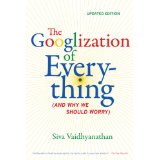
Siva Vaidhyanathan’s ‘The Googlization of Everything’ powerfully dismantles the view of Google search as providing unbiased results. Without discounting the benefits Google offers us all Vidhyanathan explicates the logics that drive Google Search and the implications they have on how we see the world. Like Pariser he explains how Google Search tailors its finds to our online activities. In producing search results Google not only looks at our past searches but also takes into account what we are currently doing in any of the Google Apps including Google Docs or Gmail. Moreover Google Search and Google Scholar only can find information from sources that makes it available to them.

In terms of Google Scholar this means that the search engine only finds articles from publisher who have a contract with Google to make information from their publications available. For example when I recently looked for literature on German sociology via Google.de I was struck by the fact that I was provided with information from amazon.de and self-publishing sites that hold student coursework but not from the major German publishers disseminating the key German texts in the subject.

All this considered it would seem that whilst Google Scholar and Search might be a good first site to start research it then is advisable to move to more reliable sources like ISI’s web of knowledge and other scientific Citation Indexes. Otherwise it would seems scientific/social scientific research also will be caught in the filter bubble; referring and cross-referring to publications only that Google provides it with.

Some References
Eli Pariser 2011. The Filter Bubble. Viking.
http://www.thefilterbubble.com/

Siva Vaidhyanathan. 2011. The Googlization of Everything. University of California Press
http://www.googlizationofeverything.com/

Neal Lathia 2011. Blogpost. Blowing Filter bubbles
http://urbanmining.wordpress.com/2011/06/20/blowing-filter-bubbles/#entry

#learnpod12

Uncategorized

On my way back from #learnpod12, an Unconference held at Doncaster College. Unusual for an unconference more than 100 people working in education-related areas came together to discuss in up-to six parallel sessions issues related to innovating teaching and learning. They shared experiences in using social media for educational purposes and exchanged information about new and old tools and ways to use them in educational settings as well as in unusual places like a village green. The discussions were lively, brought together new and old colleagues and will probably continue now while I am on the train and many of the other participants explore Doncaster. At the moment I am not certain whether @johnpopham is offering a post-event pub crawl or whether he was successful with his plea for cake. Let’s check Twitter #learnpod12 to find out…

Meeting the ‘"Anti-Christ of Silicon Valley" – Discussion with Andrew Keen

Uncategorized

Last night, May 24th, I was one of 20 lucky participants at a discussion organised by The Kernel Magazine at London’s Adam Street Private Members Club. The event was invitation-only and limited to subscribers of the Nutshell, The Kernel’s weekly newsletter. A friendly bunch of Venture Capitalists, entrepreneurs, bloggers, journalists, a social worker and a sociologist gathered around the table waiting for Andrew Keen, the self-styled “Anti-Christ of Silicon Valley” who had just published his latest book “Digital Vertigo”. Andrew (@ajkeen) of course is the author of “The Cult of the Amateur”, a book published in 2007 that puts a lid on the overexcitement for peer production, user-generated content and the associated Web2.0 hype.  

While waiting for Andrew’s arrival it transpired that with Damian Thompson, the Editor of Telegraph Blogs, another author was amongst us who had just published his new book “The Fix: How Addiction is Invading our Lives and Taking Over Your World.” In the book Damian argues that currently more and more products are created and marketed that have seductive, even addictive, qualities; like the alcoholic reaching for the needle, people taking painkillers and munching cupcakes, we increasingly feel compelled to look at our smart phone or play video-games. 

In the discussion of his book Damian illustrated his arguments by referring to his interviews with drug addicts, video gamers and psychologists. These examples provided a good starting-point for Andrew Keen who in the meantime had arrived, not in a ball of fire but with a friendly smile to discuss his “Digital Vertigo”. As it turns out some of the arguments Andrew makes in his book are closely related to the case Damian makes in his book, as Andrew writes in a review published in The Kernel Magazine yesterday: “whatever it means to be human means not be addicted to foreign substances, devices or networks” (A. Keen 2012). 

In the course of the dissemination of social technologies people give up their privacy and post their ongoing engagements on Facebook, Twitter and other networks. Thereby, maybe without their knowledge, they render formerly private activities like watching television or reading, public. They not only post messages of their activities but the technology itself makes visible what they are doing and people seem to enjoy exhibiting their (private) activities; social television and social reading are just some of the most recent trends in the exhibition of private activities.

Andrew in reference to Damian Thompson’s “The Fix” pointed out how these social technologies bear characteristics that make an engagement with them “addictive”. People are lured into social networking sites with the promise of connecting with others, and once they have arrived there find it hard to disconnect and to not check their Facebook sites and Twitter feeds. In my view this constant checking of our displays cannot be explained by an “addiction” alone but is due also to the fact that we become accountable when we fail to respond to a status update or tweet directed at us. We may receive an email, a text message or even a telephone call to remind us on our obligation to attend to our “friends” actions. Ignoring an update is not an option. What Thompson describes as “addiction” at least bears an additional quality that is that by signing up to a social network we acknowledge a tacit agreement of being constantly available to attend to our “friends’” and “followers’” actions.

With this point Andrew links to recent movements that have emerged on the web, such as #technologyshabbat on Twitter and theundolist.com. These Twitter and web-campaigns call on people to unplug at least once a week and make time to connect with friends and family without the constant interruption by the glance to the phone. 

The discussion on the evening however went beyond arguments about addiction and the internet as a technology that may disturb social relationships and moved to political questions like the role of the state as legislator, the need for more suitable “education” and debates about the need for privacy to secure space and time for human existence. I may overstate the level of debate here, we did have a glass of wine as well, but Andrew’s book starts with the philosopher Jeremy Bentham who up to the present day is displayed for public inspection in a glass-case at University College London. 


Bentham

Bentham is relevant to the debate about the impact of social technology for various reasons, including his invention of the panopticon that nowadays is often cited as the intellectual base for the emerging surveillance society or “transparency society” (David Brin). As people spend increasing time online and use social technologies to share their experiences with others, companies gather data about online activities because in the ‘Like-economy’ these activities are a commodity. In effect, the argument goes, Facebook and cognate companies exploit people’s narcissism by encouraging them to exhibit themselves, their whereabouts and ongoing activities.

Andrew called for legislation and regulation that protects people’s privacy, that enables people to conduct activities privately and determine what data they reveal of themselves and what companies can do with personal data. Some of the particip
ants in the discussion, maybe not surprisingly considering their background, countered Andrew’s argument and pointed to technologies that provide new opportunities for people to connect with each other and information without revealing data about themselves; examples for these developments are private search engines or browsers that hide people’s identities.

This point led to another strand of debate concerned with the Filter Bubble effect and opportunities for serendipity. Again, some of the participants in the discussion suggested that search engines, tracking technologies and recommender systems have become better at creating interesting results for their users. Yet, there was agreement in the room that clearer information needs to be provided about ways in which technologies extracts information from people’s private and public activities, on- and offline, to turn it into data and utility for companies. Whilst the term “education” came up, it seemed to be too vague to suffice to address the lack in skill and competence in using smart and social technologies.

Unfortunately, the evening then had to end despite us all getting increasingly excited about the event itself. Milo promised that The Kernel Magazine is planning to make these debates a regular, hopefully twice monthly event. We are all looking forward to them!


The Challenge of Technology Shabbat

Uncategorized

About a year ago, I came across a documentary about the Barbie Doll, entitled The Tribe. The film links the history of Barbie to the question of what it means to be Jewish today. I was intrigued not only by the content of the film but also by its composition, a mixture of old and new, short cuts and longer sequences, and a narration by the memorable voice of Peter Coyote. The fil sparked my curiosity to look for information on who was behind the film and if the producer had embarked on other, related projects. 

Tribe

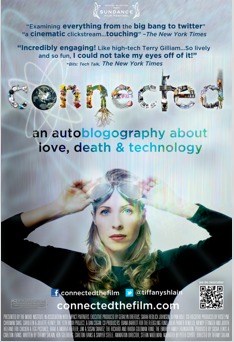
It didn’t take me long to find the website to the film and to that of its producer and director Tiffany Shlain. Apart from having directed and produced this fabulous documentary Tiffany also is the founder of the Webby Awards and the co-founder of the International Academy of Digital Arts and Sciences. Most recently she has produced the highly praised and award winning “autoblogography” Connected.

Connected

The various communications about Connected distributed on Twitter and elsewhere enticed my curiosity about Tiffany’s larger project further. Whilst still not having seen Connected – when do you come to London, Tiffany? 😉 – the documentary (seems to) advance(s) her interest in the opportunities and challenges we face in a social world pervaded by technology designed to connect us all with each other. This technology and the social media that we increasingly use everywhere on our mobile devices allows us to connect with people across the globe. As an illustration of this interdependence between people Tiffany and her team set their Twitter followers and Facebook fans the task to translate the text of “A Declaration of Interdependence” and read out in front of a running camera. The result is short film produced in collaboration between complete strangers. 

Maybe mesmerized by the possibility to connect with so many people around the world we find it increasingly difficult to put the phone to the side and connect with those nearest to us. We take out our phones in the middle of conversations or disappear to the toilet during dinner to check up on Facebook notifications and Twitter updates. Technology interrupts our daily interaction. “Who have I become?”, asks Tiffany, and comes up with the idea of a Technology Shabbat. She switches her phone off on Friday evenings, for 24hours, and encourages her friends, fans, and followers to do it like her. Apart from notifying us all about her unplugging on Friday nights together with her husband Ken Goldberg she has produced another short film, “Yelp! With Apologies to Alan Ginsberg’s ‘Howl'”. 

With the film Tiffany encourages her audience to unplug as well from time to time. Do it like her, switch off your networked devices and gain the time and focus to engage with your friends and family, at least one day a week, without being interrupted by blinking and beeping devices notifying you about the arrival of new messages and updates.

Having resisted her request for a few months last weekend I decided to give it a go and unplug. Gosh! No idea had I how difficult that would be. Apart from the habit to reach for my phone whenever I sit down and check on nes, the unplugging brings with it some practical issues. A complete phone blackout was out of the question as my weekends are organised in ways that involve phone use at various occasions to coordinate meet-ups with the rest of the family. So, the only thing I did manage was to unplug from social media. Effectively I switched off my Facebook, Twitter etc. connection from Friday evening to Sunday morning. This worked out okay and gave me time to do other things without staring at the phone in the middle of a game or while reading a book. Also, rather than spending some time on Twitter on Sunday morning, I read a newspaper and then finished a book, The Digital Scholar. Overall, the Technology Shabbat has been an interesting experience for me and I will do it again, hopefully to greater effect, at the end of this week. 

While refraining from accessing social media I also remembered a paper presented at the 2007 CHI Conference in San Jose, CA, namely Allison Woodruff and colleague’s “Sabbath Day Home Automation: ‘It’s Like Mixing Technology and Religion“, that seems pertinent to the issue. Woodruff discusses her observation in orthodox Jewish homes who because for religious reasons they are not allowed to operate technology, rely on on automated systems to help them out. She sees these automated systems as examples for technologies that are neatly embedded within the lives of people without interrupting or disrupting their social arrangements. Maybe over time we will find ways to embed our mobile phones and our social networks equally neatly into our lives. 

Putting my half-failed attempt of a technology shabbat to one side, I am looking forward to seeing Tiffany’s project which a bit clumsily might be summed up as an exploration of the technology induced tension between interdependence and identity, develop. 

Connected is in the cinemas in the USA and elsewhere since this autumn. 


Just out! Symbolic Interaction, Special Issue on "Interaction"

Uncategorized

Symbolic Interaction (2011; Vol.34, No.3/Summer)


Special Issue “Interaction”

     1. Interaction and Symbolic Interactionism(pp. 315-318)  

Dirk vom Lehn, Will Gibson

DOI: 10.1525/si.2011.34.3.315

Stable URL: http://www.jstor.org/stable/10.1525/si.2011.34.3.315


can be downloaded here:

http://kcl.academia.edu/DirkvomLehn/Papers/923199/Interaction_and_Symbolic_In…


2. Interaction Ritual Theory and Structural Symbolic Interactionism(pp. 319-329) 

Chris Hausmann, Amy Jonason, Erika Summers-Effler

DOI: 10.1525/si.2011.34.3.319

Stable URL: http://www.jstor.org/stable/10.1525/si.2011.34.3.319


3. Extending the Symbolic Interactionist Theory of Interaction Processes: A Conceptual Outline(pp. 330-339)  

Jonathan H. Turner

DOI: 10.1525/si.2011.34.3.330

Stable URL: http://www.jstor.org/stable/10.1525/si.2011.34.3.330


4. Toward a Theory of Interaction: The Iowa School(pp. 340-348)  

Dan E. Miller

DOI: 10.1525/si.2011.34.3.340

Stable URL: http://www.jstor.org/stable/10.1525/si.2011.34.3.340


     5.

Symbolic Interactionism and Ethnomethodology(pp. 349-356)  


Alex Dennis


DOI: 10.1525/si.2011.34.3.349


  Stable URL: http://www.jstor.org/stable/10.1525/si.2011.34.3.349


6. Goffman’s Interaction Order at the Margins: Stigma, Role, and Normalization in the Outreach Encounter(pp. 357-376)  

Robin James Smith

DOI: 10.1525/si.2011.34.3.357

Stable URL: http://www.jstor.org/stable/10.1525/si.2011.34.3.357


7. Discrimination and Reaction: The Practical Constitution of Social Exclusion(pp. 377-397)  

Venetia Evergeti

DOI: 10.1525/si.2011.34.3.377

Stable URL: http://www.jstor.org/stable/10.1525/si.2011.34.3.377


8. “Scissors, Please”: The Practical Accomplishment of Surgical Work in the Operating Theater(pp. 398-414)  

Jeff Bezemer, Ged Murtagh, Alexandra Cope, Gunther Kress, Roger Kneebone

DOI: 10.1525/si.2011.34.3.398

Stable URL: http://www.jstor.org/stable/10.1525/si.2011.34.3.398


Book Review

Examining Interaction Using Video(pp. 415-420)  

René Tuma

Reviewed work(s):

Video in Qualitative Research: Analysing Social Interaction in Everyday Life by Christian Heath; Jon Hindmarsh; Paul Luff

DOI: 10.1525/si.2011.34.3.415

Stable URL: http://www.jstor.org/stable/10.1525/si.2011.34.3.415


Google and Academic Research

Uncategorized

The other day I was reading an academic paper  on an iPad; the paper had a number of references to Jack Kerouac’s ‘On the Road’. Halfway through the paper my desktop signalled the arrival of an email. On opening the email I had to look twice – the publisher Penguin had sent me a message saying that Jack Kerouac’s ‘On the Road’ was available as ebook now. Coincidence? Most probably. But the crawling and searching of our computer screens for activities makes such events increasingly possible and likely to occur.

One company that engages in such actinides to monitor people’s online activities is Google. Recent publications have critically discussed these activities and pointed to the pitfalls for users and customers. Eli Pariser (2011) explicates how Google, Facebook and other companies use the tracking of online behaviour to reduce the amount of information made available to us presenting us with personalised information. Finds on Google Search are tailored to our search behaviour and our interaction on Facebook tailors the News Feed to show information posted by those we interact with, whilst other of our ‘friends’ don’t appear in the news feed anymore. The result is what Pariser calls ‘Filter Bubble’ that makes us to read, watch and listen to more of the same.

Pariser’s book has had considerable coverage in the media’s review sections and on blogs. Whilst its principal argument is appreciated it is has been criticised for not taking into account the complexity of recommendation engines and the practices of people’s search behaviour. If an initial search result is dissatisfying we continue our search without taking for granted Google as an authority that shall not be withstood. We might even try Yahoo or Bing to see what finds they produce. Yet, on the first glance the way in which Google presents its finds suggest that there is an authority at work that provides us with comprehensive, objective and unbiased search results.

For academics therefore Google Scholar often seems to the first and best point of address to search for academic articles. Thus, Google Scholar has made access to scholarly research easy and convenient. You type in keywords into the search engine and it returns a list of finds ordered by relevance. The results link to academic journals that with the appropriate access can be downloaded immediately. Again, the impression given is that the finds are comprehensive and unbiased. No indication is made that over (more) relevant research might be out there than what is presented on the screen.

Siva Vaidhyanathan’s ‘The Googlization of Everything’ powerfully dismantles the view of Google search as providing unbiased results. Without discounting the benefits Google offers us all Vidhyanathan explicates the logics that drive Google Search and the implications they have on how we see the world. Like Pariser he explains how Google Search tailors its finds to our online activities. In producing search results Google not only looks at our past searches but also takes into account what we are currently doing in any of the Google Apps including Google Docs or Gmail. Moreover Google Search and Google Scholar only can find information from sources that makes it available to them.

In terms of Google Scholar this means that the search engine only finds articles from publisher who have a contract with Google to make information from their publications available. For example when I recently looked for literature on German sociology via Google.de I was struck by the fact that I was provided with information from amazon.de and self-publishing sites that hold student coursework but not from the major German publishers disseminating the key German texts in the subject.

All this considered it would seem that whilst Google Scholar and Search might be a good first site to start research it then is advisable to move to more reliable sources like ISI’s web of knowledge and other scientific Citation Indexes. Otherwise it would seems scientific/social scientific research also will be caught in the filter bubble; referring and cross-referring to publications only that Google provides it with.

Some References
Eli Pariser 2011. The Filter Bubble. Viking.
http://www.thefilterbubble.com/

Siva Vaidhyanathan. 2011. The Googlization of Everything. University of California Press
http://www.googlizationofeverything.com/

Neal Lathia 2011. Blogpost. Blowing Filter bubbles
http://urbanmining.wordpress.com/2011/06/20/blowing-filter-bubbles/#entry

Human-robot interaction at the Computer Lab in Cambridge – visiting Laurel Riek

interaction, Robots, Technology

In Star Trek Next Generation the android Data is on the constant search for techniques that make him more human. His creator, Dr Soong, has made him look human, if a little pale, but what the particular techniques and what the particular rationale of actions are that would make him human, he has to explore and find out by living with human beings.

Yesterday, I spend some time at the Computer Laboratory in Cambridge where a group of scientists conducts research with human-looking robots. I was invited by Dr Laurel Riek – congratulations, Laurel, on passing the viva early in the week! –  to give a short talk and then have a look at the humanoid robots she has been working with over the past few years.

The robots are realistic looking busts that are equipped with a complex system of motors underneath their skulls. They have been created by a US-American company called Hanson Robotics.

Laurel used Charles and other robots of a similar kind for her research on natural human-robot interaction. Drawing on the growing body of studies concerned with social interaction, including gesture studies, the study of emotion and such like, she strives to improve the communication techniques of robots in order to enable their use in interaction with humans, in particular people in need of help, such as the elderly and disabled people.

Whilst in Star Trek Data discovers the human world by interacting within it, I found in my short encounter with Charles that human-robot interaction may provide us with resources to learn about ourselves and our actions. I think this is something Laurel is working towards when confronting people in healthcare settings with humanoid robots. Thereby, Laurel addresses current debates about how to improve the lives of those living alone or in care homes by deploying robots as companions or at least as other beings they can talk to and interact with.

Publications by Laurel Riek can be found here:

http://www.laurelriek.org/

I found her paper “Cooperative Gestures: Effective Signaling for Humanoid Robots” very interesting but the papers on emotional displays in human-android interaction, I suppose, are where Laurel’s interest lies these days.

"Will Indian Science Take Over the World?" – Angela Saini interviewed by Alok Jha (The Guardian)

Uncategorized

Img_0940

I am not sure whether Angela Saini had expected her book to be such a successful publication when travelling across India to research the Geek Nation. By now it is on the bestseller lists in the UK and India, has been reviewed numerous times and Angela has given a number of presentations and interviews in USA, India and the UK. I was lucky enough to come across an advert for the book on twitter but can’t recall what triggered my interest; I guess it was the curious relationship between science and religion that features in the book, or the ongoing debates about the enormous economic, technological and social transformations that India is currently undergoing. The book is a fantastic read and offered me who knows virtually nothing about India interesting insights into a strange world. 

Especially_for_dirkvl


When I saw that Angela was being interviewed by Alok Jha, one of the Guardian’s science and environment correspondents, in London, I immediately jumped for the opportunity to learn more about her travels and research.The interview was held as part of the Festival of Asian Literature at Asia House in London on May 24th, 2011. Asia House is a marvellous building in the centre of London, not far from Oxford Street. The Grade II* listed building has recently been redeveloped but contains the original decor from the late 1800s. Apart from rooms for public events there are exhibition spaces as well as a splendid cafe in its basement. 

Imagegen

The interview largely explored the question whether India was on the verge to challenge the old science superpowers of the USA or the UK. Angela almost immediately rejected that India was already overtaken the Western countries in importance for the development of science. However, by pointing to the long history of science in India she argued that the importance and influence of Indian science and scientists on discussion and debate in major fields was already noticeable. Science and in particular mathematics – it is sometimes claimed that the number Zero was invented and first used in India – have played an important role in the growth of India from a developing country to an emerging economy that is often compared with Brazil, Russia and China – (BRIC). In recent years, the social and economic problems of the fast growing Indian society have increased the political support for developments in science and technology. This is reflected in the emergence of now world-reknowned research centres spread across India. Angela’s research involved travelling to these centres to explore the “geekiness”, i.e. the passion and motivation of the people working in and leading the research there.  

Img_0941

To Angela and the reader’s surprise, the enormous technological and scientific advancement in these research labs happens alongside the existence of superstition and belief. For Angela the reliance on non-scientific institutions like superstition and religion reflects the despertion and helplessness of people in many situation. Over the past decades when life in India was often overshadowed poor living conditionsreligion offered people stability and a rtional to explain the condition of their daily lives. Nevertheless, it was surprising to Angela that such beliefs and superstitions are still held and referred to by some world-reknowned scientists. In interviews,top scientists at leading Indian research labs referred to research conducted at the Academy of Sanskrit Research, which might be described as a centre for religious studies. This research at the AoSR has published and translated manuscripts describing “floating vehicles”, “chariots of the gods”, used by ancient warriors. From the point of view of a Western scientist the belief in such chariots by scientists is stunning, if not unbelievable. Yet, it reflects the curious interrelationship between formal science and other kinds of enquiry that Angela also encountered when attending the Indian Science Congress. Here, she found that Nobel Price wining scientists would present the most advanced science and mathematics while next door talks were given about homeopathy and other kinds of alternative medicine that in by Western scientistis largely are seen as unscientific, if not nonsensical.1

Img_0942

The existence of ‘alternative science’ and ‘alternative medicine’ in the same academic environment in India is possible and unproblematic, Angela argued, because science is not in the same way institutionalised as in the Western world; “there is no Royal Society equivalent in India”. The lack of an institutionalised science results in the possibility of questionable science being acknowledged and used by the courts as Angela explained with regard to the use of a “truth machine” by Indian law enforcement and in court whose findings have led to the (wrongful) conviction of people for murder.2

Img_0944

Considering the curiousness of some parts of Indian science, the possibility that alternative science exists next to ‘Western’ science thr
ows up the question of what ‘science’ is actually being undertaken in India and if Indian science will take over the world, which was the title of the event. Angela based her answer to this question on her visits to the various research labs in India. She came to the conclusion that Indian science focuses on pragmatic questions. Funds are given to scientists and their labs if they concern themselves with problems the Indian society currently faces: energy, health, genetics, engineering and computer science as well as space travel, to give but a few example that she covered in her talk and book. This has given rise to important develop in the applied sciences. Yet, there are no or very little funds for basic research although Indian science relies on such research to further advance. It therefore happily welcomes back in India Indian scientists who have been trained and maybe have become world-famous elsewhere, in particular in the USA and UK.  

Will India soon challenge Western science and become a scientific superpower in its own right? No, agued Angela in the interview and in her book. Yet, the passion, or “geekiness” as she calls it, with which people engage in scientific endeavors, will help transform Indian society and raise its influence in the world. 


Angela Saini is on Twitter – @AngelaDsaini


—————

1 see for example, the site Bad Science where the non-scientificness of alternative medicine is shown. The contributions to the site are made by Ben Goldacre  

2 Angela Saini. 2009. The Brain Police: Judging Murder with an MRI. (Wired Magazine).


The Facebook Era

Book Review, innovation

Another book I recently read was Clara Shih’s ‘The Facebook Era‘. The book now in it’s 2nd edition gives practical advice on how to effectively use Facebook for marketing/business purposes. The information provided is based on Shih’s experience with business and seems very useful for practitioners in business. … I think I now read enough about Facebook for 2011. Time to check what my friends are up to…