On February 4th, 2011, Rob Wilmot, Director of BCS Digital and Co-founder of Freeserve gave a guest lecture on “Marketing & New Technologies”, a module that I convene as part of the MSc International Marketing at King’s College London. In his lecture “Social Media and the New Economy” Rob provided a fantastic overview of the importance of Social Media to business and marketing as well as to Masters’ students who soon will go out and look for work.
Rob named 2009 as a watershed when Social Media turned from a fringe activity into becoming the mainstream. He names 4 events that pushed Social Media to the fore: (1) backed by a Facebook/Twitter campaign Rage Against the Machine ‘steal’ the Christmas No. 1 spot from the 2009 X-Factor Winner Joe McElderry, (2) on Christmas Eve, for the first time, Facebook had more site visits than Google US, (3) Pepsi pulls its adverts from the Superbowl in favour of a Social Media campaign, and (4) Barak Obama becomes President of the USA after an election campaign that made very effective use of Social Media. Since 2009, this development of the growing importance of Social Media for political campaigns and business activities has accelerated and spread into other areas, such as police investigations and professional football. New Social Media websites emerge all the time and the next big service/site following Facebook’s success is probably out there already (Rob Wilmot).
The spread of Social Media is closely monitored and investigated by commercial research institutes such as Forrester Research and the Altimeter Group. This research provides interesting insights into what Social Media people use – right now mainly Facebook and YouTube -, what kind of new Social Media services are currently emerging – right now, in particular Twitter – and what the demographics of Social Media users are. It also suggests that people use Social Media for different purposes and in different ways, and increasingly while being on the move rather than while sitting at a Desktop Computer.
For the “new economy” that is arising from these developments “recommendations” of products, services and websites are of particular importance. For example, with the deployment of ‘like’ and ‘share’ buttons “Facebook aims to become the authority for recommendation on the Internet” (Rob Wilmot). This development is highly relevant for all Social Media users as the effectiveness of recommendations is closely linked to the ‘trust’ people have in each other; “trust” being seen as the basis for the building of relationships.
Companies are well aware of the link between ‘recommendation’ and ‘trust’ and pay celebrities and Twitter users with large numbers of followers, fans and friends for recommending their products and services. For the rest of us, the link between ‘trust’ and ‘recommendation’ highlights the importance to take care when posting on Facebook, Twitter and other sites. In order to develop a reputation and to build trust it is critical not to post false, misleading, offensive etc. messages to Social Media sites: ”imagine your post is published on a billboard visible to everybody on the street” (Rob Wilmot).
The effectiveness of Social Media has been notoriously difficult to measure. The impact of wrong-footed Social Media campaigns such as those by Habitat (2010) and Kenneth Cole (2011) for the image of companies, are well reported. For the measuring of the Return on Investment (ROI) tools are developed by Forrester, Altimeter, Google and many others that provide information on the relationship between Social Media campaigns and monetary return. This information is critical to refine campaigns and continue to engage with customers. As Social Media continues to develop alongside more conventional marketing channels the instruments to measure their effectiveness in delivering ROI will be refined and further developed.

Social Media are not a magic wand that resolves all the problems marketing managers may have with building relationships with customers in an increasingly complex and competitive environment. However, they are a powerful additional channel marketing managers need to take seriously when developing campaigns and engaging with (potential) customers. Common-sense rules about the way in which to conduct communication are valid in Social Media just as in conventional marketing channels. However, Social Media fundamentally change the relationship between companies and customers: in particular, they facilitate conversations with customers and, if used in the right way, support the building of trust and long-term relationships with customers.
Rob’s lecture offered a wide range of information and insights on Social Media. He suggested that there is a growing field of research designed to support companies in developing Social Media campaigns and to asse
ss, evaluate and measure their (monetary) success or failure. It seems that whilst effective measures for the quantitative impact of Social Media campaigns are emerging, methods to be used for the assessment of qualitative aspects of the relationships between Social Media users are still underdeveloped.
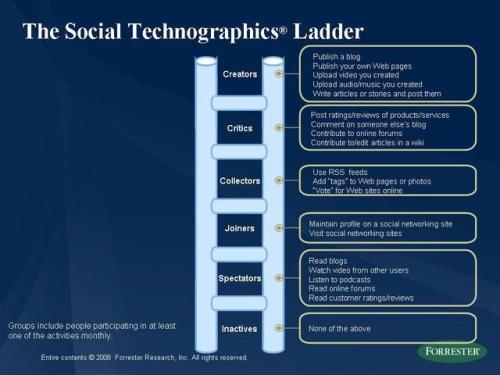
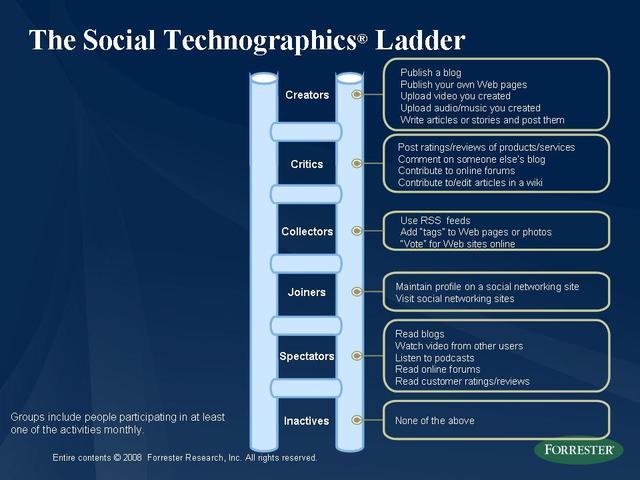
The lecture implied a range of possible research questions. The research the lecture has been based on, origins from studies conducted by research companies who aim to inform management practice and marketing strategies. Detailed academic research can contribute to this research by unpacking the concepts and foundations of relationships this research is pointing to. For example, the Social Technographics Ladder developed by Forrest Research (see Li & Bernoff 2008) creates a typology of people according to the ways in which they use Social Media tools, such a blogs, podcasts or RSS feeds. Little do we know of how people actually ‘read’ and ‘collect’ Social Media content, what resources they draw on and how they use these resources to create new content and new forms of content.
Furthermore, much has been written about the importance of the building of relationships that often origin in ‘recommendations’ from “trust agents” (Brogan 2010). Yet, little do we know of what ‘recommendations’ are made up of, when do they arise and how are they designed in different situations and with regard to different products, services and people. How do long-term relationships and loyal customers of a company arise from a recommendation by a Social Media ‘friend’. ‘Relationship’, ‘loyalty, ‘trust’, ‘reputation’ and ‘recommendation’ in this context are often used as a generic concepts rather than as products of interaction between people. Little is known of the processes through which these ‘products’ of interaction are brought about.
Detailed studies of interaction between people, online and offline, and in particular between marketing practitioners (shop keepers, vendors, marketing managers, direct marketeers, customer service personnel, etc.) and customers will useful in helping to unpack generic concepts like ‘relationship’, ‘loyalty’ and ‘trust’. Furthermore, they can specify the social organisation of activities such as the ‘conversation’ between companies and customers or those activities described in debates about Social Media as ‘engaging’ and ‘recommending’.
With such complementing interests of research companies and academic scholars it would seem sensible to engage in joint research projects and programmes that aim to develop generic concepts and models whose components are well understood and specific that they can inform the Social Media activities of companies and customers.
Relevant References
Anderson, Chris. 2006. The Long Tail. How endless choice is creating unlimited demand. Random House.
Brogan, Chris & Smith, Julien. 2010. Trust Agents: Using the Web to Build Influence, Improve Reputation, and Earn Trust. John Wiley & Sons.
Cellan-Jones, Rory. 2008. Freeserve and ten years of boom and bust. http://www.bbc.co.uk/blogs/technology/2008/09/freeserve_and_ten_years_of_boo.html
Li, Charlene & Bernoff, Josh. 2008. Groundswell: Winning in a World Transformed by Social Technologies. Harvard Business Press.
Solis, Brian. 2011. Engage: The Complete Guide for Brands and Businesses to Build, Cultivate, and Measure Success in the New Web. John Wiley & Sons.
Tapscott, Don & Williams, Anthony. 2007. Wikinomics. How Mass Collaboration Changes Everything. Atlantic Books.
Rob Wilmot in the News
Google
The Guardian