Jumping from Exhibit to Exhibit

exhibitions, interaction, interactivity, museums, visitors

There is an interesting discussion about linearity of exhibitions over at Nina Simon’s Museum2.0. Ed Rodley (*wave back*) has added his own take on this discussion on his blog “Thinking about Museums“. Ed highlights the relationship and between on the one hand the physical or geographical organization of exhibitions and on the other hand the narrative organization of the content of exhibitions. He kindly refers to my own post from a couple of week’s ago where I was trying to explicate some of the advantages of exhibitions that physically organize their exhibits in a linear way. Such an organization suggests to visitors where the next exhibit is and by glancing over to people standing there, can assess when it is opportune to move on without pushing or nudging the others to leave that piece.

In a way, my studies highlight the delicateness of people’s exploration of these spaces and how polite and respectful they conduct themselves when moving through these spaces that are in Lyn Lofland’s Words “A World of Strangers“.  Yet, what I implied to say as well was that whilst we may not know the other people who explore the museum at the same time they are not ‘strange’ in the sense that we couldn’t make assumptions about the trajectory of their actions. By monitoring, maybe only from the corner of the eye, what others are doing, we can assess their engagement with an exhibit and align our actions with their state of engagement; for example, when the person at the ‘next’ exhibit takes their glasses off and makes a step backward we can presume that possibly they will withdraw from the piece. Moreover, by having observed where they have come from we can also assume where they may go next and thereupon prepare our next action. Thus, in museums with a linear organisation of exhibits that we often find in art galleries and in history (of art, science or culture) museums, an “organized walking” can emerge that Tony Bennett refers to in his “The Birth of the Museum” and that some have described as “museum discipline”; Stefan Hirschauer, for instance” talks about the silent shuffling through galleries in his study of the famous (or infamous) “Body Worlds” exhibitions.

Many exhibitions these days however lack such a visible linearity. For example, for years now exhibitions have been organized in thematic clusters. These clusters contain a number of exhibits that somehow make up the theme of the cluster. We find these clustered themes in particular in science centres. They are predominantly made up of hands-on and computer-based interactives that engage visitors for considerable time. These interactives are designed in different ways; some are configured like a challenge encouraging visitors to interact with them multiple time to see whether they can improve on their previous attempt, or to compete in the challenge with others. It therefore is never quite clear for others when a visitor or a group of visitors engaging with an exhibit bring a challenge to an end and move on, vacating the space at the interactive. This leads to curious forms of conduct in these clusters:

– Visitors standing behind others who interact with an exhibit can be seen as ‘waiting’ and therefore as applying some pressure on those engaged in an activity. Challenges therefore are brought to an end prematurely because of the pressure of others waiting behind

– Visitors may continue to interact with an interactive or display an involvement with an interactive because neighbouring exhibits are occupied by others and they do not know where to go next; they do not want to end up waiting without being occupied themselves.

– Visitors who are with somebody who interacts with an exhibit look over their shoulder and alert the ‘user’ to a neighbouring exhibit becoming available.

In these exhibitions therefore it is not obvious where to go next but the onward movement is often influenced by the ‘becoming-available’ of neighbouring exhibits. When Ed points to the difference between the geographical and narrative organization of exhibits, we can see that an organization of exhibits in a non-linear way might obscure the narrative relationship between exhibits. Visitors do not know anymore why they become involved with an exhibit now, other than that this exhibit has now become available. It would seem that the narrative gap arising from the non-linear organization of exhibits requires tools that make up for the deficit. Some exhibitions try to achieve coherence by providing visitors with information on text-panels or in other ways.

Some related research can be found here.

Stepwise Exploration of Museums: arguments for a linear organisation of exhibits

exhibitions, interaction, museums, public places, visitors

There are long-standing debates in sociology and museum studies as well as amongst museum practitioners as to the layout of exhibitions, i.e. the organisation of exhibits in a given gallery space. For long, exhibits were organised in a linear order, often reflecting the history or evolution of human kind, art, science and culture. Tony Bennett famously discussed the political debates about the history of museums. He mentions that at the time it was thought that people would acquire knowledge about ‘progress’ by slowly walking along gallery walls, from exhibit to exhibit like “waking brains”. Thus, it was assumed people would see and learn about humankind’s progress as they see the advancement of culture and technology at each next exhibit.

In the recent past the linear organisation of exhibitions has come under sustained criticism. Most recently a post by Nina Simon on her Museum 2.0 blog takes up the controversy about the linear organisation of exhibits by looking at online exhibitions. Nina Simon makes a number of interesting points and towards the end wonders: “I’d love to see research on how open and closed exhibition layouts impact visitor dwell time, satisfaction, and engagement. What have you observed?” When looking at the existing body of research on visitor behaviour in museums it is noteworthy that studies  largely focus on visitors’ experience rather than on the organisation of their visit. That is, in the centre of her interest is the outcome of people’s engagement with exhibits, not the practices through which people make the engagement with exhibits happen. There are of course notable exceptions like Stephen Bitgood‘s studies of circulation in museums and his research on the “economy of movement” (with Stephany Dukes) in malls.

In a related way research at the Bartlett School of Architecture conducted by Kali Tzortzi explores the relationship between the choices of curators and the architecture of museums. Amongst others this research suggests that the visibility of exhibits from various locations in museums influences where visitors go when they navigate museums.

wmc_cluster

Space Syntax (Bartlett School)

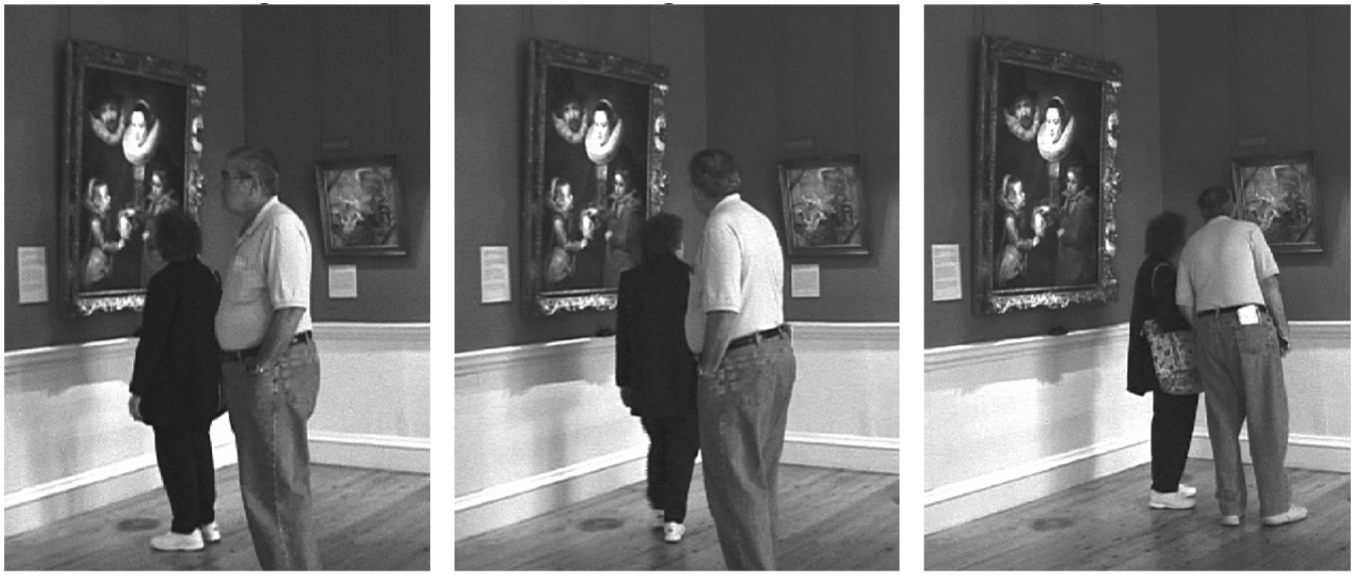
Surprisingly perhaps none of this research shows an interest in the ways in which visitors organise the navigation of exhibitions and the examination of exhibits in social interaction with others. However there is a growing body of studies that explores the social organisation of mobility in public places. These studies include research on car driving by Barry BrownEric Laurier, Pentti Haddington and Lorenza Mondada, guided tours by Mathias Broth, and my own research on mobility in museums. My studies investigate how people orient to the material and visible environment while practically organising their exploration of a gallery. For example, the studies I have conductd with my colleagues at the Work, Interaction & Technology Research Centre (King’s College London) explore how visitors to an art museum bring the looking at a Rembrandt painting to a close and jointly move on without disturbing companions or others who happen to be nearby. Or they examine how visitors arrive and come to stop at paintings and begin to look at them together while standing-side-by-side. Whilst the activities like the withdrawing from and moving to a next exhibit or the approach of a next exhibit may seem mundane and uninteresting they are critical for the way in which visitors orient to the layout of exhibits in a gallery.

0070401111001 (from vom Lehn 2006)

In particular with regard to the linear organisation of exhibits in museums it is worthwhile highlighting here that for visitors to be able to see the next exhibit and to already know what (kind of) exhibit that next exhibit is, helps them to organise their visit with others. They use the visibility of (the content of) the next exhibit, e.g. “another self-portrait”, to draw their companion’s attention to that exhibit and away from the exhibit they have been looking at previously. Thus, visitors are able to organise not only their own individual museum visit but also to influence the organisation of the museum visit of their companions. It is worthwhile stressing here that visitors are able to organise their visit in this way not only because the exhibits are organised in a linear way but because of the visibility of what (kind of) exhibit the next one is.

Furthermore, visitors can see whether that possible next exhibit is occupied by other visitors. They glance to the side and notice others looking at it. Thereby, they use the visual and bodily orientation of others at the next exhibit to gauge their state of involvement with this next piece. If visitors notice that the others are about to move on they prepare their departure from the current exhibit and orient to that next one.

In light of these observations it might be worthwhile reconsidering the critique of the linear organisation of exhibits:

– The linearity of the organisation of exhibits in the gallery coupled with a visibility of information about next exhibits can support visitors in aligning their organisation of the navigation of a gallery with that of other people.

– It is not only the visibility of next exhibits that people use to navigate museums but also they use the visibility of exhibits coupled with the visibility of other people’s actions at these exhibits to fashion their own action at the current exhibit.

– A practical viewpoint of research in museums highlights how the organisation of exhibits can help people with little or no preconception of the detailed layout of the exhibition to (practically) organise their museum visit.

for more on the research go here

Apple Maps – as conversation starter?

analysis, interaction, Social Media, Twitter

Lots has been written about Apple’s problems with their Maps application. Apparently, motorists stranded in a National Park in Australia after relying on the app had to be rescued and many people complain or joke about problems with the app.

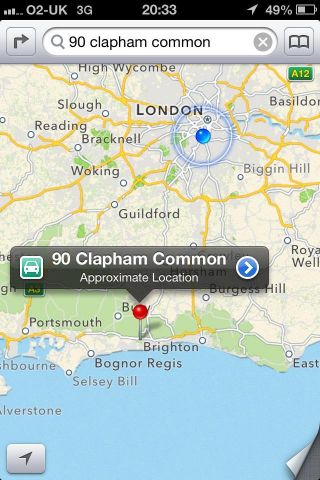
This morning, I received a Tweet via @CityJohn who used the app after arriving at Clapham South Tube station (South London). He opened the app and triggered the locate function only to be shown this map.

Image

In his tweet @CityJohn writes: Image

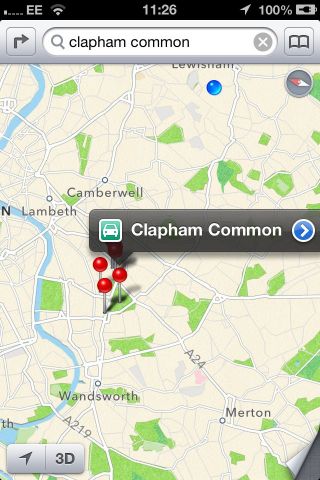
I don’t know what possessed me but I opened up my Apple Maps app and search for Clapham Common and was shown this map.

Image

As far as I can tell the map accurately locates Clapham Common and I decided to pass a picture of the map on to  @CityJohn. I have no idea about or interest in the technical workings of Apple Maps but found it interesting how Apple Maps, not only in this case, has become a conversation starter on Twitter. We all know by now that the app is anything but perfect and there is no need to post more examples of its shortfalls. But by posting curious examples one is almost certain to receive a response from others.

So, not surprisingly, when checking on @CityJohn’s Twitter Stream there now is at least one other short sequence of a ‘Twitter conversations’, just like the one I had with him. Maybe it’s worthwhile creating a collection of such instances. Maybe, this is not everybody’s cup o tea though….

Pricing and Amazon.com

analysis, innovation, Marketing, Technology

When I tweeted a review of Andreas Glaeser’s book yesterday that I had read on orgtheory.net a friend retweeted the post and added that “it’s only $8.55 on kindle”. Since I new the book was priced at £18.17 on amazon.co.uk I looked up the amazon.com site with my iPhone and noticed that it showed me a price of $29.10.

Image

When arriving home I checked the book on my laptop and found a difference in price when I looked into the amazon.com site from when I was not logged in.

When logged into Amazon.com the price was $29.10.

Image

When I log out of my account and search for the book again, the price goes down to $8.55.

Image

This observation points wither to personalized pricing or to big differences in geographical pricing of books and probably other items. In any case it reminds me of the advice that Eli Pariser gives in his book an on his website The Filter Bubble, clean your cookies.

Marketing & New Technologies (course outline (2011/12))

Technology

Topics and Readings


Week 1 (20 January 2012) – Introduction to the Course

In recent years, there has been a lot of discussion about the “internet revolution” or the “social media revolution”. These discussions principally argue that technological developments are shaping how we conduct our affairs, including how we organise our daily interactions as well as how we conduct marketing activities. This introductory lecture questions this premise that pervades also many marketing textbooks and sheds light on different perspectives on the relationship between marketing and technology.

The lecture also offers information on the practical issues involved in successfully participating in the module, such as the use of online resources, attendance and participation in lectures and tutorials and the modes of assessment operating in the course.

Readings

Bartels, R. (1986). Marketing: Management Technology or Social Process at the Twenty-First Century? In Marketing Management Technology as a Social Process. Edited by George Fisk. New York et al.: Praeger, pp.30-42.

Brassington, D. F., & Pettitt, D. S. (2007). Essentials of Marketing. Harlow/UK: Financial Times/ Prentice Hall.

Liebowirz, S.J. & Margolis, S.E. (1996). The standard typewriter keyboard is exhibit A in the hottest new case against markets. But the evidence has been cooked. http://reason.com/archives/1996/06/01/typing-errors

Marcuse, H., 1989. Some Social Implications of Technology. In A. Arate & E. Gebhardt, eds. The Essential Frankfurt School Reader. London & New York: Continuum International, pp. 138-162.

Gerardi, S., 2006. Some implications of modern technology: Revisited. The Social Science Journal, 43(2), p.293-295.

*Marx, L. (2010). Technology: The Emergence of a Hazardous ConceptTechnology & Culture51(3), 561-577.

*Matthewman, S. (2011). Technology and Social Theory. London: Sage. (Chapt. 1)

Rust, R. & Espinoza, F., 2006. How technology advances influence business research and marketing strategy. Journal of Business Research, 59(10-11), 1072-1078.

Week 2 (27 January 2012) – Marketing Technologies

Over the course of its history marketing has developed powerful technologies that nowadays are central to the knowledge disseminated in marketing textbooks like Kotler and colleagues Principles of Marketing. This lecture uses theories and concepts of technology to examine and critically discuss some of the foundations underlying the marketing concepts and related marketing technologies.

Readings

Bowker, G. & Star, S.L., 1999. Sorting Things Out. Classification and its Consequences, Cambridge, MA/London: MIT.

Joerges, B., 1994. Do Politics have Artefacts? Social Studies of Science, 23(1), p.1-20.

Martin, A. & Lynch, M., 2009. Counting Things and People: The Practices and Politics of Counting. Social Problems, 56(2), p.243-266.

*Matthewman, S. (2011). Technology and Social Theory. London: Sage.

*Suchman, L., 1993. Do Categories have Politics? Journal of Computer Supported Collaborative Work (JCSCW), 2, p.177-190.

Tadajewski, M., 2006. The ordering of marketing theory: the influence of McCarthyism and the Cold War. Marketing Theory, 6(2), p.163-199.

*Rust, R. & Espinoza, F., 2006. How technology advances influence business research and marketing strategy. Journal of Business Research, 59(10-11), 1072-1078.

*Winner, L., 1986. Do Artifacts have Politics ? In The whale and the reactor: a search for limits in an age of high technology. Chicago: University of Chicago Press, pp. 19-39.


Week 3 (3 February 2012) – Exchange, Markets and Networks

Exchange” is largely seen as a “core concept of marketing” (Kotler, Armstrong et al. 2008). Whilst textbooks describe it as a social relationship between two or more participants few studies examine how these relationships are organised to achieve cooperation. Instead, cooperation in exchange relationships is often ascribed to rational decision making; participants exchanging goods and services when they both “have something of value to offer the other” (Kotler, Armstrong et al. 2008: 12). In this view, the properties of money support the emergence of exchange and therefore are key to the development of modern, capitalist economies. Markets

Underlying this concept of money and exchange is the distinction between rational action and other types of social action. In recent years, this distinction has been criticised and the social uses of money have been elaborated on. This lecture examines the relationship between different types of social action, explores the discussion of the social uses of money and the different ways in which exchange may be organised.

Readings

Bartels, R. (1986). Marketing: Management Technology or Social Process at the Twenty-First Century? In Marketing Management Technology as a Social Process. Edited by George Fisk. New York et al.: Praeger, pp.30-42.

*Beckert, J. (2009). The social order of marketsTheory and Society. Vol.28(3), pp.245-269.

Fligstein, N., & Dauter, L. (2007). The Sociology of Markets.Annual Review of Sociology33(1), pp.105-128.

*Granovetter, M., 1973. The Strength of Weak Ties. American Journal of Sociology, 78(6), p.1360-1380.

Portes, A., 1998. Social Capital: Its Origins and Applications in Modern Sociology. Annual Review of Sociology, 24(1), p.1-24.

Spillman, L., 1999. Enriching Exchange : Cultural Dimensions of Markets. Journal of Economics, 58(4), p.1047-1071.

*Watts, D.J., 1999. Networks, Dynamics, and the Small-World Phenomenon. American Journal of Sociology, 105(2), p.493-527.

Zelizer, V.A., 2011. The Social Meaning of Money : “Special Monies”’. Culture, 95(2), pp.342-377.

Week 4 (10 February 2012) – Social Media (Guest Lecture – Rob Wilmot, BCS)

Rob Wilmot is one of the co-founders of the Internet Service Provider (ISP) Freeserve. Since 1998, the company facilitated mass access to the internet in the UK. After the company was sold for £1.6bn to Wannado in 2001 Rob has been investing in various ventures. He sits on a number of corporate and public sector boards. He also is Chairman at Doncaster College.

One of his current interests are developments in social media and social networking. In his lecture Rob will talk about these developments and their relationship to marketing.

Readings

Baym, N., 2010. Personal Connections in the Digital Age, Cambridge, UK: Polity Press

*Benkler, Y., 2007. The Wealth of Networks, Yale University Press. – Chapter 1, p.1-34

Bernoff, J. & Li, C., 2008. Groundswell: Winning in a World Transformed by Social Technologies, Cambridge, MA: Harvard Business School Press.

Brogan, C. & Smith, J., 2010. Trust Agents: Using the Web to Build Influence, Improve Reputation, and Earn Trust. Chichester: John Wiley & Sons.

*Cova, B. & Dalli, D., 2009. Working consumers: the next step in marketing theory? Marketing Theory, 9(3), p.315-339.

Hamilton, K. & Hewer, P., 2010. Tribal mattering spaces: Social-networking sites, celebrity affiliations, and tribal innovations.Journal of Marketing Management, 26(3), p.271-289.

Katona, Z., Zubcsek, P.P.A.L. & Sarvary, M., 2011. Network Effects and Personal Influences : The Diffusion of an Online Social Network. Journal of Marketing Research, XLVIII(June), p.425-443.

Kirkpatrick, D., 2010. The Facebook Effect: The Inside Story of the Company that is Connecting the World, Virgin Books.


Reading Week 5 (17 February 2012)


Week 5 (24 February 2012) – Reputation Management

Social networking sites are often used to communicate about brands, products and service. They therefore have become sites where brand image and brand vale are created or co-created with people contributing to the communication. This communication can involve talk about people’s experience with products and services and often also includes communication in which people vent their dissatisfaction with companies. And in some cases, employees submit information to social networking sites that potentially influence the company’s brand image or reputation. This lecture discusses some aspect of reputation management and social networking.

Readings

Bernoff, J., Li, C., 2008. Harnessing The Power of The Oh-So-Social Web, MIT Sloan Management Review, 2008; 49; 3; pp.35-42

Brogan, C. & Smith, J., 2010. Trust Agents: Using the Web to Build Influence, Improve Reputation, and Earn Trust. Chichester: John Wiley & Sons.

Burt, R., S., 1999. “The Social Capital of Opinion Leaders”, The ANNALS of The American Academy of Political and Social Science, 1999; 566; pp.37-54

Hutton, J., G., Goodman, M., B., Alexander, J., B., Genest, C., M., 2001. “Reputation Management: The New Face of Corporate Public Relations?” Public Relations Review, 2001; 27; pp.247-261

*Ferguson, R., 2008. Word of mouth and viral marketing: taking the temperature of the hottest trends in marketing. Journal of Consumer Marketing, 25(3), p.179 – 182.

Holloman, C., 2012. The Social Media MBA: Your Competitive Edge in Social Media Strategy Development and Delivery, Chichester: John Wiley & Sons.

Katona, Z., Zubcsek, P.P.A.L. & Sarvary, M., 2011. Network Effects and Personal Influences : The Diffusion of an Online Social Network. Journal of Marketing Research, XLVIII(June), p.425 -443.

Miller, D., 2011. Tales from Facebook, Cambridge: Polity Press.

*Rao, H., 1994. “The Social Construction of Reputation: Certification Contests, Legitimation, and The Survival of Organisations in The American Automobile Industry: 1895-1912”, Strategic Management Journal, 1994; 15; pp.29-44

Wartick, S., L., 1992. “The Relationship Between Intense Media Exposure and Change in Corporate Reputation”, Business Society, 1992; 31; pp.33-49

Yu, B., Singh, M., P., 2000. “A Social Mechanism of Reputation Management in Electronic Communities”, Proceedings of the 4th International Workshop on Cooperative Information Agents, 2000, pp.154-165


Week 6 (2 March 2012) – Innovation in Consumer Research (Siamack Salari)

Siamack Salari is founder of Everyday Lives a market and consumer research company that is well known for its innovative use of technology to conduct its studies. The projects of Everyday Lives include video-based research of shopping behaviour as well as detailed ethnographies of how people use products in their day-to-day lives.

Readings

*Belk, R. W. (1995). Studies in the New Consumer Behavior. In D. Miller (ed.) Acknowledging Consumption. London: Routledge, 58-95.

*Belk, R. W., & Kozinets, R. V. (2005). Videography in marketing and consumer research. Qualitative Market Research: An International Journal8(2), 128-141.


Week 7 (9 March 2012) – Search Marketing

Over the past decade or so two important developments have emerged in the context of Internet Marketing: Search Marketingand Social Media Marketing. The growing economic weight of companies like Google suggest that Search will be one of the important marketing activities over the coming years. It is being used to obtain an understanding of the market as well as for the building of relationships and networks (Marsden and Kirby 2005; Moran and Hunt 2008). The lecture will discuss some of the practices involved in Search Marketing and assess possible problems these practices might raise for the relationship between companies and their customers. It then will turn to Social Media Marketing and explore how social networks like Facebook, Myspace or Jumo are used for marketing purposes, including the design, promotion and distribution of products and services (Penenberg 2009; Scott 2008). The discussion will touch on current debates concerned with viral marketing and online gaming as well as trust and reputation.

Readings

Marsden, P., & Kirby, J. (2005). Connected Marketing: The Viral, Buzz and Word of Mouth Revolution. A Butterworth-Heinemann Title.

Moran, M., & Hunt, B. (2008). Search Engine Marketing, Inc.: Driving Search Traffic to Your Company’s Web Site. IBM Press.

Pariser, E., 2011. The Filter Bubble: What The Internet Is Hiding From You, Viking.

Penenberg, A. (2009). Viral Loop: The Power of Pass-it-on. Sceptre.

*Phelps, J. E., Lewis, R., Mobilio, L., Perry, D., & Raman, N. (2004). Viral Marketing or Electronic Word-of-Mouth Advertising: Examining Consumer Responses and Motivations to Pass Along Email. Journal of Advertising Research44(04), 333-348.

Scott, D. M. (2011). The New Rules of Marketing and PR: How to Use News Releases, Blogs, Podcasting, Viral Marketing and Online Media to Reach Buyers Directly. (3rd Edition). Hoboken: John Wiley & Sons.

*Sweeney, J. C., Soutar, G. N., & Mazzarol, T. (2008). Factors influencing word of mouth effectiveness: receiver perspectives.European Journal of Marketing42(3/4), 344-364.

Vaidhynathan, S., 2011. The Googlization of Everything: (And Why We Should Worry), Berkely, CA: University of California Press.


Week 8 (16 March 2012) – Service-Marketing and Service Technology

Service-Marketing has emerged as an alternative to the managerial approach to marketing that dominated developments in the discipline for the past four or five decades. This chapter briefly introduces the key concepts of service- and relationship marketing and then turns to the recent deployment of service technology into service- and retail-settings. It will briefly discuss the research on these developments and then examine some aspects of the relationship between service technology and customers by examining video-recordings collected in museums and galleries.

Readings

Armstrong, G., Kotler, P., Harker, M., & Brennan, R. (2009).Marketing an Introduction. Financial Times/ Prentice Hall.

Bitner, M. J. (2001). Service and technology: opportunities and paradoxes. Managing Service Quality11(6), 375 – 379.

Bitner, M., Brown, S., & Meuter, M. (2000). Technology infusion in service encounters. Journal of the Academy of Marketing Science28(1), 138-149.

Curran, J. M., & Meuter, M. L. (2005). Self-service technology adoption: comparing three technologies. Journal of Services Marketing19(2), 103-113.

*Heath, C. & Lehn, D. vom, 2008. Configuring “Interactivity”: Enhancing Engagement in Science Centres and Museums. Social Studies of Science, 38(1), p.63-91.

Holloway, B. B., & Beatty, S. E. (2003). Service Failure in Online Retailing: A Recovery Opportunity. Journal of Service Research,6(1), 92-105.

Parasuraman, A., & Grewal, D. (2000). The impact of technology on the quality-value-loyalty chain: A research agenda. Journal of the Academy of Marketing Science28(1), 168-174.

Week 9 (23 March 2012) Working in Social Media (Guest Lectures: Jadis Tillery)

Jadis Tillery is Head of Social Media for dot.talent a digital publisher for celebrity talent and top tier brands. In this role Jadis develops strategic WOM campaigns to harness the power of the social web through content creation and authentically engaging online communities.

Readings

Baym, N., 2010. Personal Connections in the Digital Age, Cambridge, UK: Polity Press

Benkler, Y., 2007. The Wealth of Networks, Yale University Press.

Bernoff, J. & Li, C., 2008. Groundswell: Winning in a World Transformed by Social Technologies, Cambridge, MA: Harvard Business School Press.

*Hamilton, K. & Hewer, P., 2010. Tribal mattering spaces: Social-networking sites, celebrity affiliations, and tribal innovations.Journal of Marketing Management, 26(3), p.271-289.

Katona, Z., Zubcsek, P.P.A.L. & Sarvary, M., 2011. Network Effects and Personal Influences : The Diffusion of an Online Social Network. Journal of Marketing Research, XLVIII(June), p.425 -443.

Kirkpatrick, D., 2010. The Facebook Effect: The Inside Story of the Company that is Connecting the World, Virgin Books.

Shih, C., 2010. The Facebook Era: Tapping Online Social Networks to Market, Sell, and Innovate, Prentice Hall.


Week 10 (30 March 2012) – Marketing, Technology and Society

The growing deployment of new technologies in all parts of society is often likened to the emergence of a new form of society and coupled with that a new form of economy, namely the network economy. This lecture reflects on the content of the course and debates in sociology and related disciplines to explore how marketing theory and methods may be developed to capture current changes in marketing practice.

References

Achrol, R. S. and Kotler, P. (2010). Marketing in the Network EconomyNetwork63(1999), 146-163.

Anderson, C. (2009). The Long TailBusiness. London: Random House.

Baym, N., 2010. Personal Connections in the Digital Age, Cambridge, UK: Polity Press.

Bennett, S., Maton, K. & Kervin, L., 2008. The “digital natives” debate: A critical review of the evidence. British Journal of Educational Technology, 39(5), p.775-786.

Brogan, C. & Smith, J., 2010. Trust Agents: Using the Web to Build Influence, Improve Reputation, and Earn Trust, John Wiley & Sons.

Benkler, Y., 2007. The Wealth of Networks, New Haven & London: Yale University Press.

Castells, M. (1996). The Rise of the Network Society. Vol. I: The Information Age. Economy, Society and Culture. Malden, MA: Blackwell.

Castells, M. (2002). The Internet Galaxy. Reflections on the Internet, Business, and Society. Oxford: Oxford University Press.

Chaffey, D., Ellis-Chadwick, F., Mayer, R., & Johnston, M. K. (2008). Internet Marketing: Strategy, Implementation and Practice (4th ed.). Harlow/UK: Financial Times/Prentice Hall.

Cova, B., & Dalli, D. (2009). Working consumers: the next step in marketing theory?. Marketing Theory9(3), 315-339.

Ito, M. et al., 2009. Out, Hanging. Around, Messing Out. Geeking Out. Kids Living and Learning with New Media,

Palfrey, J., 2010. Born Digital. New York: Basic Books.

Qualman, E., 2010. Socialnomics: How Social Media Transforms the Way We Live and Do Business, Chichester: John Wiley & Sons.

Rust, R. & Espinoza, F., 2006. How technology advances influence business research and marketing strategy. Journal of Business Research, 59(10-11), 1072-1078.

Shirky, C., 2009. Here Comes Everybody: The Power of Organizing Without Organizations, London: Penguin.

Tapscott, D., 2008. Grown Up Digital: How the Net Generation is Changing Your World. McGraw-Hill Professional.

Tapscott, D., & Williams, A. (2008). Wikinomics: How Mass Collaboration Changes Everything. London: Atlantic Books.

The Challenge of Technology Shabbat

Uncategorized

About a year ago, I came across a documentary about the Barbie Doll, entitled The Tribe. The film links the history of Barbie to the question of what it means to be Jewish today. I was intrigued not only by the content of the film but also by its composition, a mixture of old and new, short cuts and longer sequences, and a narration by the memorable voice of Peter Coyote. The fil sparked my curiosity to look for information on who was behind the film and if the producer had embarked on other, related projects.

It didn’t take me long to find the website to the film and to that of its producer and director Tiffany Shlain. Apart from having directed and produced this fabulous documentary Tiffany also is the founder of the Webby Awards and the co-founder of the International Academy of Digital Arts and Sciences. Most recently she has produced the highly praised and award winning “autoblogography” Connected.

The various communications about Connected distributed on Twitter and elsewhere enticed my curiosity about Tiffany’s larger project further. Whilst still not having seen Connected – when do you come to London, Tiffany? 😉 – the documentary (seems to) advance(s) her interest in the opportunities and challenges we face in a social world pervaded by technology designed to connect us all with each other. This technology and the social media that we increasingly use everywhere on our mobile devices allows us to connect with people across the globe. As an illustration of this interdependence between people Tiffany and her team set their Twitter followers and Facebook fans the task to translate the text of “A Declaration of Interdependence” and read out in front of a running camera. The result is short film produced in collaboration between complete strangers.

Maybe mesmerized by the possibility to connect with so many people around the world we find it increasingly difficult to put the phone to the side and connect with those nearest to us. We take out our phones in the middle of conversations or disappear to the toilet during dinner to check up on Facebook notifications and Twitter updates. Technology interrupts our daily interaction. “Who have I become?”, asks Tiffany, and comes up with the idea of a Technology Shabbat. She switches her phone off on Friday evenings, for 24hours, and encourages her friends, fans, and followers to do it like her. Apart from notifying us all about her unplugging on Friday nights together with her husband Ken Goldberg she has produced another short film, “Yelp! With Apologies to Alan Ginsberg’s ‘Howl'”.

With the film Tiffany encourages her audience to unplug as well from time to time. Do it like her, switch off your networked devices and gain the time and focus to engage with your friends and family, at least one day a week, without being interrupted by blinking and beeping devices notifying you about the arrival of new messages and updates.

Having resisted her request for a few months last weekend I decided to give it a go and unplug. Gosh! No idea had I how difficult that would be. Apart from the habit to reach for my phone whenever I sit down and check on nes, the unplugging brings with it some practical issues. A complete phone blackout was out of the question as my weekends are organised in ways that involve phone use at various occasions to coordinate meet-ups with the rest of the family. So, the only thing I did manage was to unplug from social media. Effectively I switched off my Facebook, Twitter etc. connection from Friday evening to Sunday morning. This worked out okay and gave me time to do other things without staring at the phone in the middle of a game or while reading a book. Also, rather than spending some time on Twitter on Sunday morning, I read a newspaper and then finished a book, The Digital Scholar. Overall, the Technology Shabbat has been an interesting experience for me and I will do it again, hopefully to greater effect, at the end of this week.

While refraining from accessing social media I also remembered a paper presented at the 2007 CHI Conference in San Jose, CA, namely Allison Woodruff and colleague’s “Sabbath Day Home Automation: ‘It’s Like Mixing Technology and Religion“, that seems pertinent to the issue. Woodruff discusses her observation in orthodox Jewish homes who because for religious reasons they are not allowed to operate technology, rely on on automated systems to help them out. She sees these automated systems as examples for technologies that are neatly embedded within the lives of people without interrupting or disrupting their social arrangements. Maybe over time we will find ways to embed our mobile phones and our social networks equally neatly into our lives.

Putting my half-failed attempt of a technology shabbat to one side, I am looking forward to seeing Tiffany’s project which a bit clumsily might be summed up as an exploration of the technology induced tension between interdependence and identity, develop.

Connected is in the cinemas in the USA and elsewhere since this autumn.

There are various attempts by science museums to bring to life some of the hidden ways in which the Internet works. When I visited the Science Museum in Chicago about 10 years ago there was an exhibit where I took a photograph of myself that then was transmitted to the other end of the gallery and displayed on a screen; the transmission of the picture was visualised on a wall where small packages moved along to where the screen was.

A few months ago in late March the National Media Museum’s Internet Galleries in Bradford opened together with Life Online that pursue a similar goal; making the development and functioning of the Internet intelligible.

Now in late July 2012, the Science Museum in London together with Google launched Chrome Weblab, “a series of interactive Chrome Experiments made by Google that bring the extraordinary workings of the internet to life”. The exhibition is in the basement of the Wellcome Wing. When I visited the gallery had just opened to the public and was already heaving with people.

Weblab is comprised of five ‘experiments’ people can engage with by using a Lab Tag and the various interfaces and systems displayed in the space. On entering the gallery each visitor can draw a Lab Tag from a computer system that is used as an identifier through which visitors’ engagement with the individual experiments is recorded and made retrievable from home. From here on the route took me into the gallery and a first large screen, the Data Tracer.

On entering the gallery I heard musical sounds which apparently came from the centre of the space but I had no idea who or what produced them and why. On closer look I saw a number of machines that looked like musical instruments that made sounds without anybody in particular playing them. I was intrigued but before I got to move to one of those instruments a person at the exhibit in front of me left the computer system and I engaged with the Data Tracer.


Data Tracer is comprised of three or four small screens connected to a large display showing a map of the world. On arrival I waited for a few minutes until a small screen become available and then fed my Lab Tag into an interface. I then was confronted with a number of thumbnail images showing objects and photographs of faces; on selecting one of the thumbnails a large copy of the image appeared on the large screen opposite locating the physical place where the image is stored and then drawing lines from there back to the Science Museum; thus, the exhibit visualizes the transformation of the image into data packages and their ‘journey’ to the Science Museum. Like the old exhibit at the Chicago Science Museum this Weblab experiment makes visible the process of using Google search engine. 

Having experimented with the exhibit for a while by tapping on two or three of the thumbnails I noticed other visitors waiting behind me and moved on to the next experiment, the Sketchbotswhere robots draw faces captured by a webcam of physical visitors in the gallery and online visitors in sand.

Only few people stopped for longer than a minute or so at the robots and often moved on when noticing that at the next lot of robots they can have their own faces or those of their children drawn.

http://www.youtube.com/watch?v=CkzXSZnDs1E&feature=player_embedded

The process fascinates people. Having taken a picture they observe the robot at work and their image appearing. They take pictures on their cameras or film the process with their mobile phones, commenting on the delicate strokes the machine makes in the sand. People also exploit the possibility to take pictures of others as a means to engage their (small) children with the exhibit who otherwise may not stay with the experiment for long. They lift children up in front of the camera, take the picture of their face and then show them that the robot is drawing that picture of their face in the sand; the activity keeps the children engaged with the exhibit for considerable time.

From the robots my visitor journey took me to the Teleporter, an exhibit that uses periscopes connected to the web to look at location around the world pre-determined by the designers. For somebody on their own the use of the periscope can feel a bit strange, as you pull the system in front of your eyes and loose awareness of what is happening around you.

Looking through the periscope I saw the inside of an aquarium located in Cape Town and could turn around to get a 360 degrees view of the space. On occasions I pressed a button at the top of the periscope to take a photograph that with the help of the Lab Tag was saved on my account. As I discovered when leaving the periscope on the wall behind the exhibit my picture was displayed on small digital photo frames together with those taken by others. The picture bears a time-stamp and can be discussed with others who had no access to what I was looking at while using the system.

One of the potentially most exciting exhibits is the Universal Orchestra, a robotic orchestra made up of eight instruments simultaneously operated by people in the gallery and on the Internet. The instruments are located in the centre of the gallery, each equipped with a computer system that people can use to create sounds. You touch different notes on the screen, the information is fed to the robot that then creates the sound.

Arriving here helped explain the soundscape I had been hearing on entering the gallery. As with some of the other exhibits I was a secondary user of the exhibit, experiencing how to use the systems and what they do before I gained access to one of the instruments. The interaction with the system kept me busy for a while, as I tried to figure out how my actions on the computer screen relate to the sounds made by instruments. Also, the exhibit is described as a “real-time collaboration with people across the world” but because it is difficult to make out who creates what sound the use of the notion of “collaboration” to describe the events is problematic.

http://www.youtube.com/watch?v=jCXX02dFbIM&feature=player_embedded

Finally, I went to a workstation where the Lab Tag is used to retrieve information about the activities a visitor has engaged with during their visit to the Weblab. The Lab Tag is slotted into the system and the computer screen shows what exhibits the visitor has been at and what they have accomplished there; for example, the photograph taken with the periscope or the sounds produced as part of the Universal Orchestra can be revisited. Seeing on the screen what I had done and what I had missed doing encouraged me to return to the gallery and conduct some further experiments with the Universal Orchestra before then leaving the exhibition.

Having arrived back home I booted my computer to visit the Online Chrome Weblab. I typed in the web address given on the back of the Lab Tag, scanned in the tag and immediately arrived at my Lab Report. The site shows my activities in the galleries on at the Science Museum, and allowed me to conduct the same experiments online. When opening for example, Online Sketchrobot, a site opens that shows live footage from the gallery before opening a screen that looks very similar to the one in the gallery. I took a picture of myself which then was processed ready for the robot to draw in the sand.

I then typed in my email address through which the system later notified me that the robot had completed its job.

The other exhibits work in a similar way. The Online Data Tracer invites visitors to ask the system to use for a physical location of an image file. I typed n my Twitter handle and the system located the associated picture in Isenburg, a small city in the German federal state of Hesse. TheOnline Teleporter allows the user to click on an image and obtain a live view into the bakery in North Carolina, the miniature exhibition in Hamburg and the aquarium in Cape Town. And the Online Universal Orchestra facilitates access to the eight instruments; one can view events in the gallery and play the instruments in the gallery from a remote location, audible to visitors in the museum and remotely. The played music can be recorded and then like the activities at the other exhibits, is retrievable from the Online Lab Tag Explorer.

Chrome Weblab is a fascinating experiment of an exhibition. It tries to make intelligible that the Internet connects remote locations on the planet. And this connectedness involves much more than the accessibility of information through search engines and web browsers but also allows for the possibility to act and interact with machines and people across the world in real-time.

The exhibition invites visitors to engage and participate with exhibits in the gallery and remotely and discover for themselves the relationship between the Internet and the social world in the gallery and remotely. It is successful in engaging people for considerable time with the topic of the Internet and creates an awareness for the connected world we are now living in; robots can be operated remotely, people in remote locations can “collaboratetively” make music, we can have a peek into the world of others from remote locations.

Over the past 10 years or so I had the opportunity to study visitors participating with technology in museums, including the Science Museum and the Wellcome Wing. Therefore, for me visiting Chrome Weblab was interesting also to see how features of  exhibits in Who am I? and Digitopolishave been further developed by the design team of Chrome Weblab. For example, the replacement of the flaky fingerprinting mechanism to save visitors’ activities with exhibit on a server by the physical Lab Tag is a huge improvement.  The tag works well and without problems with webcams at home (and at work) and also is a nice memorabilia from the visit. However I could imagine that in the future the Lab Tag is transferred to a mobile phone as people tend to loose or forget about items they take away from visits to museums. Also, the taking of photographs of people’s faces that has been a critical feature of exhibits in Who am I? has been improved. The interface is much more flexible and adaptable to use pictures visitors take.

There are three aspects of the exhibition that I believe might be worthwhile exploring further for the design team and google when revising the galleries. First, I think the key message of Weblab, i.e. the interconnectedness, is not coming through clearly enough. The relationship between people’s action in the gallery and remotely need to be made more intelligible and obvious. For example, at the moment it is unclear who plays what note at the instruments of the Universal Orchestra; at Data Tracer the actions on the small screens could be made visible, and at Sketchrobot more needs to be done to make the activities by the remote participant visible to give this part of the exhibit more prominence in the gallery.

Second, as the gallery is described as a laboratory the design team and their research staff might use it not only as a laboratory to experiment with technology but also as a space where they can experiment with human behaviour in technology-rich spaces. For example, it has been a common problem for museums that display a large number of computer-based exhibits that the number of interfaces is often much lower than the number of visitors who wish to participate with the exhibits at any one time. This leads to long waiting-times and queues at exhibits, people being secondary users rather than experiencing exhibits first hand, and unfortunately also people leaving disappointed because they did not get a chance to use an exhibit first-hand. Being setup as an experimental space the gallery would allow the design team to experiment with different ways to manage the flow in the galleries and to mange access to exhibits.

And third and maybe most importantly, considering that many visitors come with friends and family the design team could use the space to experiment with the provision of resources that facilitate and encourage collaboration at computer-based exhibits. The observations at the Sketchrobots where parents provide their children with access to the exhibit illustrate that visitors are interested in experiencing the exhibits together, yet the interfaces often prioritise individual users over collaboration. It would be fascinating to see experiments with novel interfaces that encourage visitors to collaborate with others in the gallery, and also with people in remote locations.

References

Heath, C., & vom Lehn, D. (2008). Configuring Interactivity: Enhancing Engagement in Science Centres and Museums. Social Studies of Science38(1), 63-91.

Heath, C., & vom Lehn, D. (2004). Configuring Reception: (Dis-)Regarding the “Spectator” in Museums and Galleries. Theory, Culture & Society21(6), 43-65.

Heath, C., Luff, P., vom Lehn, D., Hindmarsh, J., & Cleverly, J. (2002). Crafting participation: designing ecologies, configuring experience. Visual Communication1(1), 9-33.

Hindmarsh, J., Heath, C., vom Lehn, D., & Cleverly, J. (2005). Creating Assemblies in Public Environments: Social interaction, interactive exhibits and CSCWJournal of Computer Supported Collaborative Work (JCSCW)14(1), 1-41.

vom Lehn, D., Hindmarsh, J., Luff, P., & Heath, C. (2007). Engaging constable: revealing art with new technology. Proceedings of the SIGCHI conference on HumanComputer Interaction (pp. 1485-1494). San Jose,CA: ACM Press.

vom Lehn, D. (2010). Generating experience from ordinary activity: new technology and the museum experience. In D. O’Reilly & F. Kerrigan (Eds.), Marketing the Arts. A fresh approach (pp. 104-120). Abingdon: Routledge.

vom Lehn, D., & Heath, C. (2005). Accounting for new technology in museum exhibitions.International Journal of Arts Management7(6), 11-21.

vom Lehn, D., Heath, C., & Hindmarsh, J. (2001). Exhibiting interaction: Conduct and collaboration in museums and galleries. Symbolic Interaction24(2), 189–216.

@dirkvl

http://www.vom-lehn.net


interaction, interactivity, museums

Google and Academic Research

notes on books


The other day I was reading an academic paper  on an iPad; the paper had a number of references to Jack Kerouac’s ‘On the Road’. Halfway through the paper my desktop signalled the arrival of an email. On opening the email I had to look twice – the publisher Penguin had sent me a message saying that Jack Kerouac’s ‘On the Road’ was available as ebook now. Coincidence? Most probably. But the crawling and searching of our computer screens for activities makes such events increasingly possible and likely to occur.

Image

One company that engages in such actinides to monitor people’s online activities is Google. Recent publications have critically discussed these activities and pointed to the pitfalls for users and customers. Eli Pariser (2011) explicates how Google, Facebook and other companies use the tracking of online behaviour to reduce the amount of information made available to us presenting us with personalised information. Finds on Google Search are tailored to our search behaviour and our interaction on Facebook tailors the News Feed to show information posted by those we interact with, whilst other of our ‘friends’ don’t appear in the news feed anymore. The result is what Pariser calls ‘Filter Bubble’ that makes us to read, watch and listen to more of the same.

Image

Pariser’s book has had considerable coverage in the media’s review sections and on blogs. Whilst its principal argument is appreciated it is has been criticised for not taking into account the complexity of recommendation engines and the practices of people’s search behaviour. If an initial search result is dissatisfying we continue our search without taking for granted Google as an authority that shall not be withstood. We might even try Yahoo or Bing to see what finds they produce. Yet, on the first glance the way in which Google presents its finds suggest that there is an authority at work that provides us with comprehensive, objective and unbiased search results.

For academics therefore Google Scholar often seems to the first and best point of address to search for academic articles. Thus, Google Scholar has made access to scholarly research easy and convenient. You type in keywords into the search engine and it returns a list of finds ordered by relevance. The results link to academic journals that with the appropriate access can be downloaded immediately. Again, the impression given is that the finds are comprehensive and unbiased. No indication is made that over (more) relevant research might be out there than what is presented on the screen.

Siva Vaidhyanathan’s ‘The Googlization of Everything’ powerfully dismantles the view of Google search as providing unbiased results. Without discounting the benefits Google offers us all Vidhyanathan explicates the logics that drive Google Search and the implications they have on how we see the world. Like Pariser he explains how Google Search tailors its finds to our online activities. In producing search results Google not only looks at our past searches but also takes into account what we are currently doing in any of the Google Apps including Google Docs or Gmail. Moreover Google Search and Google Scholar only can find information from sources that makes it available to them.

In terms of Google Scholar this means that the search engine only finds articles from publisher who have a contract with Google to make information from their publications available. For example when I recently looked for literature on German sociology via Google.de I was struck by the fact that I was provided with information from amazon.de and self-publishing sites that hold student coursework but not from the major German publishers disseminating the key German texts in the subject.

All this considered it would seem that whilst Google Scholar and Search might be a good first site to start research it then is advisable to move to more reliable sources like ISI’s web of knowledge and other scientific Citation Indexes. Otherwise it would seems scientific/social scientific research also will be caught in the filter bubble; referring and cross-referring to publications only that Google provides it with.

Some References
Eli Pariser 2011. The Filter Bubble. Viking.
http://www.thefilterbubble.com/

Siva Vaidhyanathan. 2011. The Googlization of Everything. University of California Press
http://www.googlizationofeverything.com/

Neal Lathia 2011. Blogpost. Blowing Filter bubbles
http://urbanmining.wordpress.com/2011/06/20/blowing-filter-bubbles/#entry

#learnpod12

Uncategorized

On my way back from #learnpod12, an Unconference held at Doncaster College. Unusual for an unconference more than 100 people working in education-related areas came together to discuss in up-to six parallel sessions issues related to innovating teaching and learning. They shared experiences in using social media for educational purposes and exchanged information about new and old tools and ways to use them in educational settings as well as in unusual places like a village green. The discussions were lively, brought together new and old colleagues and will probably continue now while I am on the train and many of the other participants explore Doncaster. At the moment I am not certain whether @johnpopham is offering a post-event pub crawl or whether he was successful with his plea for cake. Let’s check Twitter #learnpod12 to find out…

Meeting the ‘"Anti-Christ of Silicon Valley" – Discussion with Andrew Keen

Uncategorized

Last night, May 24th, I was one of 20 lucky participants at a discussion organised by The Kernel Magazine at London’s Adam Street Private Members Club. The event was invitation-only and limited to subscribers of the Nutshell, The Kernel’s weekly newsletter. A friendly bunch of Venture Capitalists, entrepreneurs, bloggers, journalists, a social worker and a sociologist gathered around the table waiting for Andrew Keen, the self-styled “Anti-Christ of Silicon Valley” who had just published his latest book “Digital Vertigo”. Andrew (@ajkeen) of course is the author of “The Cult of the Amateur”, a book published in 2007 that puts a lid on the overexcitement for peer production, user-generated content and the associated Web2.0 hype.  

While waiting for Andrew’s arrival it transpired that with Damian Thompson, the Editor of Telegraph Blogs, another author was amongst us who had just published his new book “The Fix: How Addiction is Invading our Lives and Taking Over Your World.” In the book Damian argues that currently more and more products are created and marketed that have seductive, even addictive, qualities; like the alcoholic reaching for the needle, people taking painkillers and munching cupcakes, we increasingly feel compelled to look at our smart phone or play video-games. 

In the discussion of his book Damian illustrated his arguments by referring to his interviews with drug addicts, video gamers and psychologists. These examples provided a good starting-point for Andrew Keen who in the meantime had arrived, not in a ball of fire but with a friendly smile to discuss his “Digital Vertigo”. As it turns out some of the arguments Andrew makes in his book are closely related to the case Damian makes in his book, as Andrew writes in a review published in The Kernel Magazine yesterday: “whatever it means to be human means not be addicted to foreign substances, devices or networks” (A. Keen 2012). 

In the course of the dissemination of social technologies people give up their privacy and post their ongoing engagements on Facebook, Twitter and other networks. Thereby, maybe without their knowledge, they render formerly private activities like watching television or reading, public. They not only post messages of their activities but the technology itself makes visible what they are doing and people seem to enjoy exhibiting their (private) activities; social television and social reading are just some of the most recent trends in the exhibition of private activities.

Andrew in reference to Damian Thompson’s “The Fix” pointed out how these social technologies bear characteristics that make an engagement with them “addictive”. People are lured into social networking sites with the promise of connecting with others, and once they have arrived there find it hard to disconnect and to not check their Facebook sites and Twitter feeds. In my view this constant checking of our displays cannot be explained by an “addiction” alone but is due also to the fact that we become accountable when we fail to respond to a status update or tweet directed at us. We may receive an email, a text message or even a telephone call to remind us on our obligation to attend to our “friends” actions. Ignoring an update is not an option. What Thompson describes as “addiction” at least bears an additional quality that is that by signing up to a social network we acknowledge a tacit agreement of being constantly available to attend to our “friends’” and “followers’” actions.

With this point Andrew links to recent movements that have emerged on the web, such as #technologyshabbat on Twitter and theundolist.com. These Twitter and web-campaigns call on people to unplug at least once a week and make time to connect with friends and family without the constant interruption by the glance to the phone. 

The discussion on the evening however went beyond arguments about addiction and the internet as a technology that may disturb social relationships and moved to political questions like the role of the state as legislator, the need for more suitable “education” and debates about the need for privacy to secure space and time for human existence. I may overstate the level of debate here, we did have a glass of wine as well, but Andrew’s book starts with the philosopher Jeremy Bentham who up to the present day is displayed for public inspection in a glass-case at University College London. 


Bentham

Bentham is relevant to the debate about the impact of social technology for various reasons, including his invention of the panopticon that nowadays is often cited as the intellectual base for the emerging surveillance society or “transparency society” (David Brin). As people spend increasing time online and use social technologies to share their experiences with others, companies gather data about online activities because in the ‘Like-economy’ these activities are a commodity. In effect, the argument goes, Facebook and cognate companies exploit people’s narcissism by encouraging them to exhibit themselves, their whereabouts and ongoing activities.

Andrew called for legislation and regulation that protects people’s privacy, that enables people to conduct activities privately and determine what data they reveal of themselves and what companies can do with personal data. Some of the particip
ants in the discussion, maybe not surprisingly considering their background, countered Andrew’s argument and pointed to technologies that provide new opportunities for people to connect with each other and information without revealing data about themselves; examples for these developments are private search engines or browsers that hide people’s identities.

This point led to another strand of debate concerned with the Filter Bubble effect and opportunities for serendipity. Again, some of the participants in the discussion suggested that search engines, tracking technologies and recommender systems have become better at creating interesting results for their users. Yet, there was agreement in the room that clearer information needs to be provided about ways in which technologies extracts information from people’s private and public activities, on- and offline, to turn it into data and utility for companies. Whilst the term “education” came up, it seemed to be too vague to suffice to address the lack in skill and competence in using smart and social technologies.

Unfortunately, the evening then had to end despite us all getting increasingly excited about the event itself. Milo promised that The Kernel Magazine is planning to make these debates a regular, hopefully twice monthly event. We are all looking forward to them!