“The Illusionists” Elena Rossini’s film: The Emergence of a Global, Standardised Body Image

aesthetics

A couple years ago, I came across Elena Rossini’s Kickstarter campaign for a film titled “The Illusionists”. The film received sufficient backing and has been created over the past two or three years. Last week, Elena Rossini made the film available to backers and soon it will distributed more widely.

kickstarter

The film is comprised of historic juxtaposition images and film-clips that demonstrate not only the sexualisation of the female body in advertising and film but also the emergence of a standardised, global body image. This is most clearly and dramatically shown in the examination of the Japanese pop-group AKB 48.

Rossini uses AKB 48 as prototype for what we can expect if the recent development of the global media, celebrity and advertising continues in the same strides it has over the past few decades. Some bodies will disappear as Susie Orbach, who is interviewed in the film, says, and the Western image of the body that pervades media representation all over the world, will displace other representations of the body. And as the film powerfully shows by referring to the beauty products and their sales figures media representations increasingly have in impact on people’s actual body image and the work they conduct in order to shape their body to simulate the body of the media.

The content of the film also links nicely to current academic discussions about beauty and aesthetic judgement. Whilst in the past aesthetics was often considered as a category dealt with mainly in the arts more recently there has been considerable discussion about “practical aesthetics“, musical aesthetics, and everyday talk about beauty, aesthetics and fashion. The film neatly complements these discussions and the ways in which images of beauty and the sense of beauty change over time. Following Elena Rossini it seems that these changes are often driven by the ways in which bodies are represented in popular culture, including advertising, magazines and film. Further research on the relationship between body images, popular culture and celebrity culture might be interesting to pursue.

Phenomenology-based Ethnography: Special Issue Journal of Contemporary Ethnography #sssi #emca #sociology

ethnography, Phenomenology, publication

Dirk vom Lehn's avatarInteraction, Organisation & Technology

Two or three years ago, I met Gary Alan Fine, the ethnographer and sociologist who wrote such wonderful books on restaurant kitchens, young orators in high school debating societies, mushroom collectors and many more. We came to talk about varieties of ethnography and one of its German variations: “Phenomenology-based Ethnography”. This form of ethnography pervades German qualitative sociology but is less well-known in Anglo-Saxon sociology. It has been developed by the late Anne Honer and Ronald Hitzler together with other  German sociologists and ethnographers of whom a good number studied with Thomas Luckmann, the famous student of Alfred Schutz, at the University of Konstanz (Germany). Gary Fine wondered whether it was possible to put together a Special Issue and encouraged me to approach the editor of the Journal of Contemporary Ethnography, Charles Edgley, with the idea. With the wonderful support of Charles Edgley this Special Issue edited by myself and Ronald Hitzler, has now been produced…

View original post 1,184 more words

Everyday Aesthetics, Practical Aesthetics

aesthetics, art, interaction, lifestyle, taste

In sociology and in particular interactionist approaches there has recently been lot of interest in ‘everyday aesthetics’ and ‘practical aesthetics’. At the Participations 2015 conference in Basel in June a panel was organised by Saul Albert and Yaël Kreplak that explored how aesthetics and aesthetic judgement feature in dance (Saul Albert @saul; Leelo Keevallik), in the camera-work in TV productions (Mathias Broth), in the installation of art works (Yaël Kreplak) and in the performing arts (Darren Reed). Save for the panel at the Participations conference, there have been various publications that play into these debates: about a decade ago Christian Heath and I published “Configuring Reception”, a paper that introduced “practical aesthetics” as a practice through which people in everyday situations like museum visits produce situations in which they see and make sense of works of art and constitute them as aesthetic objects. Most recently, Lucia Ruggerone and Neil Jenkings published a paper in Symbolic Interaction “Talking about Beauty” in Symbolic Interaction where they examine participants self-reported aesthetic appreciations in relationship to their life-style.

On Selfies – Notes on Book by Jill Walker Rettberg

Book Review, Marketing, Selfie, sociology, Technology

Jill Walker Rettberg. 2014 “Seeing ourselves through Technology” Palgrave Pivot.

Unknown

There is a lot of public and academic discussion about “Selfies” at the moment. When we uncritically follow some of this debate we could believe it is an entirely new phenomenon created by mobile phones equipped with cameras, and maybe selfie-sticks. Jill Walker Rettberg has written an insightful analysis of the ‘selfie-phenomenon’ that situates the photographic selfies we are all familiar with, within the wider social and historic context of past and present technologies and techniques used to create representations of the self, including self-portraits, auto-biographies, and more recently quantified modes of self-logs and activity trackers.

Having situated “Selfies” Walker Rettberg moves on to discuss how “filters” are being used and create distinct version of self-representations. These filters can be technological, such as Instagram filters, or cultural. Whilst the former can be deployed to create images of our selves that show us how we want to be seen by others, the latter are those filters we deploy in response to the socio-cultural environment we inhabit; they guide for example the section of images that we create, collect and display.

A “Selfie” rarely occurs in isolation but often are produced in a series. By examining series of selfies, such as changes of profile pictures over time Walker Rettberg can show how the way in which people present themselves over time changes. As in previous chapters Walker Rettberg manages to link her analysis with knowledge about art history and art theory.

The emergence of Selfies is closely linked to the growing trend of tracking applications and logs. Walker Rettberg illuminates this linkage between these two phenomena and explicates the growing automation of the tracking and its relationship to the earlier discussion about filters. One strength of this chapter is the elaboration of this relationship between, for example the quantified self, the use of automation in the data collection and analysis and the filtering of information in the process. Walker Rettberg further elaborates on the quantified self movement in a separate chapter.

All the developments Walker Rettberg examines and discusses in her book throw in the open issues of surveillance and privacy that every now and again create a media hysteria without being properly dealt with. In her final chapter Walker Rettberg explicates some of the privacy issues related to selfies and possible consequences of the self-logging for people.

Overall, the book provides a very good analysis of the Selfie phenomenon and offers plenty of food for thought on possible further research on related phenomena, such as quantification of the self, automation etc.

Phenomenology-based Ethnography: Special Issue Journal of Contemporary Ethnography #sssi #emca #sociology

research methods, sociology

Two or three years ago, I met Gary Alan Fine, the ethnographer and sociologist who wrote such wonderful books on restaurant kitchens, young orators in high school debating societies, mushroom collectors and many more. We came to talk about varieties of ethnography and one of its German variations: “Phenomenology-based Ethnography”. This form of ethnography pervades German qualitative sociology but is less well-known in Anglo-Saxon sociology. It has been developed by the late Anne Honer and Ronald Hitzler together with other  German sociologists and ethnographers of whom a good number studied with Thomas Luckmann, the famous student of Alfred Schutz, at the University of Konstanz (Germany). Gary Fine wondered whether it was possible to put together a Special Issue and encouraged me to approach the editor of the Journal of Contemporary Ethnography, Charles Edgley, with the idea. With the wonderful support of Charles Edgley this Special Issue edited by myself and Ronald Hitzler, has now been produced and is in the process of being published, first on OnlineFirst of JCE.

Journal of Contemporary Ethnography – Special Issue: Phenomenology-based Ethnography

Table of Content

Dirk vom Lehn and Ronald Hitzler – Phenomenology-based Ethnography: Introduction to the Special Issue

Abstract

The article provides the background and rationale for the Special Issue. It explains the origins of phenomenology-based ethnography in Alfred Schutz’s analysis of the life-world and points to some recent development in this approach that is of particular importance in sociology in German-speaking countries. It finishes with a brief introduction to the articles of the issue.

Anne Honer and Ronald Hitzler – Life-World-Analytical Ethnography: A Phenomenology-Based Research Approach

Abstract

Life-world-analytical ethnography aims to investigate the subjective perspective—the life-worlds—of other people. Life-world-analytical ethnography is based on the premise that any world which is not apprehended as a life-world—that is, as the totality of a world that is subjectively experienced—is a fiction. For we do not, in fact, have any knowledge of a world that is not subjectively experienced—of the world per se, as it were. The investigation of one’s own life-world is a difficult program in itself, a program that mundane phenomenology, in particular, endeavors to pursue. However, the investigation of the life-worlds of other actors calls for numerous additional precautions and measures. This article discusses the origins and foundations as well as particular challenges of life-world-analytical ethnography.

Thomas S. Eberle – Exploring another’s subjective life-world: A phenomenological approach

Abstract

Regarding the relationship between phenomenology and the social sciences, significantly different traditions exist between German-speaking countries and the Anglo-Saxon world, which create many misunderstandings. Phenomenology is not just a research method; in its origin, it is a philosophy and has epistemological and methodological implications for empirical research. This essay pursues several goals: First, some basic tenets of Husserl’s phenomenology and Schutz’s mundane life-world analysis are restated. Second, an approach of “phenomenological hermeneutics” is presented that complies with the postulate of adequacy and aspires to understand other people’s life-worlds more profoundly than the widely accepted research practice of treating interview transcripts as data. The methodical procedure is illustrated using selected pieces from a case study of a patient who suffered a cerebral hemorrhage and became severely disoriented. Third, some crucial implications of such an approach are discussed in regard to a phenomenology-based ethnography.

Siegfried  Saerberg – Chewing accidents: A phenomenology of visible and invisible everyday accomplishments

Abstract

This article compares two variations of bodily practices and bodily-grounded orientations and systems of relevance: the blind and the sighted life-worlds. Blindness is conceptualized as a particular style of perception being in no way a deficit but on equal footing with sight. Comparison will show differences and commonalities that may give a deeper insight into how bodily and sensory orientation and practice work in a mundane situation. This situation is feeding behavior and in particular its failure in “Chewing Accidents” focusing on three variations: tongue biting, swallowing a wasp, and biting on a cherry pit. Data are taken from participant observation, focused interviews, and online sources such as blogs and medical forums. By virtue of a detailed phenomenological description of chewing behavior, the article shows that blindness is not the contradiction of sight and vice versa. Invisibility is an element of the everyday life-world, with the latter being dependent on dark areas.

Michaela Pfadenhauer and Tilo Grenz – Uncovering the Essence: The Why and How of Supplementing Observation with Participation in Phenomenology-Based Ethnography

Abstract

Participation in phenomenology-based ethnography is about involvement and “doing-it-yourself,” which generates data derived from immediate experience that can contribute to the reconstruction of the internal viewpoint by uncovering the essence of a phenomenon. This phenomenological orientation is the main focus of interest of the present paper. Based on reflections on the ethnographer as a participant who voluntarily assumes the role of the stranger, we demonstrate how observation can be supplemented with participation. We exemplify it with an ongoing research project on the deployment of a so-called social robot in dementia care. Our aim is to show that a subjective perspective, which does not claim to be superior but rather to be of value in its own right, increases the knowledge yield.

Dariuš Zifonun – Posttraditional Migrants: A Modern Type of Community

Abstract

This article analyses the participation of migrants in sport. Based on the case study of a Turkish soccer club in Germany, it scrutinizes the structural and processual features of ethnic self organization. The club responds to the problems of social order in modern complex societies—problems emanating from the pluralization of social life-worlds—by employing a number of characteristic answers. Among them are the segmentation into sub-worlds, the composition of an integrative ideology of friendship as well as the creation of a soccer style. In processes of legitimation and delegitimation, questions of belonging and recognition are being negotiated. All of this allows for the management of ambivalence in everyday life and contributes to the distinctively posttraditional character of community. The article suggests that a sociology of social worlds approach can substantially contribute to the study of the interactive social structures of society.

Hubert Knoblauch and Bernt Schnettler – Video and Vision: Videography of a Marian Apparition

Abstract

In this article, we sketch the field of qualitative video-analysis and locate videography within this. Instead of presenting the methods of videography formally, we illustrate the application of this method in a particular field: Marian apparitions occurring in a German town in 1999, captured live on video. The presentation of the method in this paper follows a general methodological structure. (1) We first outline the ethnographic context of the setting in which the video-recordings were made. This context includes actors, religious associations, and locations as well as some aspects of the apparitional events’ historical genesis. (2) We then turn to look at the performance of the Marian vision as recorded in the video. By applying sequential analysis, we roughly identify a temporal order to the event, which exhibits an interesting deviation from earlier forms of apparitions due to the way it takes a subjectively “spiritual” form. This finding leads us to finally (3) address the role of the subjective perspective that, as we argue, is a further essential dimension of videography. It is on this level that we are made aware of the relevance of the life-world as a methodological background for the kind of interpretive social science that takes the actor’s perspective into account.

Paul Eisewicht & Heiko Kirschner – Giving in on the Field: Localizing Life-World Analytic Ethnography in Mediatized Fields

Abstract

This article proposes a differentiation of ethnographic research by theoretical paradigm, methodological stance, and scientific purpose. Following these categories, we specify life-world-analytical ethnography as originating from the (subject-centered) action theory with an emphasis on observational participation, an affirmative–descriptive attitude toward the research, as well as the implementation of data gathered by personal experience and its interactive verification within the field. Furthermore, we address the challenges ethnographers are facing when conducting their research in mediatized fields and illustrate the advantages of a life-world analytical approach on our case of online-livestreams and videogaming. We thereby introduce the concept of passing to methodologically expand this approach.

Castells’ Internet Galaxy

Book Review, internet, notes on books, Technology

More than five decades ago Marshall McLuhan published his famous Gutenberg Galaxy. The book has been highly influential in a range of disciples from communication and media studies to sociology, management studies and many more. With the growing popularity in the late 1990s McLuhan became not only the Patron Saint of Wired Magazine but also again the centre of academic debate about the noticeable changes in the media ecology.

6656b2c105e58270fb6e5f0d67c9b58d-d

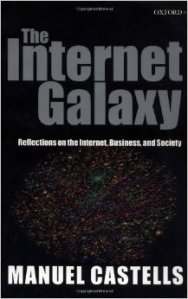
Already in 2001 Manuel Castells took it upon himself to examine concurrent technological developments and publish a book with the title “The Internet Galaxy. Reflections in the Internet, Business, and Society” (Oxford: OUP). Save for the title of the book though, there is very little similarity with McLuhan’s book. This is not a critique of the book but merely of the title. The book indeed provides interesting analyses of the relationship between technological and societal developments. In a way, Castells’ Internet Galaxy continues a discussion that he began with his trilogy on the Network Society published in the mid to late 1990s.

51gQM0Tlr1L._SY344_BO1,204,203,200_

Castells thereby carefully avoids the technological determinism that characterises so many contemporary book about the internet and society. Instead he uses his sociological expertise to offer an analysis of how the Internet and related network technologies provide the basis for new opportunities and challenges for business and economy, politics, and culture. He devotes an entire chapter to a discussion of the digital divide, and emphasises that access to the Internet is not the only barrier to participation in the Network Society but it is a prerequisite for an involvement in societal processes.

In his chapter on “e-Business and the New Economy” Castells investigates the opportunities of new forms of production including changes in labor-relations. He also discusses the financial markets and highlights the fragility of financial markets that are subject to global communication via online networks. In some way that now can be seen as a prediction of the 2007/8 financial crisis, but Castells is not in the business of making prediction. Instead he sticks to an analysis of the present (2001) and recent past and from there on reveals possible directions for business, work and labor and the economy as a whole.

Although The Internet Galaxy was published in 2001 it still is a worthwhile read as it provides a well-founded analysis of networked organisation of society.

Musical Technologies of Memory

Uncategorized

over on the SSSI Music blog Jason Sumerau posted an interesting piece on Musical Technologies of Memory

Society for the Study of Symbolic Interaction - Blog's avatarSymbolic Interaction Music Blog

I have an electric guitar in my office. Cherry red and white, it lives on a little stand situated between one of my bookshelves and a file cabinet. Sometimes when I get stuck on a manuscript or course preparation, I pick it up and just play for a little while (without amplification) to clear my mind. I find the feel of the strings between my fingers allows me to relax and think about other things for a while, which often helps me work through whatever has me temporarily stuck. At other times, it sparks conversations with students and colleagues who notice it upon entering my office. In such cases, some people ask about its origin, design, or sound while others comment on its appearance or seek to get me to play a bit (to varying degrees of success). While preparing for my university’s graduation ceremony this past week, I found…

View original post 1,100 more words

Openness in the Academic and Corporate World

Uncategorized

“Consultants frequently tell academics that they are obliged to become more “corporate” in outlook-to pay more attention to the bottom line and to develop more proprietary products and services. These pressures are particularly intense in fields with immediate commercial relevance. However, certain principles of openness derived from traditional science and academic life might end up serving the long-term economic interests of American industries.” (p.253)

from Frank Pasquale. 2011. RESTORING TRANSPARENCY TO AUTOMATED AUTHORITY. Journal of Telecommunications and High Technology Law. Vol.9: 235-254

  Mobile Guides to Historic Places in Action and Interaction

apps, interactivity, mobility, museums, Technology

first published in “Museum & Heritage Magazine” (Winter Issue, 2013)

Dirk vom Lehn (King’s College London)

Hannah Lewi & Wally Smith (University of Melbourne)

Museums and Heritage Sites increasingly offer mobile guides and Apps to encourage people to use their smartphones and tablet computers for the exploration of exhibitions, outdoor spaces and buildings. These Mobile Apps provide information in multimedia formats, text, pictures and video-clips. They sometimes also allow people to play games and send emails. In this short article we discuss two examples to highlight some of the opportunities and challenges offered by Mobile Apps.

The information delivered by these apps can draw people’s attention to particular exhibit features, make visible aspects of objects and artifacts that are invisible, hidden or have disappeared over time. Pictures and text shown by mobile guides, such as the ‘Formative Histories Walking App‘, designed by academics at the University of Melbourne, allow people to compare the architectural reality in front of them with information on the device. This juxtaposition of material reality and virtual reality aims to stimulate interest in the architecture and urban history of Melbourne, and provides the basis for people’s sustained engagement with buildings that they might walk past without noticing or appreciating.

The ‘Formative Histories Walking App’ has been designed as part of a project at the University of Melbourne, carried out by the authors, to explore novel ways to engage students with architectural history. In this case, the Mobile App was used as a teaching and learning tool that presented rich visual and oral information on an iPod Touch. Like a human guide, the App takes students on a two-hour walk along Collins Street, a prominent central city axis in Melbourne; the walk involves twenty stops at significant buildings from the nineteenth and early twentieth century. Using a map and menu on the iPod Touch users explore the street and find and examine architectural features in light of the information displayed by the Mobile App. This information is comprised of short text and audio summaries at each stop and a limited number of images that elaborate on aspects such as key buildings set in their historical context, comparative architectural examples from international architects or details of buildings that are not readily visible for the students. In this sense, the information delivered by the app replicates a slideshow similar to those architecture students experience in the classroom; pictures of objects nearby are juxtaposed with objects from different periods or by other architects and designers.

A second exploration of the potentials of the mobile digital guide for heritage, museum and architecture sites has been the design of a prototype iPod guide that provides visitors with information about the Shrine of Remembrance, a significant site and war memorial in Melbourne built in 1934. With this prototype the team aimed to allow people to see the Shrine in relationship to a wealth of currently unseen archival material. The mobile guide encourages visitors to juxtapose images, films and audio-recordings with the reality in front of them. By drawing less on conventional text, and more on visual information presented in innovative formats such as timelines, collages and close-up details the designers were interested in testing how user’s might share the screen with others and discuss the content and their experience of the site. encourage people to share the screen with others and discuss the content. Mobile guides and Apps like the examples briefly described here have great potential to create innovative media in the interpretation of museums and heritage sites that engage people in new ways with exhibits and exhibitions, architecture, gardens etc. They principally replicate two models of guiding visitors through a site that the researchers have found in many new Apps in the cultural and tourism genre :

  • the human guide model: these guide direct people’s exploration of a site with an identifiable guiding voice or presence on a predefined route. A number of stops are planned into the route where visitors are given information about an exhibit, building, plant, etc.
  • the interactive exhibition model: these guides offer a wealth of content in various forms that visitors can use to interpret and features of a site. The route does not have to be preplanned and can be changed, shortened or extended at any point in time.

These models of guiding visitors – which are sometimes mixed together – are often used with a variety of formats of content: chronologies and timelines, spatially-organised information; slideshows offering both highly curated narratives and freedom of choice; archival film; and oral histories.

Our own research in Melbourne and elsewhere suggests that apps designed with the human guide model in mind can be successful in situations with a well-defined visitor route. Elsewhere an interactive exhibition model that offers people the opportunity to self-select what objects and artifacts to examine can be more engaging. In either model, reception is influenced by the way information is structured and presented in the guide, and how this mirrors the physical reality. Text is not very popular with visitors while images, film and oral histories are. Chronologically listed information, for example, does not hold people’s attention when confronted with a rich spatial panorama. A powerful approach is to juxtapose archival images and films with views of the present-day reality; a technique used successfully by the ‘Streetmuseum’ app created by the Museum of London.

For a long time, research in the social sciences has argued that people’s experience and learning in museums and heritage sites can be enhanced when they talk, discuss and interact with each other. Therefore an unresolved problem for designers is to develop mobile guides that facilitate and encourage social interaction and discussion between visitors. Our experiments with different kinds of app show that people tend to treat the use of the device as a private activity and experience talk with others as disruptive. Future experiments, maybe using larger displays, will show how devices such as tablet computers might be more conducive to social interaction and conversation.

Authors

Dirk vom Lehn teaches Marketing, Interaction & Technology and is member of the Work, Interaction & Technology Research Centre (King’s College London). His research focuses on the interweaving of technology with social interaction in museums and galleries, optometric consultation and street-markets. Email: dirk.vom_lehn@kcl.ac.uk (http://www.vom-lehn.net)

Hannah Lewi teaches architecture history, theory and design. Her research areas include modern Australian architecture, new media for history and heritage applications, and theoretical inquiry into heritage and conservation. She is the current Chair of Docomomo Australia, and recent publications include Hannah Lewi and David Nichols (eds) Community: Building Modern Australia (Sydney: UNSW Press), 2010. Email: hlewi@unimelb.edu.au (http://www.findanexpert.unimelb.edu.au/display/person25951#tab-publications)

Wally Smith teaches and researches in the fields of human-computer interaction and knowledge management. Recent publications explore the role of commercial demonstrations of information technology, and the connections between stage magic and the history of informational artefacts. Email: wsmith@unimelb.edu.au (http://www.findanexpert.unimelb.edu.au/display/person18782#tab-publications)