Paper on Analysing “the Sequential Organization of Social Interaction in Exhibitions” #emca #video #sociology #museum

Ethnomethodology, interaction, interaction, interactionism, museums, publication, research methods, Uncategorized

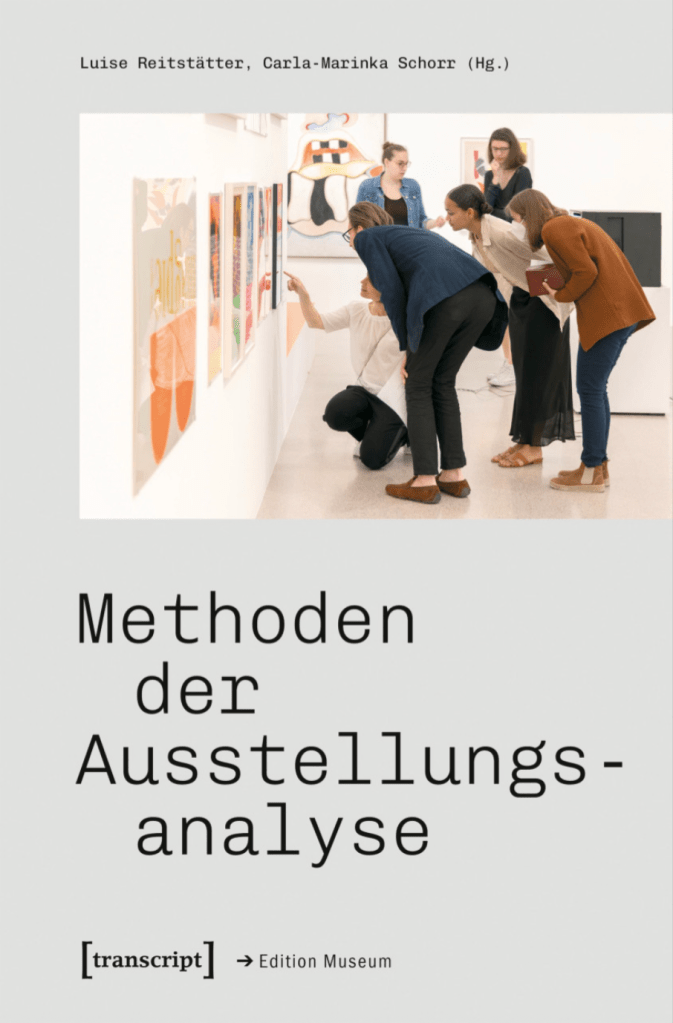
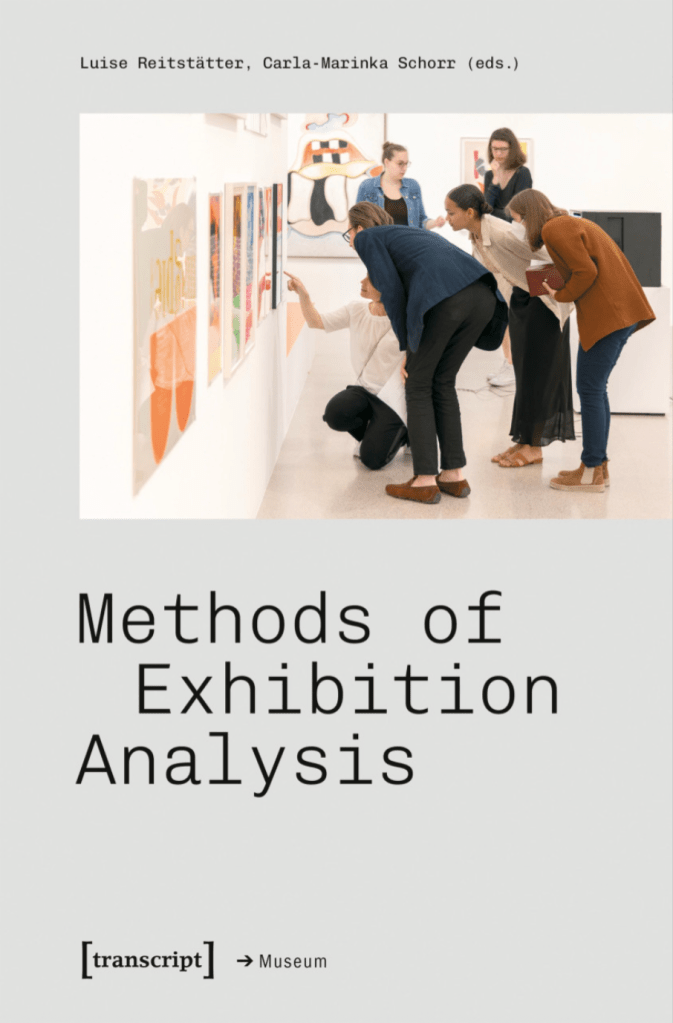
Luise Reitstätter and Carla-Marinka Schorr have published an excellent edited collection titled “Methods of Exhibition Analysis” (open access, in English and German) that showcases a wide range of research methods used to investigate visitors’ experience of exhibits and exhibitions. All the chapters are structured in very similar ways, making it easy for readers, academics and practitioners alike, to compare and contrast the opportunities and challenges of different methods.

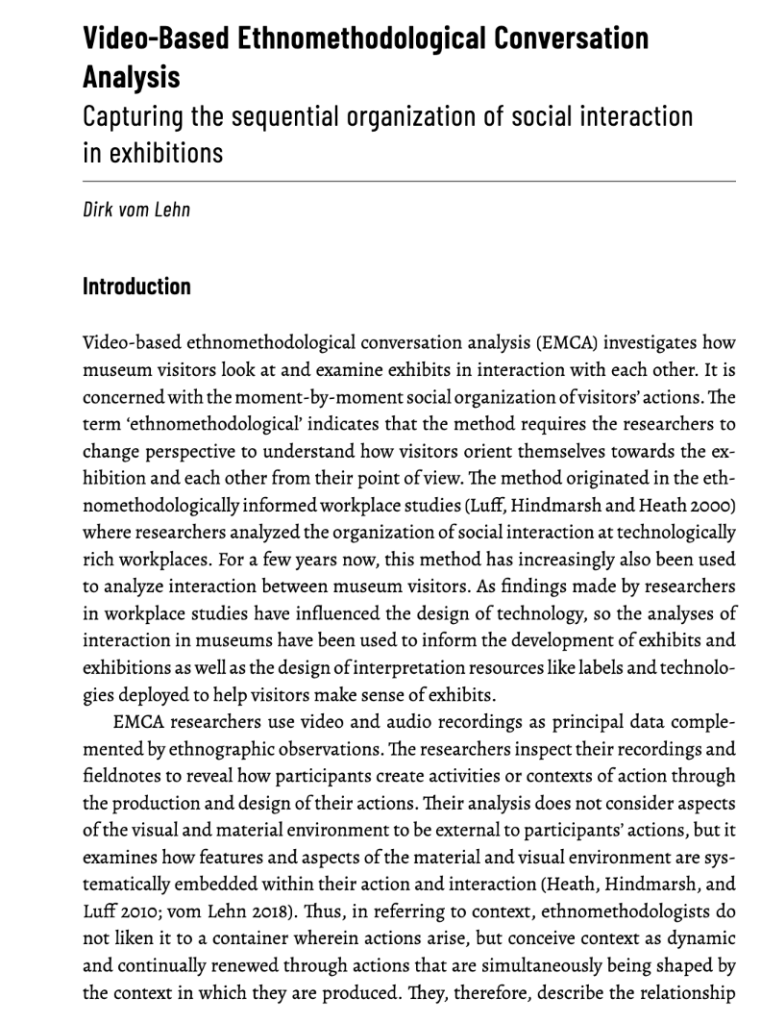
I have a short chapter in the book titled “Video-Based Ethnomethodological Conversation Analysis. Capturing the sequential organization of social interaction in exhibitions” the discusses how to collect and analyse video-recorded interaction in museums.

New Paper: “Social interaction and dark tourism in prison museums” by Rachael Ironside, Brianna Wyatt, Craig Wight, Alona Roitershtein, Dirk vom Lehn

Ethnomethodology, exhibitions, experience, interaction, interaction, interactionism, museums, public places, publication, Uncategorized

This study explores how prison tourism experiences are co-constructed through situated visitor interactions. Penal heritage sites are decommissioned prisons, transformed into immersive educational attractions, drawing upon multiple interpretative practices to engage visitors with historic and contemporary issues of crime and punishment. Using ethnomethodological conversation analysis (EMCA), this research examines how gestures, talk, gaze and bodily position influence how visitors see, interpret, and emotionally negotiate difficult heritage. Findings reveal that visitors co-produce dark tourism experiences and negotiate the perceived darkness of sites through embodied practice. Situating visitors as active social agents, this study provides insights into the co-construction of dark tourism experiences, emphasising interpretation as an emergent process shaped by interaction rather than predetermined by site design or individual motivation.

New research suggests people make sense of disturbing places together, not alone

Incomplete List of Books and Papers on ‘Mobility’

Announcement, Anthropology, ethnography, interaction, Mobile, mobility

Mobility – Short List 

Asimakopoulos, Stavros, and Alan Dix. ‘Walking: A Grounded Theory of Social Engagement and Experience’. Interacting with Computers 29, no. 6 (1 November 2017): 824–44. https://doi.org/10.1093/iwc/iwx014.

Becker, Carol. ‘The Art of Crossing the Street’. Art Journal 58, no. 1 (1999): 10–15.

Broth, Mathias, and Lorenza Mondada. ‘Delaying Moving Away: Place, Mobility, and the Multimodal Organization of Activities’. Journal of Pragmatics 148 (July 2019): 44–70. https://doi.org/10.1016/j.pragma.2019.05.013.

———. ‘Walking Away: The Embodied Achievement of Activity Closings in Mobile Interaction’. Journal of Pragmatics47, no. 1 (2013): 41–58. https://doi.org/10.1016/j.pragma.2012.11.016.

Broth, Matthias, and Frederik Lundstrom. ‘A Walk on the Pier. Establishing Relevant Places in a Guided, Introductory Walk’. In Interaction and Mobility: Language and the Body in Motion, edited by Pentti Haddington, Maurice Nevile, and Lorenza Mondada. Berlin: DeGryter, 2013.

Brown, Barry, and Eric Laurier. ‘Maps and Car Journeys: An Ethno-Methodological Approach’. Cartographica 4 (2005): 17–33.

Brown, Barry, Eric Laurier, Hayden Lorimer, Owain Jones, Oskar Juhlin, Mark Perry, Daniele Pica, et al. ‘Driving and “ Passengering ”: Notes on the Ordinary Organization of Car Travel’. Mobilities 3, no. 1 (2008): 1–31.

Carlin, Andrew P. ‘Navigating the Walkways: Radical Inquiries and Mental Maps’, n.d.

Cosley, Dan, Jonathan Baxter, Soyoung Lee, Brian Alson, Saeko Nomura, Phil Adams, Chethan Sarabu, and Geri Gay. ‘A Tag in the Hand : Supporting Semantic , Social , and Spatial Navigation in Museums’. Technology, 2009, 1953–62.

De Stefani, Elwys. ‘Rearranging (in) Space: On Mobility and Its Relevance for the Study of Face-to-Face Interaction’. In Space in Language and Linguistics, edited by Peter Auer, Martin Hilpert, Anja Stukenbrock, and Benedikt Szmrecsanyi, 434–63. DE GRUYTER, 2013. https://doi.org/10.1515/9783110312027.434.

De Stefani, Elwys, and Lorenza Mondada. ‘Encounters in Public Space: How Acquainted Versus Unacquainted Persons Establish Social and Spatial Arrangements’. Research on Language and Social Interaction 51, no. 3 (3 July 2018): 248–70. https://doi.org/10.1080/08351813.2018.1485230.

Deppermann, Arnulf. ‘Intersubjectivity and Other Grounds for Action-Coordination in an Environment of Restricted Interaction: Coordinating with Oncoming Traffic When Passing an Obstacle’. Language & Communication 65 (March 2019): 22–40. https://doi.org/10.1016/j.langcom.2018.04.005.

Deppermann, Arnulf, Eric Laurier, and Lorenza Mondada. ‘Overtaking as an Interactional Achievement: Video Analyses of Participants’ Practices in Traffic’. Gesprächsforschung 19 (2018): 1–131.

Due, Brian, and Simon Lange. ‘Semiotic Resources for Navigation: A Video Ethnographic Study of Blind People’s Uses of the White Cane and a Guide Dog for Navigating in Urban Areas’. Semiotica 2018, no. 222 (25 April 2018): 287–312. https://doi.org/10.1515/sem-2016-0196.

Drury, John, and Elizabeth Stokoe. ‘The Interactional Production and Breach of New Norms in the Time of COVID-19: Achieving Physical Distancing in Public Spaces’. British Journal of Social Psychology 61, no. 3 (2022): 971–90. https://doi.org/10.1111/bjso.12513.

Foster, Susan Leigh. ‘Walking and Other Choreographic Tactics: Danced Inventions of Theatricality and Performativity’. SubStance 31, no. 2 (2002): 125–46. https://doi.org/10.1353/sub.2002.0028.

Goffman, Erving. Behavior in Public Places. Notes on the Social Organization of Gatherings. New York and London, 1963.

———. Relations in Public. Microstudies of the Social Order. New York: Basic Books, 1971.

Haddington, Pentti. ‘Leave-Taking as Multiactivity: Coordinating Conversational Closings with Driving in Cars’. Language & Communication 65 (March 2019): 58–78. https://doi.org/10.1016/j.langcom.2018.04.003.

Haddington, Pentti, and Tiina Keisanen. ‘Location, Mobility and the Body as Resources in Selecting a Route’. Journal of Pragmatics 41, no. 10 (October 2009): 1938–61. https://doi.org/10.1016/j.pragma.2008.09.018.

Hall, Tom. ‘Footwork: Moving and Knowing in Local Space(s)’. Qualitative Research 9, no. 5 (1 November 2009): 571–85. https://doi.org/10.1177/1468794109343626.

Hall, Tom, and Robin James Smith. ‘Stop and Go: A Field Study of Pedestrian Practice, Immobility and Urban Outreach Work’. Mobilities 8, no. 2 (1 May 2013): 272–92. https://doi.org/10.1080/17450101.2012.659470.

Hester, Stephen, and David Francis. ‘Analysing Visually Available Mundane Order: A Walk to the Supermarket’. Visual Studies 18, no. 1 (1 April 2003): 36–46. https://doi.org/10.1080/14725860320001000056.

Karamouzas, Ioannis, Brian Skinner, and Stephen J. Guy. ‘Universal Power Law Governing Pedestrian Interactions’. Physical Review Letters 113, no. 23 (2 December 2014). https://doi.org/10.1103/PhysRevLett.113.238701.

Laurier, Eric, Magnus Hamann, Saul Albert, and Elizabeth Stokoe. ‘Guest Blog: Walking in the Time of COVID-19’. Research on Language and Social Interaction – Blog (blog), 5 May 2020. https://rolsi.net/2020/05/05/guest-blog-walking-in-the-time-of-covid-19/.

Weilenmann, Alexandra, Daniel Normark, and Eric Laurier. ‘Managing Walking Together: The Challenge of Revolving Doors’. Space and Culture 17, no. 2 (May 2014): 122–36. https://doi.org/10.1177/1206331213508674.

Laurier, Eric, and Barry Brown. ‘Rotating Maps and Readers: Praxiological Aspects of Alignment and Orientation’. Transactions of the Institute of British Geographers 33 (April 2008): 201–21. https://doi.org/10.1111/j.1475-5661.2008.00300.x.

Lloyd, Michael. ‘Getting by: The Ethnomethods of Everyday Cycling Navigation’. New Zealand Geographer n/a, no. n/a. Accessed 14 August 2020. https://doi.org/10.1111/nzg.12274.

Marsh, Peter, and Peter Collett. ‘Patterns of Public Behavior: Collision Avoidance on a Pedestrian Crossing’. In Non-Verbal Communication Interaction and Gesture, edited by Adam Kendon, 199–217. The Hague: Mouton, 1981.

Merlino, Sara, and Lorenza Mondada. ‘Crossing the Street: How Pedestrians Interact with Cars’. Language & Communication 65 (March 2019): 131–47. https://doi.org/10.1016/j.langcom.2018.04.004.

Mondada, Lorenza. ‘Commentary: Being Mobile, Talking on the Move: Conceptual, Analytical and Methodological Challenges of Mobility’. In Space in Language and Linguistics, edited by Peter Auer, Martin Hilpert, Anja Stukenbrock, and Benedikt Szmrecsanyi, 464–70. DE GRUYTER, 2013. https://doi.org/10.1515/9783110312027.464.

———. ‘Talking and Driving: Multiactivity in the Car’. Semiotica 191 (2012): 223–56.

———. ‘Walking and Talking Together: Questions/Answers and Mobile Participation in Guided Visits’. Social Science Information 56, no. 2 (2017): 220–53. https://doi.org/10.1177/0539018417694777.

Petri, Jakub. ‘The Forgotten Art of Walking. Toward Intra-Active Geography of an Urban Landscape’. Journal of Aesthetics & Culture 14, no. 1 (31 December 2022): 2156437. https://doi.org/10.1080/20004214.2022.2156437.

Ryave, A. L., and J. N. Schenkein. ‘Notes on the Art of Walking’. In Ethnomethodology, edited by Roy Turner, 265–74. Middlesex: Penguin, 1974.

Smith, Robin James, and Tom Hall. ‘Mobilities at Work: Care, Repair, Movement and a Fourfold Typology’. Applied Mobilities 1, no. 2 (2 July 2016): 147–60. https://doi.org/10.1080/23800127.2016.1246897.

———. ‘Pedestrian Circulations: Urban Ethnography, the Mobilities Paradigm and Outreach Work’. Mobilities 11, no. 4 (7 August 2016): 498–508. https://doi.org/10.1080/17450101.2016.1211819.

Vergunst, Jo Lee, and Tim Ingold, eds. Ways of Walking: Ethnography and Practice on Foot. 1st edition. London New York: Routledge, 2016.

vom Lehn, Dirk. ‘Configuring Standpoints: Aligning Perspectives in Art Exhibitions’. Bulletin Suisse de Linguistique Appliquée 96 (2012): 69–90.

———. ‘Withdrawing from Exhibits: The Interactional Organisation of Museum Visits’. In Interaction and Mobility: Language and the Body in Motion, edited by Pentti Haddington, Lorenza Mondada, and Maurice Nevile, 65–90. March. Berlin: de Gryter, 2013.

Watson, Rod. ‘The Visibility Arrangements of Public Space: Conceptual Resources and Methodological Issues in Analysing Pedestrian Movements’. Communication & Cognition 38, no. 3–4 (2005): 201–27.

The Anthem Companion to Harold Garfinkel #EMCA #SSSI #Interactionism

Ethnomethodology, Garfinkel, interaction, interactionism

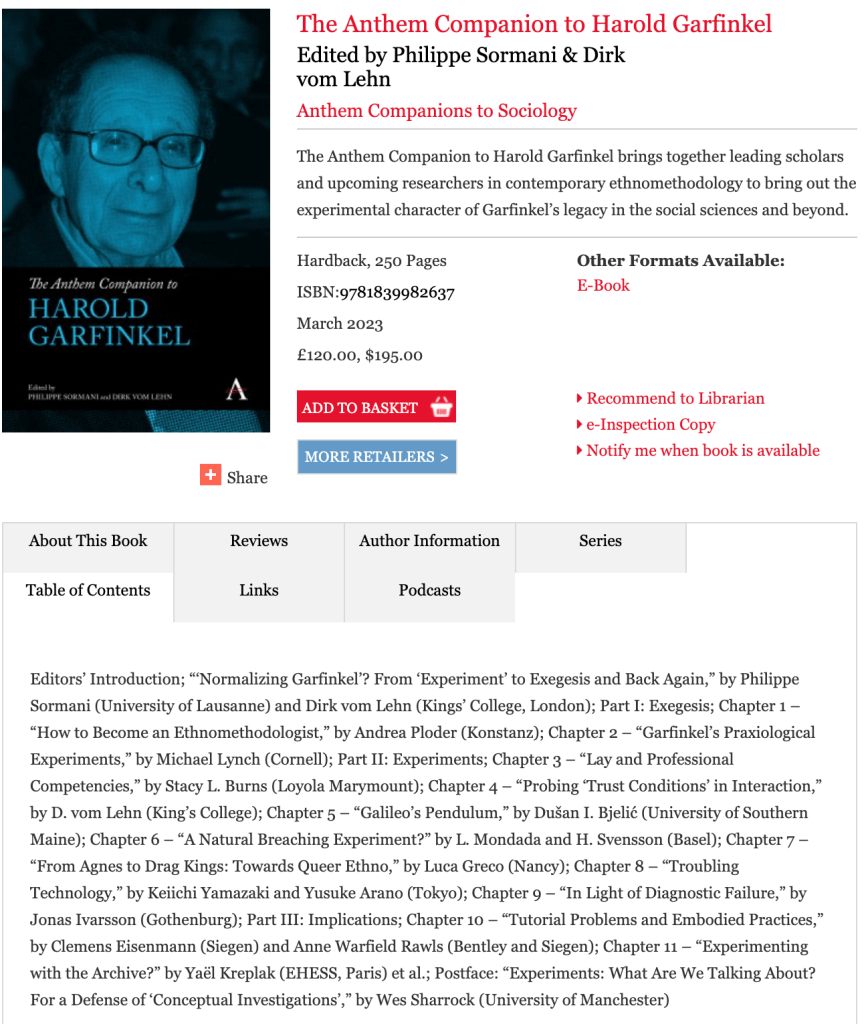
Hopefully, by the end of the year or at the latest by Spring 2023 “The Anthem Companion to Harold Garfinkel” co-edited by Philippe Sormani and myself will be published with Anthem Press. It’s currently due to be published in March 2023.

CONTENTS

List of Illustrations

Introduction                Rediscovering Garfinkel’s ‘Experiments’, Renewing Ethnomethodological Inquiry

by Philippe Sormani and Dirk vom Lehn 

Part I: Exegesis

Chapter One                Garfinkel’s Praxeological ‘Experiments’ 

by Michael Lynch 

Chapter Two               The Continuity of Garfinkel’s Approach:  Seeking Ways of ‘Making the Phenomenon Available Again’ through the Experience and Usefulness of ‘Trouble’ 

by Clemens Eisenmann and Anne Warfield Rawls

Part II: ‘Experiments’

Chapter Three             Lay and Professional Competencies: Linking Garfinkel’s Tutorial Exercises to a Study of Legal Work

by Stacy Lee Burns 

Chapter Four               Bargaining on Street-Markets as ‘Experiment in Miniature’ 

by Dirk vom Lehn 

Chapter Five               Notes on Galileo’s Pendulum

by Dušan I. Bjelić 

Chapter Six                 Disruptures of Normal Appearances in Public Space: the Covid19 Pandemic as a Natural Breaching Situation

by Lorenza Mondada and Hanna Svensson 

Chapter Seven             Gender as a Scientific Experiment: Towards a Queer Ethnomethodology 

by Luca Greco 

Chapter Eight              Breaching and Robot Experiments: Continuing Harold Garfinkel’s Spirit of Experimentation

by Keiichi Yamazaki and Yusuke Arano 

Chapter Nine               Dealing with Daemons: Trust in Autonomous Systems 

by Jonas Ivarsson 

Part III: Implications              

Chapter Ten                Experimenting with the Archive? Performing Purdue in Paris, an Instructive Reprise

by Yaël Kreplak and Philippe Sormani  

Chapter Eleven           Rereading Galileo’s Inclined Plane Demonstration

by Kenneth Liberman, in conversation with Harold Garfinkel  

Postface                      ‘Experiments’ – What Are We Talking About? A Plea for Conceptual Investigations

by Wes Sharrock 

Notes on Contributors

Index of Names

Index of Subjects

Special Issue ‘The Senses in Social Interaction’ edited by Will Gibson (@Willjimgibson) and Dirk vom Lehn (@dirkvl) published in Symbolic Interaction (@sociologylens) #sssi #emca #senses #interaction

Announcement, interaction, interactionism, Senses

Symbolic Interaction (@sijournal) has just published our Special Issue on ‘The Senses in Social Interaction’ (Vol.44(1)). The Table of Contents is below.

Will Gibson and Dirk vom Lehn – Introduction: The Senses in Social Interaction [Open Access] https://doi.org/10.1002/symb.539

Danielle Pillet-Shore – “When to Make the Sensory Social: Registering in Face‐to‐Face Openings” https://doi.org/10.1002/symb.481 (with video abstract)

Giolo Fele and Ken Liberman – “Some Discovered Practices of Lay Coffee Drinkershttps://doi.org/10.1002/symb.486

Lorenza Mondada – “Orchestrating Multi‐sensoriality in Tasting Sessions: Sensing Bodies, Normativity, and Languagehttps://doi.org/10.1002/symb.472

Sally Wiggins and Leelo Keevallik – “Enacting Gustatory Pleasure on Behalf of Another: The Multimodal Coordination of Infant Tasting Practices” https://doi.org/10.1002/symb.527

Francesca Astrid Salvadori and Giampietro Gobo – “Sensing the Bike: Creating a Collaborative Unerstanding of a Multi-Sensorial Experience in MotoGP Racinghttps://doi.org/10.1002/symb.529

Brian Due – Distributed Perception: Co‐Operation between Sense‐Able, Actionable, and Accountable Semiotic Agents https://doi.org/10.1002/symb.538

Sylvie Grosjean, Frederik Matte and Isaac Nahon-Serfaty – “Sensory Ordering” in Nurses’ Clinical Decision‐Making: Making Visible Senses, Sensing, and “Sensory Work” in the Hospitalhttps://doi.org/10.1002/symb.490

David Matthew Edmonds and Christian Greiffenhagen – “Configuring Prospective Sensations: Experimenters Preparing Participants for What They Might Feel” https://doi.org/10.1002/symb.485

Eduardo de la Fuente and Michael James Walsh – “Framing Atmospheres: Goffman, Space, and Music in Everyday Lifehttps://doi.org/10.1002/symb.506

Book Reviews

Brigitte Biehl – “Atmospheres always open to change” – Review of ‘Atmospheres and the Experiential World: Theory and Methods’ By Sumartojo, Shanti and Pink, Sarah ( Routledge, 2019) – https://doi.org/10.1002/symb.507

Don Everhart- “Phenomenology, Ethnomethodology, and Intercorporeality” Review of ‘Intercorporeality: Emerging Socialities in Interaction’ edited by Christian Meyer, Juergen Streeck, and J. Scott Jordan (OUP, 2019) https://doi.org/10.1002/symb.523

Jessica S. Robles – “Contact: Pushing the Boundaries of Touch‐in‐Interaction” – Review of ‘Touch in Social Interaction: Touch, Language, and Body’ edited by Asta Cekaite and Lorenza Mondada (Routledge, 2019) https://doi.org/10.1002/symb.524

Jeffrey van den Scott – “Loud, Fast, and Hard: Changing Identities in a Musical Subculture” – Review of ‘Psychobilly: Subcultural Survival’ By Kimberly Kattari (Temple University Press, 2020) https://doi.org/10.1002/symb.522

James Fletcher – “Finding Order through Disorder: Dementia as a Reflection of Social Organization” – Review of ‘Forgetting Items: The Social Experience of Alzheimer’s Disease’ By Baptiste Brossard (Indiana University Press, 2019).

Chris Land – “An Oasis of Beer in the Desert of the Real?” – Review of ‘Vegas Brews: Craft Beer and the Birth of a Local Scene’ by Borer, Michael Ian (NYU, 2019)https://doi.org/10.1002/symb.512

Judson G. Everitt – “Emotions, Interactions, and Institutions in Preschool Teaching” – Review of ‘Between Teaching and Caring in the Preschool: Talk, Interaction, and the Preschool Teacher Identity‘ by John C. Pruit https://doi.org/10.1002/symb.487

Philippe Sormani – “Reflexive Ethnography as “Data Science”? A Sociological Contribution to Praxeology” – Review of ‘Daten‐Karrieren und epistemische Materialität: Eine wissenschaftssoziologische Studie zur methodologischen Praxis der Ethnografie By Meier zu Verl, Christian ( J. B. Metzler Verlag, 2018) https://doi.org/10.1002/symb.488

Noreen M. Sugrue – “Evolutionary Explanation Meets Social Reality” – Review of ‘Blueprint: The Evolutionary Origins of a Good Society’ by Nicolas Christakis (Little Brown Spark, 2019). https://doi.org/10.1002/symb.483

SSSI 2019 – Thematic Panel: “Symbolic Interactionism and the Resurgent Interest in Organization and Management” #sociology #sssi #organizationstudies #management

Announcement, interaction, interactionism

At this year’s conference of the Society for the Study of Symbolic Interaction Patrick McGinty (Western Illinois University) and I will organise a Thematic Panel titled “Symbolic Interactionism and the Resurgent Interest in Organization and Management”.

The panel has been motivated by recent publications on the influence of interactionist research on and contribution to management and organisation studies. These publication have highlighted the curious mutual disregard of interactionism and organisational analysis and management studies. This panel will bring together interactionist scholarship that over recent years has undertaken considerable efforts in bringing the debates in these areas together and pushing forward the interactionist research of management and organization, both through theorizing and research.

More details on the panel’s speakers and presentations have been published in the SSSI 2019 Programme.


Relevant References

Dingwall, Robert, and Phil M Strong. “The Interactional Study of Organizations.” Journal Of Contemporary Ethnography14, no. 2 (1985): 205–31.
Fine, Gary Alan. “Justifying Work: Occupational Rhetorics as Resources in Restaurant Kitchens.” Administrative Science Quarterly41, no. 1 (1996): 90–115.
Gibson, Will, and Dirk vom Lehn. Institutions, Interaction and Social Theory. Oxford: Palgrave, 2017.
Grills, Scott, and Robert Prus. “Management Motifs: An Interactionist Approach for the Study of Organizational Interchange. New York: Springer. 2018.

Harrington, Brooke. Capital without Borders : Wealth Managers and the One Percent. Cambridge, MA: Harvard University Press, 2016.

Hallett, Tim, and Marc Ventresca. “Inhabited Institutions: Social Interactions and Organizational Forms in Gouldner’s Patterns of Industrial Bureaucracy.” Theory and Society35, no. 2 (April 2006): 213–36. https://doi.org/10.1007/s11186-006-9003-z.

McGinty, Patrick J. W. “Divided and Drifting: Interactionism and the Neglect of Social Organizational Analyses in Organization Studies: The Neglect of Social Organizational Analyses.” Symbolic Interaction37, no. 2 (May 2014): 155–86. https://doi.org/10.1002/symb.101.

Norris, Dawn R. Job Loss, Identity, and Mental Health. New Brunswick, New Jersey: Rutgers University Press, 2016.
Sapir, Adi, and Nahoko Kameo. “Rethinking Loose Coupling of Rules and Entrepreneurial Practices among University Scientists: A Japan–Israel Comparison.” The Journal of Technology Transfer44, no. 1 (February 2019): 49–72. https://doi.org/10.1007/s10961-017-9596-6
Watson, Patrick G. “‘Common Sense Geography’ and the Elected Official: Technical Evidence and Conceptions of ‘Trust’ in Toronto’s Gardiner Expressway Decision.” Canadian Journal of Sociology43, no. 1 (March 31, 2018): 49–76. https://doi.org/10.29173/cjs27058.

Garfinkel, Ethnomethodology and Studies of Interaction #emca #sociology #interactionism https://doi.org/10.1007/s10746-019-09496-5

Ethnomethodology, Garfinkel, interaction, Phenomenology, Schutz, sociology

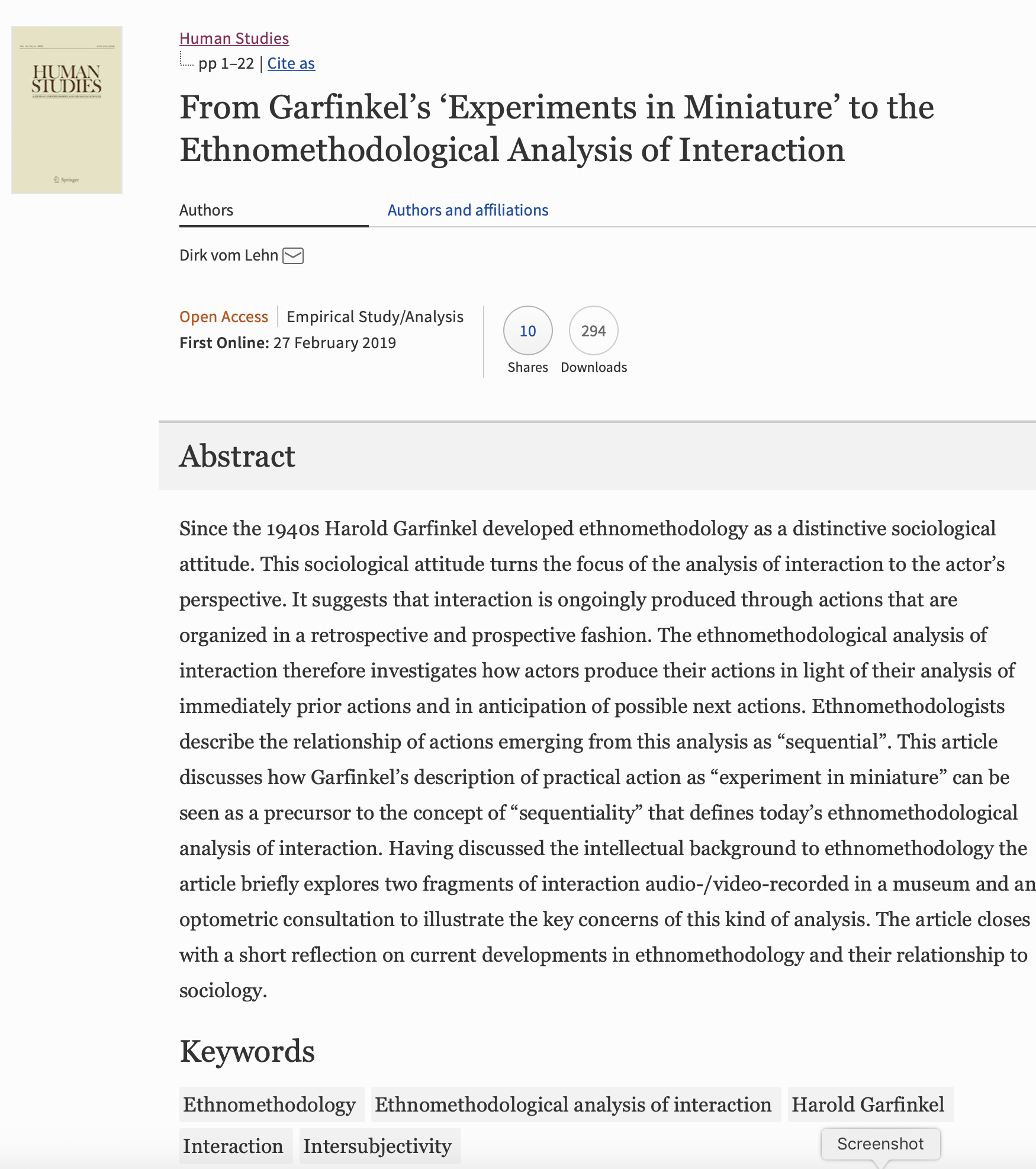
vom Lehn, D. (2019). From Garfinkels’ ‘Experiments in Miniature’ to the Ethnomethodological Analysis of Interaction. Human Studies, 42(2), 305-326. https://doi.org/10.1007/s10746-019-09496-5

vomLehn-2019-Experiments

#Garfinkel #ethnomethodology #sociology #interaction #interactionism

Ethnomethodologische Interaktionsanalyse #EMCA

Ethnomethodology, experience, Garfinkel, Goffman, interaction, Videoanalysis

In den vergangenen 10 Jahren sind verschiedene Texte zur Analyse von Interaktion erschienen, in deren Zentrum Videoaufnahmen als Daten stehen. Von besonderer Bedeutung sind in diesem Zusammenhang Texte, die sich auf die Ethnomethodologie und Konversationsanalyse stützen. “Ethnomethodologische Interaktionsanalyse” schließt hier und an mein Buch zu Harold Garfinkel an, in dem ich die Entwicklung der Ethnomethodologie als besondere soziologische Einstellung nachzeichne.

413rZIStmsL

Ethnomethodologische Interaktionsanalyse” bettet die Analyse von Interaktion auf Basis von Videoaufnahmen in den Kontext der Entwicklung der Ethnomethodologie ein und führt die Analyse am Beispiel von Daten, die ich in den Untersuchungsräumen von Optometrikern aufgezeichnet habe, vor. Dabei gehe ich auf Praktikalitäten der Datenerhebung und -analyse und die Transkription von Videodaten ein. Anschließend wendet sich das Buch der Darstellung von Analysebefunden in Live-Präsentationen und in Texten zu. Das Buch ist in der Serie ‘Standards standardisierter und nicht-standardisierter Sozialforschung’, die von Nicole Burzan, Ronald Hitzler und Paul Eisewicht herausgeben wird, bei Beltz/Juventa erschienen. “Ethnomethodologische Interaktionsanalyse” ist als Kindle-Buch und vom 20. August 2018 auch in der gedruckten Version erhältlich.

Everyday Aesthetics, Practical Aesthetics

aesthetics, art, interaction, lifestyle, taste

In sociology and in particular interactionist approaches there has recently been lot of interest in ‘everyday aesthetics’ and ‘practical aesthetics’. At the Participations 2015 conference in Basel in June a panel was organised by Saul Albert and Yaël Kreplak that explored how aesthetics and aesthetic judgement feature in dance (Saul Albert @saul; Leelo Keevallik), in the camera-work in TV productions (Mathias Broth), in the installation of art works (Yaël Kreplak) and in the performing arts (Darren Reed). Save for the panel at the Participations conference, there have been various publications that play into these debates: about a decade ago Christian Heath and I published “Configuring Reception”, a paper that introduced “practical aesthetics” as a practice through which people in everyday situations like museum visits produce situations in which they see and make sense of works of art and constitute them as aesthetic objects. Most recently, Lucia Ruggerone and Neil Jenkings published a paper in Symbolic Interaction “Talking about Beauty” in Symbolic Interaction where they examine participants self-reported aesthetic appreciations in relationship to their life-style.

Museum Visiting: Slowing Down and the Experience of Art

exhibitions, experience, interaction, museums

There is a renewed interest in museum visiting and the practices of doing so. Only this weekend (October 9th, 2014), Stephanie Rosenbloom published an article in the New York Times that explores “The Art of Slowing Down in a Museum“. Rosenbloom refers to Daniel Fujiwara’s (now Director at SImetrica) study of the impact of museum visiting on people’s enjoyment of life as well as on James O. Pawelski’s work in the area of positive psychology. All these studies are of great interest and very helpful in highlighting the impact of the arts on people’s lives. It would be great if such research that is primarily interested in measuring impact and focuses on individuals as experiencing subjects, would include also the influence of the presence of other visitors in museums, both companions and others. It would seem that in order to follow the arguments and suggestions on how to organise a museum visit would require prior negotiation with those we are with in a museum. Statistics of museum visiting clearly show that people not only primarily come with others to museums but also that one main reason for the visit is socialising and interacting with others, whereby works of art (and other exhibits) providing hubs for concerted activities.

Considering that Pawelski, Fujiwara and others show that spending more time with a work of art increases feelings of happiness and satisfaction and that people enjoy interacting with others in museums, exploring how we can facilitate sustained social activities around works of art and other exhibits in museums seems to be an obvious avenue to pursue.


Relevant Literature

Heath, vom Lehn. (2004) Configuring Reception. Theory, Culture and Society Vol21(6): 43-65

Heath, Luff, vom Lehn, Hindmarsh, Cleverly. (2002) Crafting Participation. Visual Communication. Vol1(1): 1-33

Hindmarsh, Heath, vom Lehn, Cleverly. (2002) Creating Assemblies in Public Environment. CSCW Journal Vol.14(1): 1-41

Leinhardt, Crowley, Knutson 2002. Learning Conversations in Museums. Routledge

vom Lehn, Heath 2005. Accounting for Technology in Museums. International Journal of Arts Management Vol7(3): 11-21

vom Lehn, Heath, Hindmarsh 2001. Exhibiting Interaction: conduct and collaboration in museums. Symbolic Interaction. Vol.24(2): 189-216