PhD Studentship: “Urban Agora and the Search for Authenticity – London’s Street Markets as Alternative Retail Experiences” #KingsBusinessSchool #Marketing #Sociology #Studentship #PhD

Uncategorized

https://www.findaphd.com/phds/project/urban-agora-and-the-search-for-authenticity-london-s-street-markets-as-alternative-retail-experiences/?p182137

About the Project

This PhD project aims to explore how market participants produce “authenticity” and use it to generate value (Zukin, 2011). Specifically, it investigates how marketing practices undertaken by market operators and traders in a street market facilitate the emergence of “authentic spaces”, the generation of value, and wider economic and social benefits for the community. Market participants engage in marketing practices to attract and retain customers (Dibb et al., 2014). They encompass transactional activities such as offering curation and relational activities such as interaction with customers and amongst traders. This project is anchored in the UK non-store retailing industry. While retailing is dominated by online sales (ONS, 2021), brick-and-mortar retail forms such as street markets still exist, adding up to roughly 1000+ locations nationwide (NABMA, 2022). They allow for economic and social interaction among local communities and visitors. Given their flux and heightened competition for pitches in crowded urban spaces, innovative marketing practices are indispensable for street traders and operators (Binkley and Connor, 1998; GLA, 2019; RBKC, 2022; vom Lehn, 2014). 

London houses around 280 street markets. They employ roughly 13,250 people and contribute £247.6 million to the capital’s economy (GLA, 2019). The Royal Borough of Kensington and Chelsea (RBKC) – the project’s non-academic partner – houses eight markets (RBKC, 2022). The RBKC street trading office manages two of them, including the world-famous Portobello Market, and exerts statutory controls over the other sites. These markets supply local communities and tourists with goods ranging from antiques, fruit and vegetables to street food. 

Although some marketing scholars attempt to define authenticity, the concept remains ambiguous (Bartsch et al., 2022; Nunes et al., 2021). Most conceptualisations acknowledge that authenticity is not a set of discrete properties but an ongoing process of verifying the assumed with the factual or the stated with the actioned (Chiu et al., 2012; Zhang and Patrick, 2021). How this applies to physical spaces, such as street markets, has yet to be explored. Moreover, studies examining authenticity tend to do so from the demand, not the supply side (e.g., Fuchs et al., 2015; Zhang and Patrick, 2021). However, authenticity requires two reference points. As most studies concentrate on changes in individual perceptions (Becker et al., 2019), insights into the economic or societal consequences of authenticity and its curation remain rare (Siemens et al., 2020). The project aims to examine authenticity through a multistakeholder lens, focusing on the supply side (traders’ and market operators’ viewpoints) and economic (customer purchase behaviour) and societal (community well-being) consequences. The final framing of the PhD thesis topic would be however incumbent on the PhD student in cooperation with RBKC and the academic supervisor team. The overall project ownership lies within the successful applicant

What we expect from the candidate?

As a necessary prerequisite to express your interest in this project you shall meet all formal requirements to apply for the doctoral programme at KBS (https://www.kcl.ac.uk/study/postgraduate-research/areas/management-research-mphil-phd) as well as NOT already have been awarded a PhD or equivalent degree. This project is only meant as the thematic context for your PhD research while enrolled in the PhD in marketing programme.

We are looking for a candidate (either home or overseas) with a background in any of the disciplines of marketing, business management, sociology, applied economics, public policy, cultural and urban studies or related fields. They must be interested in exploring the abovementioned topics with us and keen to engage with RBKC’s street trading office on a regular basis. You do not need to be an expert in street market management or trading as this is clearly a PhD in marketing endeavour, though some interest in the intersection of the brick-and-mortar non-store retailing industry and municipal policies is assumed. 

We further expect a reasonable level of personal resilience, readiness to engage with various retailing topics, ability to openly approach people, good oral and written communication skills, as well as a general willingness to embrace new challenges, and diverse cultural settings. We appreciate, a high level of motivation and curiosity in conjunction with the ability to efficiently self-organise. 

Please note the project is available full-time only for a start in September 2025. 

Benefits we offer.

The project provides:

•           a committed contact person at the RBKC street trading office. 

•           access to various RBKC stakeholders depending on the final research design.

•           selected opportunities to get to know the RBKC street trading office/council better through, e.g., a placement or ad hoc project support tasks (please note that while we very much advocate for renumerated engagement, all these options would be time-limited and/or part-time and/or depend on the candidate’s willingness to volunteer as well as subject to availability and, if applicable, individual visa conditions).

•           workspace on our Strand Campus located in Central London. 

•          a edicated interuniversity KBS/Brunel supervisory team with long-standing research experience in marketing, public services management, and small business/family entrepreneurship, and qualitative and quantitative research methods. 

How to apply?

Please submit 1. a letter of motivation (up to 2 pages), and 2. your updated CV incl. your UG and PG degree grades (1 page only) by February 28, 2025, via e-mail to the whole supervisor team:

-Dr Anna Dubiel (Senior Lecturer in Marketing), KBS, anna.dubiel@kcl.ac.uk

-Prof. Dirk vom Lehn (Professor of Organisation and Practice), KBS, dirk.vom_lehn@kcl.ac.uk

-Dr Carolin Decker-Lange (Senior Lecturer in Strategy and Entrepreneurship), Brunel University of London, carolin.decker-lange@brunel.ac.uk

The project team will invite selected applicants for an interview in-person at KBS premises in Central London or if not feasible via MS Teams on March 20 or March 21, 2025. Please kindly note, that we are unable to provide application-related feedback for unsuccessful applicants.

Please do not concurrently – in the context of this project – apply with the KBS PhD programme office. We will ask you to do so if selected. In practice, this means that the applicant selected will need to formally apply with the KBS PhD in Marketing programme with a deadline on June 1, 2025. Being selected for the project does not guarantee admission to the KBS PhD in Marketing programme.


Funding Notes

Funding at the level of home/international student fees (as applicable) and a basic stipend

·      the full KBS home/international tuition fees for three years, the pending submission status fee, and 

·      a tax-free stipend of approximately £21k/annum (2024-2025 rate is £21,237) for four years with small, annual inflationary increases.


References

Bartsch, F., Zeugner-Roth, K. P., & Katsikeas, C. S. (2022). Consumer authenticity seeking: conceptualization, measurement, and contingent effects, Journal of the Academy of Marketing Science, 50, 296–323.
Becker, M., Wiegand, N., & Reinartz, W. J. (2019). Does it pay to be real? Understanding authenticity in TV advertising, Journal of Marketing, 83(1), 24-50.
Binkley, J.K., & Connor, J.M. (1998). Grocery market pricing and the new competitive environment. Journal of Retailing, 74(2), 273-294. 
Chiu, H.-C., Hsieh, Y.-C., & Kuo, Y.-C. (2012). How to align your brand stories with your products. Journal of Retailing, 88(2), 262-275. 
Dibb, S., Simões, C., & Wensley, R. (2014), Establishing the scope of marketing practice: insights from practitioners, European Journal of Marketing, 48(1/2), 380-404.
Fuchs, C., Schreier, M., & Van Osselaer, S. M. (2015). The handmade effect: What’s love got to do with it? Journal of Marketing, 79(2), 98-110.
Greater London Authority (2019), Street markets toolkit: Evidencing and capturing social value, https://www.london.gov.uk/sites/default/files/ulm_toolkit_web.pdf, accessed October 23, 2024
NABMA (2022), National markets survey 2022, https://nabma.com/version2020/wp-content/uploads/2022/12/NABMA-Survey-2022.pdf, accessed November 2, 2024.
Nunes, J. C., Ordanini, A., & Giambastiani, G. (2021). The concept of authenticity: What it means to consumers, Journal of Marketing, 85(4), 1-20.
Office of National Statistics (2021), Economic trends in the retail sector, Great Britain: 1989 to 2021, https://www.ons.gov.uk/economy/nationalaccounts/balanceofpayments/articles/economictrendsintheretailsectorgreatbritain/1989to2021#online-retail-in-the-uk-analysis-by-sector, accessed November 1, 2024 
RBKC (2022), Kensington and Chelsea markets plan 2022-27, https://www.rbkc.gov.uk/business-and-enterprise/business-advice/markets-and-street-trading-0, accessed November 1, 2024.
Siemens, J. C., Weathers, D., Smith, S., & Fisher, D. (2020). Sizing up without selling out: the role of authenticity in maintaining long-run consumer support for successful underdog brands. Journal of Advertising, 49(1), 78-97.
vom Lehn, D. (2014). Timing Is Money: Managing the Floor in Sales Interaction at Street-Market Stalls, Journal of Marketing Management, 30(13–14), 1448–1466. https://doi.org/10.1080/0267257X.2014.941378.
Zhang, Z., & Patrick, V. M. (2021). Mickey D’s has more street cred than McDonald’s: Consumer brand nickname use signals information authenticity, Journal of Marketing, 85(5), 58-73.
Zukin, S. Reconstructing the authenticity of place. Theory and Society 40, 161–165 (2011). https://doi.org/10.1007/s11186-010-9133-1

Peopling Marketing: Interactionist Studies of Marketing Interaction #sssi #emca #sociology #marketing #ethnography #video

Uncategorized

Pre-published version

Peopling Marketing, Organization, and Technology takes an interactionist attitude to study the organization of marketing interaction and the embedding of technology within that organization. By analysing clear illustrative studies, this book explicates the interactionist attitude and demonstrates that production, placing, promotion, and pricing are achieved in, and through, marketing interaction. The studies investigate marketing interaction on street-markets, decision-making about the digitalization of supermarkets, the design of exhibitions and social media to generate memorable experiences, the interactive experiencing of exhibits, and the development of guiding visions in the promotion of Virtual Reality. The analyses reveal the practical and social organization of actions through which marketing and consumption are accomplished. By using different interactionist research methods, they show the contribution research using the interactionist attitude can make to marketing and consumer research, as well as to interactionist sociology concerned with marketing interaction. Aimed at academics, researchers, and students in the fields of marketing and consumer research, as well as in social psychology and sociology, this book will encourage scholars and students in marketing and consumer research to shift their focus from the symbolic to marketing interaction.

Table of Contents (pre-published chapters)

1 Peopling Organisations, Marketing Interaction, and Technology

2 Interactionism and Marketing

3 Marketing Interaction on Street-Markets

4 Digitising Distribution in a Supermarket Chain

5 Designing “Dramatic Experiences” in Museums

6 Editing Museum Experiences: Online Gallery Talks

7 Self-Service Technology and the Exhibition Experience

8 Pricing in Marketing Interaction on Street-Markets

9 Promoting “Virtual Reality” in Public Discourse

10 Discussion: Peopling Marketing, Organization, and Technology

Bibliography

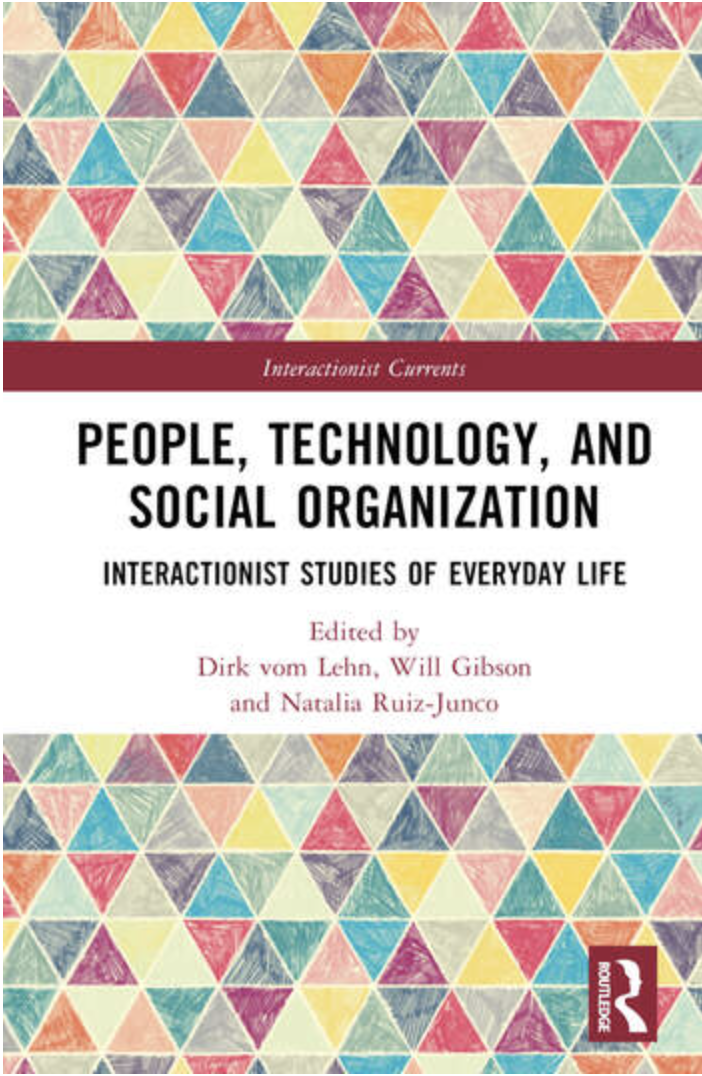
“People, Technology and Social Organization. Interactionist Studies of Everyday Life” edited by Dirk vom Lehn, Will Gibson and Natalia Ruiz-Junco (Routledge, 2023) – Table of Contents #emca #interactionism #sssi #sociology

Uncategorized

Google Books Amazon (UK) Amazon (US) Routledge (UK) Routledge (US)

People, Technology and Social Organization

Interactionist Studies of Everyday Life

edited by Dirk vom Lehn, Will Gibson and Natalia Ruiz-Junco

Table of Contents

1 Introduction by Dirk Vom Lehn, Will Gibson, and Natalia Ruiz-Junco

Abstract

The introduction explains the motivation for this book that is a continuation of a long-standing interactionist concern with the empirical exploration of the uses of technologies in people’s everyday lives. The chapter provides a brief overview of the current debates about technology in interactionist sociology. It discusses how technology supports the emergence of and features in, social relationships, how different members of the interactionist “family” – symbolic interactionists, social constructionists, and ethnomethodologists – explore the interweaving of technology with interaction, and how recent technological developments have encouraged studies of online identities, online communities, and online communication as well as the impact of the use of technology on issues such as power and social hierarchies and the formation and negotiations of identity. The chapter ends with a brief summary of the content of the book.

Part 1 Power and Control

2 Being Family and Friends to Abused Women – A Qualitative Study of Digital Media in Intimate Partner Violence by Susanne Boethius and Malin Åkerström

ABSTRACT In research on intimate partner violence, most studies focus on those who are abused. In thischapter, we focus on how families, friends, relatives, and employers of abuse victims interactthrough the use of smartphones, social media platforms, apps, and other internet-connecteddevices. We discuss how digital technology is integrated into the lives of domestic abusevictims and their social networks: friends, relatives, family, and coworkers. Digital technologyhas increased the reach of abuse in close relationships, extending the troubles beyond theborders of the couple immediately involved and providing new ways and opportunities forperpetrators to be present even when physically absent.

3 News, Sex, and the Fight Between Corporate Control and Human Communication Online by Michael Dellwing

Abstract

Centralization, decentralization, hobbyism and monetization have been in perpetual conflict over dominance on the internet for decades. Two domains stand in the center of this fight: news and sex. While sex was long a domain of hobbyist interaction, news was long a domain of centralized, corporate aggregation. Today, subversive use of existing monetized services blur the lines, like decentralized news content on youtube channels as well as nude content on hub sites or onlyfans, which retain decentralization at the expense of introducing monetization. 


These seemingly distant fields are connected: we are witnessing a fight over corporate and centralized control of online spaces, fought with weapons of moral panics. Corporate and state actors show increasing hostility against all forms of decentralized online spaces, using the narrative of “disinformation” to delegitimize and create moral panics over decentralized actors in news and using the narrative of “exploitation” to create moral panics over hobbyist sexual interaction. The former fight has led to demonetization and algorithmic hiding of decentralized news on YouTube; the latter has felled sex- and body-positive online nudity spaces, notably Tumblr in December 2018. In turn, remaining hobbyist corners of online sex spaces show increasing hostility against monetized online sex, which is in large parts infighting between different non-corporate actors, and acts as a diversion from the larger subversive power of online sex. Ground zero for this fight is the r/gonewild subreddit, a mainstay of informal nude self-presentation on reddit. The chapter reconstructs the topography of these conflicts by both reconstructing the moral panics.

4 Terminal Violence: Online Interactions and Infra-Humanization by Simon Gottschalk

Abstract

Combining hypermodern theory and symbolic interactionism, I use vignettes of routine interactions with terminals and with others through terminals to critically examine five of their interrelated features: (1) solicitations overload, (2) the mobilization for instantaneity, urgency, and visibility, (3) digital labor exploitation, (4) ontological disruptions, and (5) silencing. These features require users to adjust their emotional dispositions and mental habits, and those adjustments foster infra-humanization. Whereas infra-humanization is typically explained as an interpersonal process that originates in human agents, the vignettes illustrate that it can also be an intrapersonal experience that originates in non-human ones. In the conclusion, I suggest the need to develop the concept and experience of infra-humanization as a perspective that can help us to critically examine the effects of terminal interaction and resist them.          

5 Summing Up the Criminal Case Online David Wästerfors

Abstract

Online engagement with criminal cases is often interpreted in either punitive or crowdsourcing terms, but interactonist and ethnomethodological analyses can disclose other and more fundamental aspects. This chapter looks closely at a particular practice among posters on the Swedish platform Flashback: that of summing up the discussion ‘so far’. To sum up is a delicate and vulnerable act of rhetoric in this setting, often requested to create order but also criticized for resulting in errors, thereby seen as deflecting rather than reflecting what has been posted previously. By the help of Garfinkel and Sacks’ conceptualization of ‘formulations’ – a common way for conversationalists to comment on and demarcate their actions within an ongoing conversation – the chapter exemplifies the indexical, reflexive and accountable character of online summaries in the Flashback community. Even though summaries can be viewed as a cleansing and ordering device, they might as well expand rather than end the discussion. The author argues that interactions around summaries of crime cases illustrate the online sleuthing culture and how its internal social control as well as meaning production constitute an online setting.

Part 2 Identity and Community

6 Organizing Subcultural Identities on Social Media: Instagram Infrastructures and User Actions by J. Patrick Williams and Samuel Judah

Abstract

This chapter contributes to interactionist scholarship on the intersection of social media and identity through exploring aspects of contemporary subcultural identification on Instagram. Focusing on the straightedge subculture, we pay close attention to users’ productive and consumptive behaviors as embodied in vernacular visual culture. Our particular interest is in how the subcultural and the technological are intertwined in people’s everyday practices. To study this, we focus on the observable vernacular practices through which subcultural identities are made recognizable and intelligible by others through interactions on Instagram. We first describe how Instagram’s infrastructure affords users’ identity expressions, as well as researchers’ analysis of them, through metapictures. We then look at posts as actions that portray subcultural identities visually through photos, narratively through captions, and hypertextually through hashtags. Our focus on action highlights the discursive and constructed nature of subcultural identities.        

7 A Queer Kind of Stigma by Christopher T. Conner and Sarah Ann Sullivan

Abstract

Using a multi-sited multiple methods qualitative research design (including participant observation, in-depth interviews, and analysis of dating profiles) we explore the popular gay dating app “Grindr.” This paper examines how users engage in stigma management techniques in the online world, and how some members reproduce the stigmatization process through their interactions. We also find new forms of stigma that exist within the app through the use of blocking and non-responses—users who were found undesirable preferred being blocked rather than ignored, due to the lack of information provided by those who chose not to respond.  Moreover, while Goffman’s (1963) concept of stigma calls for us to consider how groups manage their stigmatized identities, his analysis of the concept does not explore in-group stigma of those already stigmatized. This paper extends the concepts of homonormativity showing how users reify the concept through a cultural system erected on hierarchies of sexual capital. As other scholars have argued, this process also exemplifies how toxic techno cultures are produced in digital environments through a complex relationship between user interactions and app structure (Massanari 2015). Finally, this paper extends Goffman’s theory of stigma by showing how users make sense of the structural constraints of the app and navigate stigma in the digital world.

8 Symbolic Separation: The Amish and 21st-Century Technologies by Corey J. Colyer, Rachel E. Stein, and Katie E. Corcoran

Abstract

America’s strict Anabaptist communities (such as the Amish) remain a curiosity in the twenty-first century. Their commitments to modesty and technological simplicity mark them counter-cultural, drawing curious onlookers. This chapter considers how members of these strict Anabaptist communities use, reject, and adapt certain technologies to conform with cultural expectations. By regulating technological practice, these communities establish “cultural fences” (Kraybill 2004; Kraybill, Johnson-Weiner, and Nolt 2013). This chapter examines how Amish (and members of other Plain Anabaptist communities) embrace or reject technology. We argue that these dynamics follow the principles of negotiated order (Strauss 1978; Maines 1982). Drawing on Donald Kraybill’s (2001) suggestion that The Amish “negotiate with modernity,” we show how adopting, rejecting, and adapting technology establish symbolic boundaries of Amish identity.

Part 3 Practices and Technology

9 Receiving Phone Calls During Medical Consultations: The Production of Interactional Space for Technology Use by Aleksandr Shirokov, Iuliia Avgustis, and Andrei Korbut

Abstract

Receiving and making calls requires participants to coordinate phone’s use with different ongoing activities. This is especially relevant in institutional settings such as doctor–patient interaction since the participants have a particular task at hand. Upon hearing a call or feeling the mobile phone’s vibration, neither patients nor doctors pick up the phone immediately. They systematically wait for the end of the turn or use various methods depending on the interactional environment to finish their or other’s turn and only then answer the call. In this chapter, we explore how doctors and patients are jointly producing slots for answering the incoming call. Our data consists of 151 video recordings of consultations with various medical professionals collected at a private clinic in Moscow, Russia, in 2018–2019. Data are analyzed using the method of Conversation Analysis. We outline a certain pattern in the way phone calls are handled in medical consultations: doctors tend to initiate the suspension of the conversation with patients and transition to the telephone conversation during their turns.

10 Non-Talking Heads: How Architectures of Digital Copresence Shape Question-Silence-Answer-Sequences in University Teaching by Kenan Hochuli and Johanna Jud

Abstract

This chapter focuses on question-answer sequences in online university teaching. We analyze how lecturers and students organize both individual and interactional conduct after a question has been asked but no answer has been given yet for two different configurations of interaction on digital videoconferencing platforms: One is the “face wall” of Zoom, where participants find themselves in a situation of polyexponation, i.e., a technically increased possibility of mutual perception. The other is Adobe Connect, a platform on which the lecturer communicates auditorily while students use the “chat” function to communicate. The analysis demonstrates how the ways in which participants establish and negotiate copresence within these environments create a different kind of conditional relevance for responding to each other’s contribution. Whereas silent students remain invisible on Adobe Connect, participants on Zoom become noticeable as non-talking heads on the face wall. This chapter’s analysis of short video sequences offers a detailed insight into the unfolding of what has become everyday human interaction in online environments. The data are in German with an English Translation.

11 The Role of Cursor Movements in a Screen-Based Video Game Interaction by Lydia Heiden, Heike Baldauf-Quilliatre, and Matthieu Quignard

Abstract

In a computer-mediated interaction, when participants are not physically co-present, certain resources are no longer available for interaction while others appear, according to the affordances of the technological environment. In this study, we investigate one particular digital tool, the cursor, in the context of a shared interface where cursor movements are visible to one co-participant. We show that the cursor is not only used to “interact” with the digital environment (via clicks) but that cursor movements, which cannot be interpreted by the machine, are oriented towards the co-participants and may have interactional functions. We describe three different kinds of these movements (straight pointing movement, swaying/circling movement and “moving away”) which, depending on who is doing them and in which sequential position they occur, contribute to the sequential organization of the interaction: as a display of attention, as a device for turn-holding/turn-claiming/leaving the floor or as a particular resource in argumentation.

12 Problems with the Digital Public Encounter by Daniela Boehringer

Abstract

The “public encounter” (Goodsell 1981) in the welfare state has massively changed over the past decades. In many cases, it is unnecessary to meet face-to-face with ‘street-level bureaucrats’ (Lipsky 1980) to manage social matters such as unemployment, because self-service applications are ready to hand. How citizens use these applications and how they are “made at home” in the everyday (Sacks 1992) still needs to be uncovered. This question will be considered from a conversation-analytic perspective. The website with job offers run by the German Public Employment Service (PES) is an example in this regard. After describing the website and the features of its use, the paper analyses real-time video data of members searching for a job on that site. The main focus of analysis are the moments of irritation and how the users manage them, are the paper concludes with reflections on the (new?) nature of the digital public encounter.

13 Smartphone Tooling: Achieving Perception by Positioning a Smartphone for Object Scanning by Louise Lüchow, Brian L. Due, and Ann Merrit Rikke Nielsen

Abstract

People have been using tools for thousands of years. These practices of “tooling” have been described as having a “mechanical effect” on an object (e.g., chopping wood). In this chapter we propose that tooling may also have an “informational effect”. To make this argument we explore how visually impaired people (VIP) carry out physical shopping in grocery stores using their smartphones and the SeeingAI application (app). Using a smartphone for scanning means using it as a tool, hence the chapter title “smartphone tooling”. The data consists of a collection of cases in which a VIP is using the smartphone and app to scan products, and the app then provides audible information. The chapter is based on video ethnographic methodology and ethnomethodological multimodal conversation analysis. The chapter contributes to studies of tools and object-centred sequences by showing how VIPs achieve perception of relevant object information in and through a practice we suggest calling “positioning for object scanning”. This is configured by three distinct actions: 1) aligning, 2) adjusting, and 3) inspecting. Studying the practices of VIPs enables us to establish new understandings about the accomplishment of spatial relations between body, object, and technology in situ, without visual perception. This research contributes to EM/CA studies of perception as practical action, visual impairment, and object-centred sequences. 

Part 4 Reflections on Interactionist Studies of Technologies

14 Where Next for Interactionist Studies of Technology? by Dirk Vom Lehn, Will Gibson, and Natalia Ruiz-Junco

Abstract

In the concluding chapter, the editors of the book reflect on the chapters and their contribution to interactionist theory and method, and provide some suggestions for future directions of interactionist research. They highlight that the studies reported in this book continue the traditions of enquiry and critique regarding established views of technology and its relationship

to society. They also point out that the studies make use of novel, often image-based and video-based research methods to explore technology in everyday life. In summary, they argue that interactionism continues to provide a critical set of approaches for the study of technology in everyday life.


New Article: “Challenges and Opportunities in the International Reception of ‘Communicative Constructivism'” by D. vom Lehn (@dirkvl) and Margarethe Kusenbach #sociology #communicative #constructivism #constructionism #ethnography #video #sssi #emca

Uncategorized

Challenges and Opportunities in the International Reception of ‘Communicative Constructivism‘”

Dirk vom Lehn , King’s College London

Margarethe Kusenbach, University of South Florida

ABSTRACT

In this article, we offer some observations on the international standing of communicative constructivism (CoCo), as discussed in scholarship published largely in German over the past decade (e.g., KELLER, KOBLAUCH & REICHERTZ, 2013; KNOBLAUCH, 2019a [2016]; REICHERTZ, 2009). We seek to explain why, in our view, CoCo has not thus far had a noticeable influence on academic discourse in international, particularly Anglo-American, sociology. Amongst others, we highlight issues regarding the name that was picked for the perspective and regarding the literal translation of German CoCo terminology into the English language. We also point to some theoretical and methodological choices that have made it difficult to link CoCo to interactionist sociology in general, and to ethnomethodology and ethnography in particular, i.e., perspectives that we are closely aligned with. We conclude with a summary of our observations and a few suggested steps communicative constructivists might consider taking to broaden and diversify the appeal of their program beyond German speaking sociology.

KEYWORDS: 

#communicative #constructivism #constructionism #ethnography #ethnomethodology #focusedethnography #sssi #interactionism #videography

Review Essay zur Übersetzung von Harold Garfinkels “Studies in Ethnomethodology” #Soziologie #Ethnomethodologie #Konversationsanalyse #Gesprächsanalyse #emca

Uncategorized

Soeben ist mein Aufsatz/Review Essay zur exzellenten Übersetzung von Harold Garfinkels ‘Studies in Ethnomethodology’ in der Soziologischen Review erschienen.

vom Lehn, D. (2021). Ethnomethodologie: von marginalem Forschungsprogramm zu soziologischem Klassiker. Review Essay zu Harold Garfinkel, ‚Studien zur Ethnomethodologie‘, herausgegeben von Erhard Schüttpelz / Anne Warfield Rawls / Tristan Thielmann, übersetzt von Brigitte Luchesi, Frankfurt/New York: Campus 2020, 386 S., gb., 24,95 € Original: Harold Garfinkel, ‘Studies in Ethnomethodology’, Englewood Cliffs/NJ, Prentice-Hall 1967, 304 S. In Soziologische Revue, vol. 44, no. 4, 2021, pp. 518-531. https://doi.org/10.1515/srsr-2021-0069

FQS – Debate: “Quality of Qualitative Research” #sociology #sssi #emca

Announcement, Call for Papers, quantitative/qualitative, research methods, Uncategorized

Over 20 years ago, in 2000, Franz Breuer, Jo Reichertz and Wolff-Michael Roth started a FQS debate on the “Quality of Qualitative Research.” In past contributions to this debate a wide range of issues has been discussed, such as various qualitative techniques of collecting or analyzing data, or the application of such methods within different disciplinary and institutional contexts. Since its beginning, the call for contributions to this debate has remained unchanged, while academic discussions surrounding this topic have changed substantially. The questions that were raised originally—What is “good” science? What are “good” social sciences? What is “good” qualitative social research? What are the criteria and standards for such evaluations?—are still relevant today and will continue to provide a baseline for future contributions, however, an update of the call for this FQS debate may be in order.

In the past, qualitative researchers have fought hard for acceptance and recognition of their work; this battle has largely been won. Today, in most social science disciplines (perhaps with the exception of psychology), qualitative epistemologies, theories, and methods are used and taught as “mainstream” science alongside their quantitative counterparts. Most university colleagues, students, and administrators have fully accepted their legitimacy and utility. While this is excellent news, it does not mean that debates about the “quality” of qualitative research have been, or should be, abandoned. Today, such debates take place in multiple contexts of discourse in which the “quality” of qualitative research is understood and treated in very different ways.

  1. The continued globalization and interdisciplinary appeal of qualitative research has accelerated the diversification of existing frameworks, theories, methodologies and methods. We are encountering many innovative developments that originate within the “older” qualitative approaches, such as social constructionism, symbolic interactionism, ethnomethodology, conversation analysis, phenomenology, hermeneutics, grounded theory methodology, and discourse analysis. In addition, today, many qualitative researchers transcend traditional boundaries and draw on a much broader theoretical canon when using and developing new qualitative methods, including critical approaches such as feminist, postcolonial and critical race theories, political economy frameworks, as well as postmodernism, poststructuralism and arts-based epistemologies. Moreover, collaboration between qualitative social scientists and scholars from discipline as diverse as the arts, design, computer sciences, medicine, and other health sciences have accelerated the development of “alternative” research methods. These developments lead to many new questions, such as: What does the new theoretical landscape of qualitative epistemologies and methodologies look like? How do various national and cultural contexts shape developments and debates of new qualitative frameworks? Finally, how is the “quality” of new qualitative research practices assessed across different disciplines and epistemological contexts?
  2. Over the past 20 years, qualitative research has been influenced by tremendous developments and expansions in technology and social media. Researchers increasingly use tools such as video-cameras, smart phones, and the Internet to collect data. A wide array of software packages has both reduced and increased the complexity of data collection and analysis. We must ask new questions, such as: How does the proliferation of new tools and technologies shape the practical and intellectual work of qualitative researchers? Which new social worlds and relationships have emerged, and how should they be examined and theorized qualitatively?
  • Funding mechanisms in the (social) sciences have also changed substantially, alongside institutional structures in the university. Today, in addition to public and non-profit funding bodies, researchers must turn to private and commercial institutions to acquire resources, some of which are very open toward qualitative approaches while others question their utility. New questions, such as the following, emerged: How do changes in funding and other institutional structures influence the theory and practice of qualitative research? How do the new funding and institutional landscapes vary by country, by region, and by discipline? What impacts do these changes have on the selection of research topics and on qualitative research ethics and responsibilities?
  • Lastly scientific research has increasingly come under pressure from politicians and policy makers, as well as from other influential experts, who have bluntly questioned the scholarly enterprise and confronted all scientific research with hostility and antagonism. This raises questions, such as: How do researchers who use qualitative theories, methodologies and methods respond to fundamental challenges of their (social) scientific expertise? How do they convince public audiences that their work raises and helps solve important questions?

Despite long-standing discussions about the quality of qualitative research, still no agreement has been reached about a catalogue of criteria that would serve to guarantee its value across the myriad contexts in which it is used today, similar to the classical, canonical standards that exist for quantitative scholars. In fact, we must broaden our understandings of what qualitative research is, and how it is practiced, while we continue to ask questions about its “quality.” The many issues and questions raised above may serve to re-invigorate discussions about the “Quality of Qualitative Research” in this FQS Debates, in alignment with current developments and concerns. As internal and external conditions for qualitative research practice have changed, a new engagement with the original issues, we hope, will invite new participants, raise new questions, and will lead to new insights within this worthwhile “Quality” debate. A reconfigured international FQS debate team eagerly awaits your submissions.

This is a Call without a deadline.

For questions, please contact the Section Editors: Franz Breuer, Paul Eisewicht, Margarethe Kusenbach, Jo Reichertz, Dirk vom Lehn, e-mail: deb_quality@qualitative-research.net

PhD Studentship – Work, Interaction & Technology Research Group, King’s Business School – Communication in Optometry before and after Covid-19 #optometry #sociology #studentship

Uncategorized

The changing role of the optometrist in assessing eye-sight and eye health during and after Covid-19

King’s Business School have a 4 year, fully funded PhD studentship (fees and stipend) available to undertake research concerned with communication and interaction in remote optometry consultations. The successful candidate will be expected to undertake qualitative, in-depth, studies of the organisation of eye examinations undertaken via telephone, video-phone, etc. Their research will relate to previous video-based studies of communication and interaction undertaken by the supervisory team. 

The successful candidate will be a member of the Work, Interaction & Technology Research Group at King’s Business School. Members of the WIT Group are concerned with social interaction in organisational settings, examining the interplay between social interaction and technology. Candidates will undertake naturalistic studies of communication and interaction in optometry that draw on ethnographic and video-based research methods. They will have a social science background and have received training in qualitative research methods, including ethnomethodology and conversation analysis, ethnography, qualitative interviewing and grounded theory.

The PhD project will be undertaken in collaboration with the College of Optometrists and co-supervised by Professor Dirk vom Lehn (KCL) and Professor Peter Allen (Anglia Ruskin University, Cambridge). It, therefore, provides candidates with the opportunity to develop a distinctive approach to their research.

The successful candidate will begin in October 2021.

For further information, please contact Professor Dirk vom Lehn at dirk.vom_lehn@kcl.ac.uk

Application Information 

Early applications are encouraged. Applicants are strongly advised to contact the supervisor Professor Dirk vom Lehn at dirk.vom_lehn@kcl.ac.uk

Please submit the following to kbs-phd@kcl.ac.uk 

  1. Copy of your CV
  2. One academic reference letter
  3. Letter of interest (1-2 page) including how you would be a best fit for the project.  

Note – applicants must check that they meet our entry requirements prior to applying

You should hold, or be completing, a Master’s degree with a Merit or higher (or overseas equivalent) and have achieved a 2:1 Bachelor’s degree (or overseas equivalent) in a relevant subject.

English language requirements

If you are a native English speaker or have been awarded a degree within the last five years from one of the countries listed here, you may not be required to take an English language test. English language competency is assessed on a case-by-case basis.

If your first language is not English you must be able to provide recent evidence that your spoken and written command of the English language is adequate for the programmes for which you have applied. Check our English language requirements here (Band B). You can use our pre-sessional English calculator to check if your language scores meet our requirements.

Please note, we cannot review individual eligibility before you apply and are only able to consider complete applications which include all supporting documents.

Application Procedure 

Shortlisted candidates will be invited to an interview and the successful candidate will be asked to submit their formal application via King’s Apply online system. 

Please contact kbs-phd@kcl.ac.uk if you have any queries regarding the application procedure.

Table of Contents: ‘INTERNATIONAL ROUTLEDGE HANDBOOK OF INTERACTIONISM’ BY D. VOM LEHN, N. RUIZ-JUNCO, AND W. GIBSON #SSSI #EMCA #SOCIOLOGY #HANDBOOK

Uncategorized

Table of Contents

Part 1

  1.  Introduction

Dirk vom Lehn, Natalia Ruiz-Junco and Will Gibson

Part 2 – Varieties of Interactionism

2.1. Pragmatism and Interactionism – Frithjof Nungesser

2.2. Blumer, Symbolic Interactionism and 21st century sociology – Thomas J. Morrione

2.3. Straussian Negotiated Order Theory c.1960-Present – Adele Clarke

2.4. Recent Developments in the New Iowa School of Symbolic Interactionism – Michael Katovich and Shing-Ling S. Chen

2.5. Dramaturgical Framework and Interactionism – Greg Smith

2.6. Ethnomethodology and Conversation Analysis: The Other Interactionism – Jason Turowetz and Anne Warfield Rawls

Part 3–Self, Identity, and Emotions

3.1 Click, Validate, and Reply: Three Paradoxes of the Terminal Self – Simon Gottschalk

3.2. Animal Selfhood – Leslie Irvine

3.3. The Self and the Supernatural – Rachael Ironside

3.4. The (Un)Healthy Body and the Self – Lisa Jean Moore and Sumayra Khan

3.5. Identity and Racialisation – Matt Hughey & Michael Rosino

3.6. Symbolic Interaction beyond Binaries – J.E. Sumerau

3.7. Culture and Emotion: Interactionist Perspectives – Doyle McCarthy

Part 4 – Social Organisation 

4.1. Organizations and Institutions – Patrick McGinty

4.2. Symbolic Interactionism, Social Structure, and Social Change: Historical Debates and Contemporary Challenges – Stacey Hannem

4.3. Mental Health and Symbolic Interactionism: Untapped Opportunities – Baptiste Brossard

4.4. Handling Video of [Police] Violence: Theoretical versus Practical Analyses

– Patrick Watson & Albert J. Meehan

4.5. Space, Mobility, and Interaction – Robin James Smith

4.6. Nature and the Environment in Interaction – Anthony Puddephatt

4.7. The Social Construction of Time – Michael G. Flaherty

4.8. Collective Memory – Lisa-Jo van den Scott

Part 5 – Interactionism, Media and the Internet

5.1. Media Logic, Fear, and the Construction of Terrorism – David Altheide

5.2. Public Fear and the Media – Joel Best

5.3. Policing and Social Media – Chris Schneider

5.4. Interactionism and online identity: How has interactionism contributed to understandings of online identity? – Hannah Ditchfield

5.5. Physical Co-presence and Distinctive Features of Online Interactions – Xiaoli Tian and Yui Fung Yip

5.6. Happy Birthday Michael Jackson: Dead Celebrity and Online Interaction – Kerry O. Ferris

5.7. Multi-Player Online Gaming – David Kirschner

Part 6 – New Developments in Methods

6.1. Situational Analysis as Critical Pragmatist Interactionism – Carrie Friese, Rachel Washburn & Adele Clarke

6.2. Video in Interactionist Research – René Tuma

6.3. Digital Naturalism: Ethnography in Networked Worlds: Ethnography in Networked Worlds – Michael Dellwing

6.4. Ethics in Symbolic Interactionist Research – Will & Deborah van den Hoonard

Part 7 – Reimagining Interactionism

7.1. Toward an expanded Definition of Interactionism – Linda Liska Belgrave, Kapriskie Seide and Kathy Charmaz

7.2. Some Antinomies of Interactionism – Martyn Hammersley

7.3. Interactionist Research: Extending Methods, Extending Fields – Emilie Morwenna Whitaker & Paul Atkinson 

7.4. The New Horizons of Symbolic Interactionism – Kent Sandstrom, Lisa K. van den Scott & Gary Alan Fine

‘International Routledge Handbook of Interactionism’ by D. vom Lehn, N. Ruiz-Junco, and W. Gibson #sssi #emca #sociology #handbook

Uncategorized

This was fun! Over the past couple years, I worked with Natalia Ruiz-Junco, Will Gibson and over 30 colleagues on the production of the International Routledge Handbook of Interactionism. The book is currently prepared for publication on May 27th. The electronic version of the Handbook which is much more affordable than the printed book, can already be purchased.

Because we had so much fun cooperating on this book, we are planning our next joint project already. We are currently working on an edited book with the working title “People, Technology, and Social Organization: interactionist studies of everyday life”. A Call for Abstracts with a deadline of May 15th can be accessed here.