Reframing art online through collective meaning-making
Linh Dan Nguyen, Chloe Preece & Dirk Vom Lehn

Linh Dan Nguyen, Chloe Preece & Dirk Vom Lehn

Hopefully, by the end of the year or at the latest by Spring 2023 “The Anthem Companion to Harold Garfinkel” co-edited by Philippe Sormani and myself will be published with Anthem Press. It’s currently due to be published in March 2023.

CONTENTS
List of Illustrations
Introduction Rediscovering Garfinkel’s ‘Experiments’, Renewing Ethnomethodological Inquiry
by Philippe Sormani and Dirk vom Lehn
Part I: Exegesis
Chapter One Garfinkel’s Praxeological ‘Experiments’
by Michael Lynch
Chapter Two The Continuity of Garfinkel’s Approach: Seeking Ways of ‘Making the Phenomenon Available Again’ through the Experience and Usefulness of ‘Trouble’
by Clemens Eisenmann and Anne Warfield Rawls
Part II: ‘Experiments’
Chapter Three Lay and Professional Competencies: Linking Garfinkel’s Tutorial Exercises to a Study of Legal Work
by Stacy Lee Burns
Chapter Four Bargaining on Street-Markets as ‘Experiment in Miniature’
by Dirk vom Lehn
Chapter Five Notes on Galileo’s Pendulum
by Dušan I. Bjelić
Chapter Six Disruptures of Normal Appearances in Public Space: the Covid19 Pandemic as a Natural Breaching Situation
by Lorenza Mondada and Hanna Svensson
Chapter Seven Gender as a Scientific Experiment: Towards a Queer Ethnomethodology
by Luca Greco
Chapter Eight Breaching and Robot Experiments: Continuing Harold Garfinkel’s Spirit of Experimentation
by Keiichi Yamazaki and Yusuke Arano
Chapter Nine Dealing with Daemons: Trust in Autonomous Systems
by Jonas Ivarsson
Part III: Implications
Chapter Ten Experimenting with the Archive? Performing Purdue in Paris, an Instructive Reprise
by Yaël Kreplak and Philippe Sormani
Chapter Eleven Rereading Galileo’s Inclined Plane Demonstration
by Kenneth Liberman, in conversation with Harold Garfinkel
Postface ‘Experiments’ – What Are We Talking About? A Plea for Conceptual Investigations
by Wes Sharrock
Notes on Contributors
Index of Names
Index of Subjects
Soeben ist mein Aufsatz/Review Essay zur exzellenten Übersetzung von Harold Garfinkels ‘Studies in Ethnomethodology’ in der Soziologischen Review erschienen.
vom Lehn, D. (2021). Ethnomethodologie: von marginalem Forschungsprogramm zu soziologischem Klassiker. Review Essay zu Harold Garfinkel, ‚Studien zur Ethnomethodologie‘, herausgegeben von Erhard Schüttpelz / Anne Warfield Rawls / Tristan Thielmann, übersetzt von Brigitte Luchesi, Frankfurt/New York: Campus 2020, 386 S., gb., 24,95 € Original: Harold Garfinkel, ‘Studies in Ethnomethodology’, Englewood Cliffs/NJ, Prentice-Hall 1967, 304 S. In Soziologische Revue, vol. 44, no. 4, 2021, pp. 518-531. https://doi.org/10.1515/srsr-2021-0069
Over 20 years ago, in 2000, Franz Breuer, Jo Reichertz and Wolff-Michael Roth started a FQS debate on the “Quality of Qualitative Research.” In past contributions to this debate a wide range of issues has been discussed, such as various qualitative techniques of collecting or analyzing data, or the application of such methods within different disciplinary and institutional contexts. Since its beginning, the call for contributions to this debate has remained unchanged, while academic discussions surrounding this topic have changed substantially. The questions that were raised originally—What is “good” science? What are “good” social sciences? What is “good” qualitative social research? What are the criteria and standards for such evaluations?—are still relevant today and will continue to provide a baseline for future contributions, however, an update of the call for this FQS debate may be in order.
In the past, qualitative researchers have fought hard for acceptance and recognition of their work; this battle has largely been won. Today, in most social science disciplines (perhaps with the exception of psychology), qualitative epistemologies, theories, and methods are used and taught as “mainstream” science alongside their quantitative counterparts. Most university colleagues, students, and administrators have fully accepted their legitimacy and utility. While this is excellent news, it does not mean that debates about the “quality” of qualitative research have been, or should be, abandoned. Today, such debates take place in multiple contexts of discourse in which the “quality” of qualitative research is understood and treated in very different ways.
Despite long-standing discussions about the quality of qualitative research, still no agreement has been reached about a catalogue of criteria that would serve to guarantee its value across the myriad contexts in which it is used today, similar to the classical, canonical standards that exist for quantitative scholars. In fact, we must broaden our understandings of what qualitative research is, and how it is practiced, while we continue to ask questions about its “quality.” The many issues and questions raised above may serve to re-invigorate discussions about the “Quality of Qualitative Research” in this FQS Debates, in alignment with current developments and concerns. As internal and external conditions for qualitative research practice have changed, a new engagement with the original issues, we hope, will invite new participants, raise new questions, and will lead to new insights within this worthwhile “Quality” debate. A reconfigured international FQS debate team eagerly awaits your submissions.
This is a Call without a deadline.
For questions, please contact the Section Editors: Franz Breuer, Paul Eisewicht, Margarethe Kusenbach, Jo Reichertz, Dirk vom Lehn, e-mail: deb_quality@qualitative-research.net
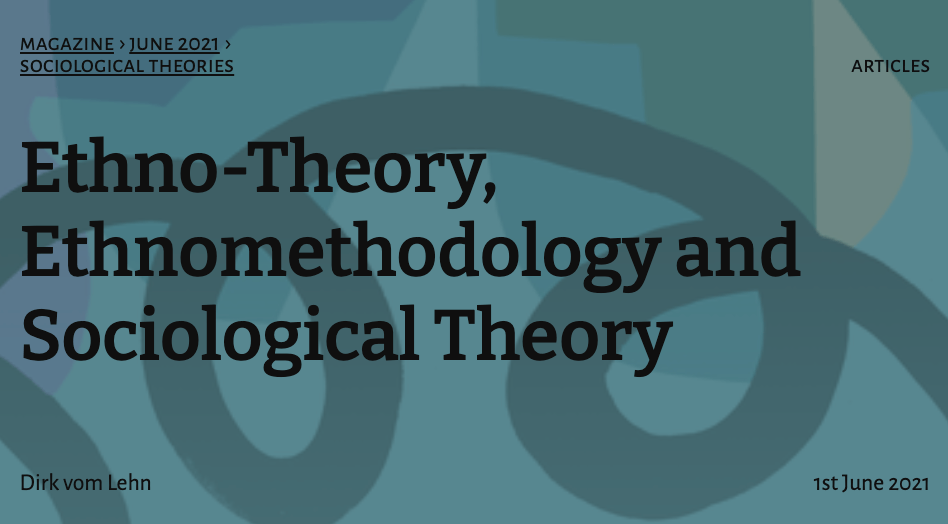
In June, I wrote a short piece about the practice of theorising, ethnomethodology, and the pandemic for the Magazine of The Sociological Review. The brief text can be accessed HERE or by clicking the image below.

The changing role of the optometrist in assessing eye-sight and eye health during and after Covid-19
King’s Business School have a 4 year, fully funded PhD studentship (fees and stipend) available to undertake research concerned with communication and interaction in remote optometry consultations. The successful candidate will be expected to undertake qualitative, in-depth, studies of the organisation of eye examinations undertaken via telephone, video-phone, etc. Their research will relate to previous video-based studies of communication and interaction undertaken by the supervisory team.
The successful candidate will be a member of the Work, Interaction & Technology Research Group at King’s Business School. Members of the WIT Group are concerned with social interaction in organisational settings, examining the interplay between social interaction and technology. Candidates will undertake naturalistic studies of communication and interaction in optometry that draw on ethnographic and video-based research methods. They will have a social science background and have received training in qualitative research methods, including ethnomethodology and conversation analysis, ethnography, qualitative interviewing and grounded theory.
The PhD project will be undertaken in collaboration with the College of Optometrists and co-supervised by Professor Dirk vom Lehn (KCL) and Professor Peter Allen (Anglia Ruskin University, Cambridge). It, therefore, provides candidates with the opportunity to develop a distinctive approach to their research.
The successful candidate will begin in October 2021.
For further information, please contact Professor Dirk vom Lehn at dirk.vom_lehn@kcl.ac.uk
Application Information
Early applications are encouraged. Applicants are strongly advised to contact the supervisor Professor Dirk vom Lehn at dirk.vom_lehn@kcl.ac.uk
Please submit the following to kbs-phd@kcl.ac.uk
Note – applicants must check that they meet our entry requirements prior to applying
You should hold, or be completing, a Master’s degree with a Merit or higher (or overseas equivalent) and have achieved a 2:1 Bachelor’s degree (or overseas equivalent) in a relevant subject.
If you are a native English speaker or have been awarded a degree within the last five years from one of the countries listed here, you may not be required to take an English language test. English language competency is assessed on a case-by-case basis.
If your first language is not English you must be able to provide recent evidence that your spoken and written command of the English language is adequate for the programmes for which you have applied. Check our English language requirements here (Band B). You can use our pre-sessional English calculator to check if your language scores meet our requirements.
Please note, we cannot review individual eligibility before you apply and are only able to consider complete applications which include all supporting documents.
Application Procedure
Shortlisted candidates will be invited to an interview and the successful candidate will be asked to submit their formal application via King’s Apply online system.
Please contact kbs-phd@kcl.ac.uk if you have any queries regarding the application procedure.
Despite the long-time talk about the demise of the street-market as an inefficient place to make money street-markets, flea-markets and car-boot sales are booming. People seem to have discovered these places not only as markets to buy and sell objects but also as places for leisure activities. In London and other big cities street-markets have become major tourist attractions. In recent years, they have been redeveloped to increase their attractiveness and possibly also to give them a more trustworthy, clean and orderly look. Moreover, they often are equipped with surveillance cameras and security staff who police trading and behaviour more generally. Yet, what has remained largely the same over the past years is that sales are produced in interaction between traders and customers, people who first show an interest in a particular stall or sales item and then make a purchase, or sometimes leave without buying anything. “Price” and”price information” plays a particular part in the interaction between traders and their customers. In “Timing is money” I consider pricing not so much as a process of calculation for the participant to get the best value out of the interaction, although this may play a part in this as well, but as a communicative practice that traders and customers deploy in the interaction. The paper examines the moment when and the way in which traders and customers use “price” in their interaction, e.g. when do they use price in an offer or request of a sales item? It turns out that price is often deployed as a technique to manage the ‘floor’ and the interaction at the stall. For example, when customers display an interest in an item but are not yet committed to buying an item offers, including price information, are designed in a particular way that encourage the customers to commit to make a purchase.
The paper uses “focused ethnography” as a research method. Alongside other recent developments in ethnography, such as “short-term ethnography” (Pink and Morgan 2013) Hubert Knoblauch developed “focused ethnography” (2005) an observational research methods that often supported by video-recordings examines in detail particular settings and activities while spending only relatively short periods of time there.
References
Pink, Sarah & Morgan, Jennie (2013). Short-term Ethnography. Symbolic Interaction Vol.36(3) 351-361
I have just come back from a workshop at a museum where we discussed the use of labels and mobile systems, PDAs, Audioguides, or mobile phones to support or even enhance people’s experience of exhibits and exhibitions. As in other museums, the managers and curators still largely think of abele and electronic systems as information sources for individual visitors. Hence, information is written or recorded for an individual visitor to retrieve. This is somewhat surprising for a number of reasons, including the observation of the same managers and curators that devices and systems like movie phones, touch-screen systems, PDAs and Audioguides encourage people to spend more time with the systems than with with exhibits. When managers and curators report their observations in exhibitions they talk about visitors reading labels and looking at the screens of digital systems for considerable time whilst spending considerably less, sometimes no, time with the works of art hung along the gallery wall.
Research conducted over the past 20 or 30 years confirms the observations by these managers and curators about the distracting impact of information sources in museums. Together with recent research in the learning and cognitive science also suggests that if one wishes to enhance people’s experience of and learning in exhibition that there is not a need for more or more complex information sources and system but for information delivered in a way that encourages social interaction and discussion between people. Quasi-experimental studies and naturalistic, video-based studies of visitors’ interaction in museums suggests that it is not only the design of systems, i.e. the small screens and interfaces that undermine social interaction but also the content and the structure of the content delivered by labels and electronic systems. What would be required are naturalistic experiments with label content and the content of audio-guides that through questions, references to exhibit features and maybe game-like activities that involve more than one visitor in concerted and collaborative forms of looking, examination and experience.
If anybody has seen examples like this, please let me know.
Relevant Literature
Heath, vom Lehn. (2004) Configuring Reception. Theory, Culture and Society Vol21(6): 43-65
Leinhardt, Crowley, Knutson 2002. Learning Conversations in Museums. Routledge
As part of the ESRC funded project The Practical Work of the Optometrist Helena Webb, Christian Heath, Dirk vom Lehn, Will Gibson and Bruce Evans have published an article concerned with the opening of optometric consultations in the journal Research on Language and Social Interaction. The paper particularly explored the sensitivity clients display to the use of the word ‘problem’ in the opening questions of the history taking.
The Problem With “Problems”: The Case of Openingsin Optometry Consultations
Abstract
This article contributes to conversation analytic understanding of openings in health-care consulta-tions. It focuses on the case of optometry: a form of health-care practice in which an optometristconducts checks of a patient’s vision and eye health. Patients are advised to attend regularly for rou-tine assessments and can also request a specific appointment at any time. Analysis of a corpus of 66 consultations shows what happens when the optometrist’s opening question solicits the client’s“problems” with their eyes. We find three types of patient response. Patients who have requested aspecific appointment (most often) report a problem with their eyes and establish a problem-purposeencounter. Patients attending for a routinely timed appointment either report no problems and estab-lish a routine-assessment purpose, or if they do have a problem, they delay reporting it or downplay it.We track through what happens subsequently. The findings have practical implications for diagnosisand treatment.
As part of the ESR funded project Will Gibson, Helena Webb and Dirk vom Lehn have published a paper that explores new ways in which a reflection on the use of transcript in the examination of video-recorded interaction can aid the analysis.
Analytic Affordance: Transcripts as Conventionalised Systems in Discourse Studies
Abstract
This article explores the role of transcripts in the analysis of social action. Drawing on a study of the interactional processes in optometry consultations, we show how our interest in the rhythm of reading letters from a chart arose serendipitously from our orientation to transcription conventions. We discuss our development of alternative transcription systems, and the affordances of each. We relate this example to constructivist debates in the area of transcription and argue that the issues have been largely characterised in political terms at the expense of a focus on the actual processes of transcription. We show here that analytic affordances emerge through an orientation to professional conventions. The article ends by suggesting that a close reflection on the design of transcripts and on transcription innovation can lead to more nuanced analysis as it puts the researcher in dialogue with the taken for granted ideas embedded in a system.
The article is on Early View at Sociology and with access can be downloaded here.