Openness in the Academic and Corporate World

Uncategorized

“Consultants frequently tell academics that they are obliged to become more “corporate” in outlook-to pay more attention to the bottom line and to develop more proprietary products and services. These pressures are particularly intense in fields with immediate commercial relevance. However, certain principles of openness derived from traditional science and academic life might end up serving the long-term economic interests of American industries.” (p.253)

from Frank Pasquale. 2011. RESTORING TRANSPARENCY TO AUTOMATED AUTHORITY. Journal of Telecommunications and High Technology Law. Vol.9: 235-254

  Mobile Guides to Historic Places in Action and Interaction

apps, interactivity, mobility, museums, Technology

first published in “Museum & Heritage Magazine” (Winter Issue, 2013)

Dirk vom Lehn (King’s College London)

Hannah Lewi & Wally Smith (University of Melbourne)

Museums and Heritage Sites increasingly offer mobile guides and Apps to encourage people to use their smartphones and tablet computers for the exploration of exhibitions, outdoor spaces and buildings. These Mobile Apps provide information in multimedia formats, text, pictures and video-clips. They sometimes also allow people to play games and send emails. In this short article we discuss two examples to highlight some of the opportunities and challenges offered by Mobile Apps.

The information delivered by these apps can draw people’s attention to particular exhibit features, make visible aspects of objects and artifacts that are invisible, hidden or have disappeared over time. Pictures and text shown by mobile guides, such as the ‘Formative Histories Walking App‘, designed by academics at the University of Melbourne, allow people to compare the architectural reality in front of them with information on the device. This juxtaposition of material reality and virtual reality aims to stimulate interest in the architecture and urban history of Melbourne, and provides the basis for people’s sustained engagement with buildings that they might walk past without noticing or appreciating.

The ‘Formative Histories Walking App’ has been designed as part of a project at the University of Melbourne, carried out by the authors, to explore novel ways to engage students with architectural history. In this case, the Mobile App was used as a teaching and learning tool that presented rich visual and oral information on an iPod Touch. Like a human guide, the App takes students on a two-hour walk along Collins Street, a prominent central city axis in Melbourne; the walk involves twenty stops at significant buildings from the nineteenth and early twentieth century. Using a map and menu on the iPod Touch users explore the street and find and examine architectural features in light of the information displayed by the Mobile App. This information is comprised of short text and audio summaries at each stop and a limited number of images that elaborate on aspects such as key buildings set in their historical context, comparative architectural examples from international architects or details of buildings that are not readily visible for the students. In this sense, the information delivered by the app replicates a slideshow similar to those architecture students experience in the classroom; pictures of objects nearby are juxtaposed with objects from different periods or by other architects and designers.

A second exploration of the potentials of the mobile digital guide for heritage, museum and architecture sites has been the design of a prototype iPod guide that provides visitors with information about the Shrine of Remembrance, a significant site and war memorial in Melbourne built in 1934. With this prototype the team aimed to allow people to see the Shrine in relationship to a wealth of currently unseen archival material. The mobile guide encourages visitors to juxtapose images, films and audio-recordings with the reality in front of them. By drawing less on conventional text, and more on visual information presented in innovative formats such as timelines, collages and close-up details the designers were interested in testing how user’s might share the screen with others and discuss the content and their experience of the site. encourage people to share the screen with others and discuss the content. Mobile guides and Apps like the examples briefly described here have great potential to create innovative media in the interpretation of museums and heritage sites that engage people in new ways with exhibits and exhibitions, architecture, gardens etc. They principally replicate two models of guiding visitors through a site that the researchers have found in many new Apps in the cultural and tourism genre :

  • the human guide model: these guide direct people’s exploration of a site with an identifiable guiding voice or presence on a predefined route. A number of stops are planned into the route where visitors are given information about an exhibit, building, plant, etc.
  • the interactive exhibition model: these guides offer a wealth of content in various forms that visitors can use to interpret and features of a site. The route does not have to be preplanned and can be changed, shortened or extended at any point in time.

These models of guiding visitors – which are sometimes mixed together – are often used with a variety of formats of content: chronologies and timelines, spatially-organised information; slideshows offering both highly curated narratives and freedom of choice; archival film; and oral histories.

Our own research in Melbourne and elsewhere suggests that apps designed with the human guide model in mind can be successful in situations with a well-defined visitor route. Elsewhere an interactive exhibition model that offers people the opportunity to self-select what objects and artifacts to examine can be more engaging. In either model, reception is influenced by the way information is structured and presented in the guide, and how this mirrors the physical reality. Text is not very popular with visitors while images, film and oral histories are. Chronologically listed information, for example, does not hold people’s attention when confronted with a rich spatial panorama. A powerful approach is to juxtapose archival images and films with views of the present-day reality; a technique used successfully by the ‘Streetmuseum’ app created by the Museum of London.

For a long time, research in the social sciences has argued that people’s experience and learning in museums and heritage sites can be enhanced when they talk, discuss and interact with each other. Therefore an unresolved problem for designers is to develop mobile guides that facilitate and encourage social interaction and discussion between visitors. Our experiments with different kinds of app show that people tend to treat the use of the device as a private activity and experience talk with others as disruptive. Future experiments, maybe using larger displays, will show how devices such as tablet computers might be more conducive to social interaction and conversation.

Authors

Dirk vom Lehn teaches Marketing, Interaction & Technology and is member of the Work, Interaction & Technology Research Centre (King’s College London). His research focuses on the interweaving of technology with social interaction in museums and galleries, optometric consultation and street-markets. Email: dirk.vom_lehn@kcl.ac.uk (http://www.vom-lehn.net)

Hannah Lewi teaches architecture history, theory and design. Her research areas include modern Australian architecture, new media for history and heritage applications, and theoretical inquiry into heritage and conservation. She is the current Chair of Docomomo Australia, and recent publications include Hannah Lewi and David Nichols (eds) Community: Building Modern Australia (Sydney: UNSW Press), 2010. Email: hlewi@unimelb.edu.au (http://www.findanexpert.unimelb.edu.au/display/person25951#tab-publications)

Wally Smith teaches and researches in the fields of human-computer interaction and knowledge management. Recent publications explore the role of commercial demonstrations of information technology, and the connections between stage magic and the history of informational artefacts. Email: wsmith@unimelb.edu.au (http://www.findanexpert.unimelb.edu.au/display/person18782#tab-publications)

Are you doing Qualitative or Quantitative Research? #sociology

quantitative/qualitative, research methods, sociology

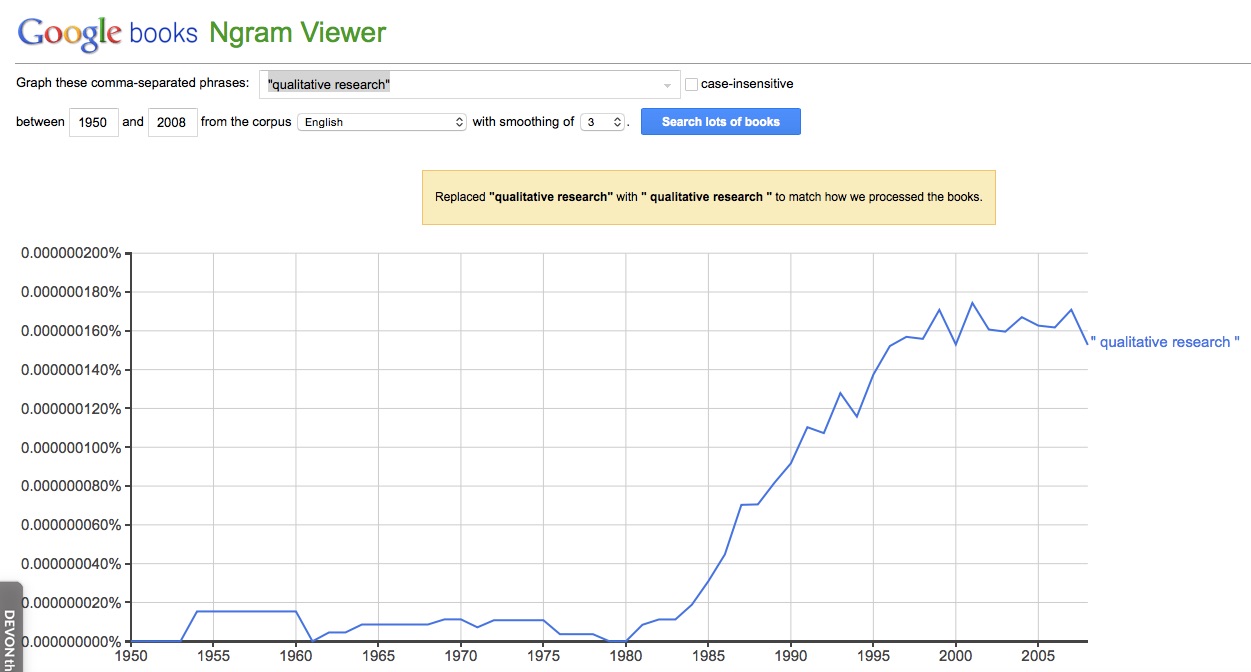
There is plenty of debate about the ‘quantitative/qualitative divide’ in the social sciences. Howard Aldrich has written an excellent piece arguing to abolish the distinction, and thereby reinvigorated the debate, for example on OrgTheory and Work in Progress.  A quick look at Google’s Ngram viewer is quite interesting. For “qualitative research” it shows

qual-res

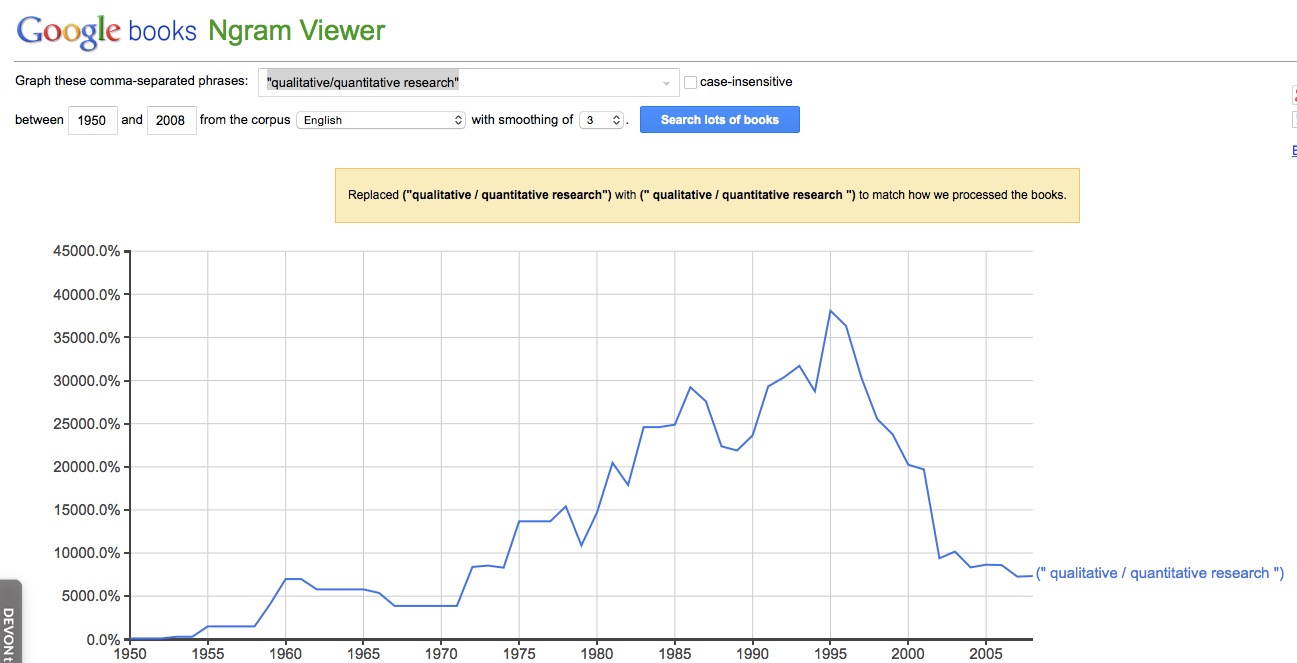
and for the distinction “qualitative/quantitative”

quant:qual

Without having pursued any further research into this, the latter graph might be indicative of Aldrich’s argument. It will be interesting to see if Lia Pearce’s forthcoming chapter will shed light on this.

Pearce, Lisa D. (Forthcoming). Thinking Outside the “Q” Boxes: Further Motivating a Mixed Research Perspective. In Hesse-Biber, Sharlene Nagy & Johnson, R. Burke (Eds.), The Oxford Handbook of Mixed and Multimethod Research. New York: Oxford University Press.

Mervyn Horgan’s Review of “Drama of Social Life” edited by Charles Edgley

Book Review, dramaturgical, Goffman, symbolic interactionism

I was lucky enough to be invited to contribute to Charles Edgley’s fabulous edited volume “Drama of Social Life”. In the most recent (November 2014) issue of Symbolic Interaction Melvyn Horgan reviews Edgley’s volume.

horgan-review

He highlights in particular the unconventional departure from a mere focus on Goffman and Goffmanian style studies and the early reference to Kenneth Burke’s work that critically informed the dramaturgical perspective (as did Goffman’s).

The review is here.

Customer Value and Customer Service – It depends whom you ask

customer experience, customer service, Marketing, vouchers

Restaurants issue vouchers to attract more custom. For Cafe Rouge, a restaurant chain of some popularity with families in the UK, these Vouchers are offered by Tesco, by the chain itself, and by websites like Vouchercodes. I picked up a voucher from Vouchercode to head for a Cafe Rouge restaurant in Central London on a Sunday. Here is the Voucher:

Cafe-rouge voucher

The voucher clearly states, valid 7 days a week, one kid’s main free with every adult’s meal. We went as a couple with two kids, expecting some noticeable discount on our bill that mounted up to something like £44. Like most insurance policies most vouchers also come with a catch. Although this voucher clearly states “valid 7 days a week” the catch is mentioned in point 10 of the terms and conditions:

Cafe Rouge Terms

The terms and conditions list a number of restaurants that are exempt from accepting our voucher. Unfortunately, we did not read the small print and fell into the trap. When asking for the bill we obviously were not aware of the special status of our restaurant and mentioned to the restaurant’s waitress and then the manager that we had expected to be able to use the voucher when two explanations were given for them not accepting it.

1. It’s your own fault

When presenting the voucher to the waitress she said that this restaurant was exempt from accepting the voucher which was stated in the terms and conditions that we should have read before ordering. Many other restaurants of the same chain still accepted vouchers and next time maybe we should pick one of those.

As customers we were not really happy to be blamed, yet having seen the small print now we are obviously aware that we better had spent some more time reading the small print.

2. It’s the company’s management fault

Because we were not ready to accept the waitress’ explanation we asked her if the manager of the restaurant was around. She called the manager over who was a very polite young lady who showed her understanding and relieved us from the blame her staff had put on us. She explained the reason for the voucher policy with the company’s management having changed ownership recently and that basically the new management was to blame for having introduced a new policy on vouchers. Since recently certain restaurant’s were exempt from the acceptance of vouchers. She said that she regularly was confronted by customers finding themselves in the very same situation we were in now; their vouchers were invalid and they had to pay the full bill. There was nothing she could do about that.

Obviously looking at the terms and conditions, the waitress and restaurant manager are in the right. We were in the wrong and should have done our research properly before entering the venue and ordering our food. Yet, we as other customers just want to go for a meal without having to check the terms and conditions of the visit. One would imagine that restaurants like Cafe Rouge have an interest in their customers leaving happy and satisfied, and maybe think about returning.

There was a time when managers of companies argued that the ‘the customer is always right’ and that customers should not feel deceived or misled with the product or service they receive for their money. The distribution of vouchers that requires customers to read the small print that might inform them about exemptions of the vouchers’ validity does not seem to be a marketing activity devised in this spirit.

Museum Visiting: Slowing Down and the Experience of Art

exhibitions, experience, interaction, museums

There is a renewed interest in museum visiting and the practices of doing so. Only this weekend (October 9th, 2014), Stephanie Rosenbloom published an article in the New York Times that explores “The Art of Slowing Down in a Museum“. Rosenbloom refers to Daniel Fujiwara’s (now Director at SImetrica) study of the impact of museum visiting on people’s enjoyment of life as well as on James O. Pawelski’s work in the area of positive psychology. All these studies are of great interest and very helpful in highlighting the impact of the arts on people’s lives. It would be great if such research that is primarily interested in measuring impact and focuses on individuals as experiencing subjects, would include also the influence of the presence of other visitors in museums, both companions and others. It would seem that in order to follow the arguments and suggestions on how to organise a museum visit would require prior negotiation with those we are with in a museum. Statistics of museum visiting clearly show that people not only primarily come with others to museums but also that one main reason for the visit is socialising and interacting with others, whereby works of art (and other exhibits) providing hubs for concerted activities.

Considering that Pawelski, Fujiwara and others show that spending more time with a work of art increases feelings of happiness and satisfaction and that people enjoy interacting with others in museums, exploring how we can facilitate sustained social activities around works of art and other exhibits in museums seems to be an obvious avenue to pursue.


Relevant Literature

Heath, vom Lehn. (2004) Configuring Reception. Theory, Culture and Society Vol21(6): 43-65

Heath, Luff, vom Lehn, Hindmarsh, Cleverly. (2002) Crafting Participation. Visual Communication. Vol1(1): 1-33

Hindmarsh, Heath, vom Lehn, Cleverly. (2002) Creating Assemblies in Public Environment. CSCW Journal Vol.14(1): 1-41

Leinhardt, Crowley, Knutson 2002. Learning Conversations in Museums. Routledge

vom Lehn, Heath 2005. Accounting for Technology in Museums. International Journal of Arts Management Vol7(3): 11-21

vom Lehn, Heath, Hindmarsh 2001. Exhibiting Interaction: conduct and collaboration in museums. Symbolic Interaction. Vol.24(2): 189-216

Notes on Alice Marwick’s (@alicetiara) “Status Update”

book, Book Review, Social Media

I’ve just been reading Walter Kirn’s review of Alice Marwick’s (@alicetiara) excellent book “Status Update“. The review strikes me as odd and off-the-mark. The author seems to have misunderstood Marwick’s book and misconceives ethnography by criticising Marwick for offering anecdotes. Never mind that review though. The book is very worthwhile reading for everybody with an interest in recent development in social media and social networking technologies. Marwick’s focus is not so much the technology itself, i.e. not Facebook, Twitter, Foursquare, etc. but the scene that has arisen in the context of these technologies. This scene mainly based in San Francisco, involves people who develop these technologies as well as people who use them for to organise their social lives, online and offline.

The book highlights how the entrepreneurs in their enthusisam for the opportunities offered by social technologies forget or ignore, deliberately or not, the neoliberal ideology that underpins their work and work ethic. The result of this ignorance is an inequality embodied in the observation that the entrepreneurs largely are young, white male. Women are decoration and accessories, “sex objects and secretaries” as Marwick writes. Whilst the media are full of talk about the “social media revolution” Marwick reveals that the members of the tech-community in San Francisco are technology enthusiasts with a business sense that at times makes (some of) them rich. Others who are not technology savvy enough to create their own Facebook-like riches exploit the opportunities offered by social media to become “micro-celibrities”. This status as mirco-celebrity allows some of them to connect with people, offline and online, who otherwise they’d never met. For some the drive to become a micro-celebrity and connect with the really rich and famous, means to reveal events and activities from their private lives, revelations some of them sometimes later regret; for example when being ‘trolled’ and spit out by the audience that for long seemed to love them.

Marwick’s book has variously been reviewed. If you want to check a good review before buying the book check Ravi Mattu’s review in the Financial Times and Finola Kerrigan’s (@finolak) review in Times Higher Education, but ignore Kirn’s in the NYT.


Call for Sessions – 2015 Konferenz der Society for the Study of Symbolic Interaction in Chicago #soziologie #interaktionismus

Announcement, SSSI, Symbolic Interaction

Im August 2015 findet in Chicago die jährliche Konferenz der Society for the Study of Symbolic Interaction statt.

Weitere Information und ein Call for Sessions befindet sich auf dieser Website.

Der Blog der Vereinigung ist hier.

Die Zeitschrift der Vereinigung Symbolic Interaction wird von Wiley veröffentlicht. Hier Editor ist derzeit Professor Robert Dingwall. Der Blog der Zeitschrift ist hier und der YouTube Channel mit Videoabstracts und Interviews befindet sich hier.

How To View Critics Telling You How to View Art in a Museum

Ethnomethodology, exhibitions, experience, Uncategorized

Excellent post by Ed Rodley in response on a critic’s explanation of how to look at art in museums.

Ed Rodley's avatarThinking about Museums

The blind fingerless art critic by Flickr user Shareheads CC-BY 2.0 The blind fingerless art critic
by Flickr user Shareheads
CC-BY 2.0

I have a confession to make: art critics baffle me. Especially when they venture to make grand pronouncements about the right way to go about experiencing art in museums. So when I saw the title of Philip Kennicott’s piece in the Washington Post, titled “How to view art: Be dead serious about it, but don’t expect too much” I will confess that I died a little bit inside. “Sigh. Another ‘you people are doing it all wrong’ piece.” Just what the world needs, another art critic holding forth on the sad state of museums and museumgoing. But, though there is plenty of sneering, there’s also a lot worthy of discussion. And debate. Kennicott’s post didn’t stand alone too long before Jillian Steinhauer posted a reply at Hyperallergic, and Jen Olencziak a rebuttal at Huffington Post. So, let’s take a…

View original post 2,719 more words